
Triatom
Grow Fourth and Multiply
15,527,402,881 = 3534 = 304 + 1204 + 2724 + 3154 — from David Wells’ Penguin Dictionary of Curious and Interesting Numbers (1986), entry for “15,527,402,881”
Second Whirled Warp
In “First Whirled Warp”, I looked at the paths traced by the midpoint of two points moving at varying speeds around the perimeter of a circle or polygon. Now I wanted to look at the midpoint of two points moving on the perimeter of a star. Suppose the star looks like this:
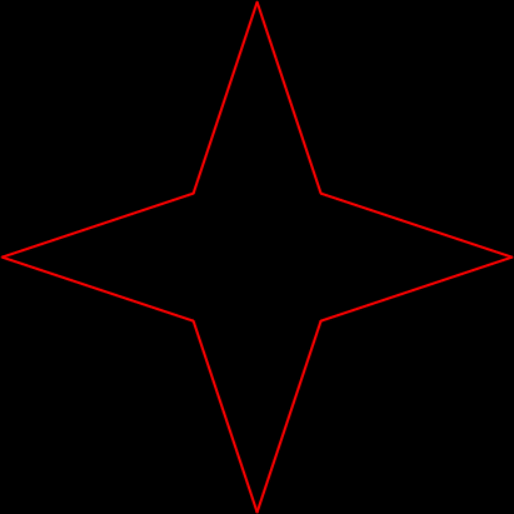
Four-pointed star
If the two points start at the same vertex and one point is moving 1/2 as fast as the other, the midpoint traces a shape like the head of a fox:
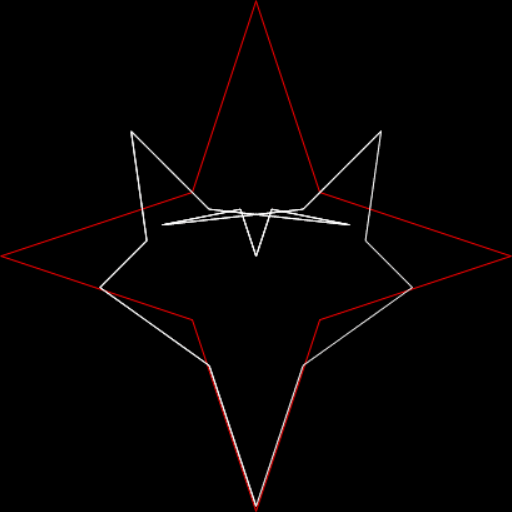
Fox-head from midpoint of two points moving in speed-ratio 1/2 : 1 (or 1 : 2)
If one point is moving 1/3 as fast (or 3x faster), the trace looks like this:
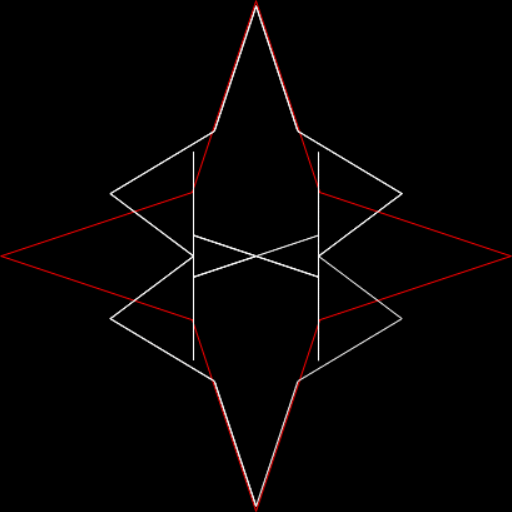
Midpoint of two points moving in speed-ratio 1/3 : 1
And if the points are moving -1/3 : 1, that is, in opposite directions (one clockwise, one widdershins):
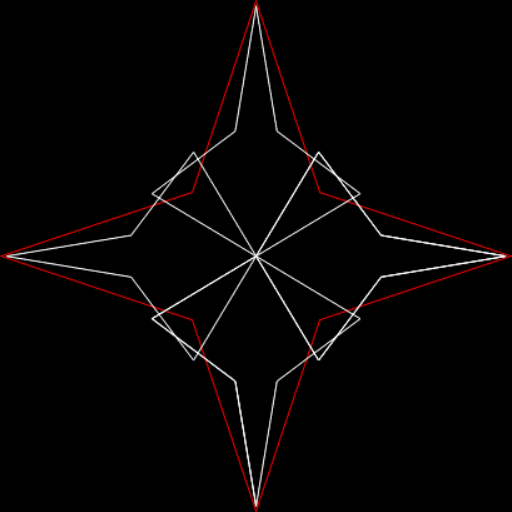
Speed-ratio -1/3 : 1
And you can adjust all pixels outward so that the outer vertices of the star lie on the perimeter of a circle:
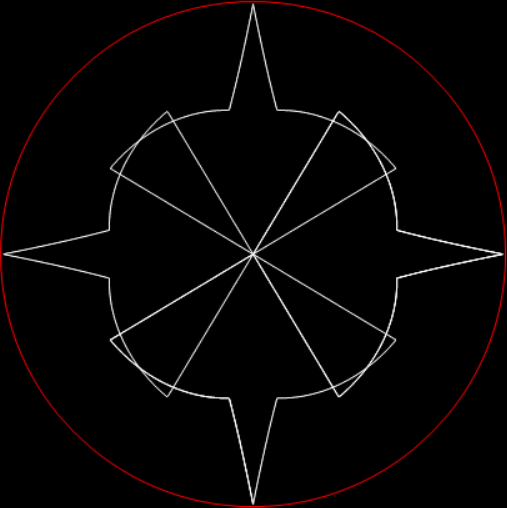
Speed-ratio -1/3 : 1 (circular)
Here are more traces created by the midpoint of two points moving around the perimeter of a four-pointed star:
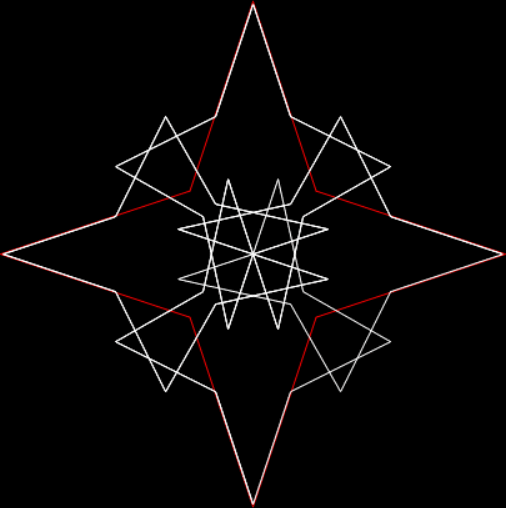
Speed-ratio 1/5 : 1
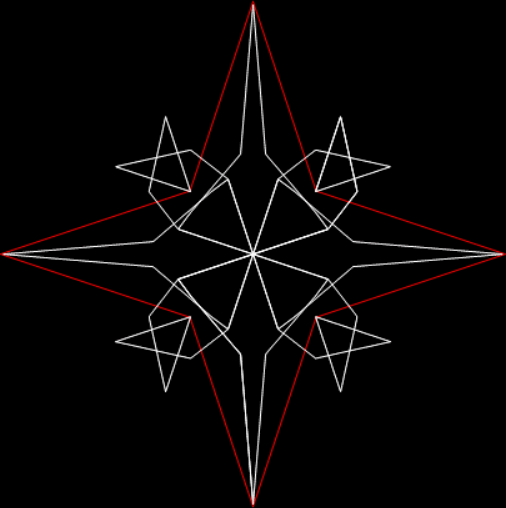
Speed-ratio 3/5 : 1
↓
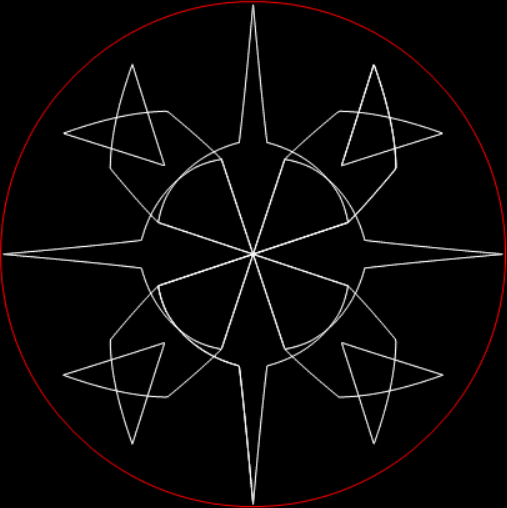
Speed-ratio 3/5 : 1 (circular)
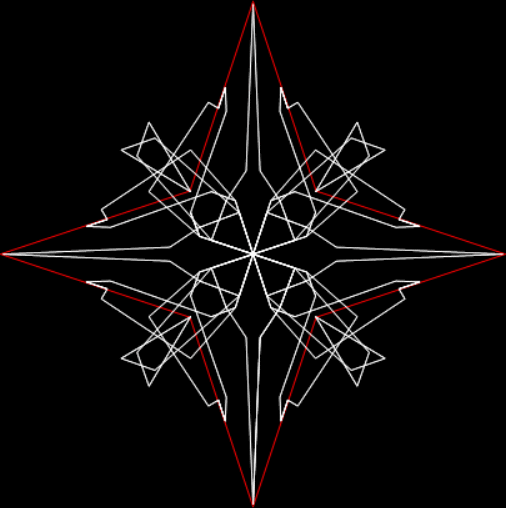
Speed-ratio -3/7 : 1/3
↓
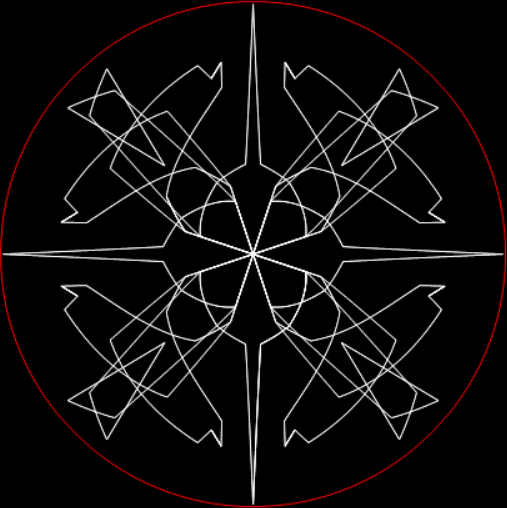
Speed-ratio -3/7 : 1/3 (circular)
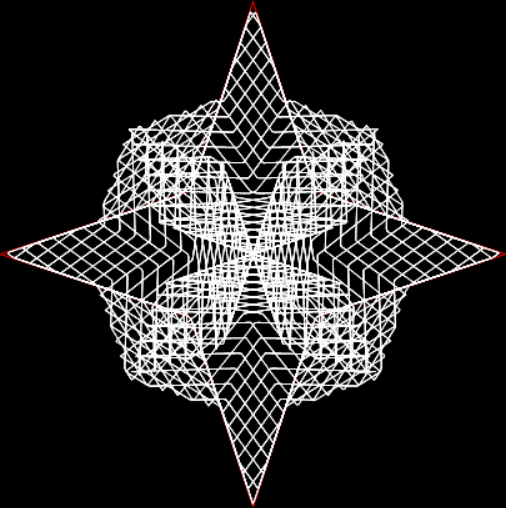
Speed-ratio 7/3 : 6/7
↓
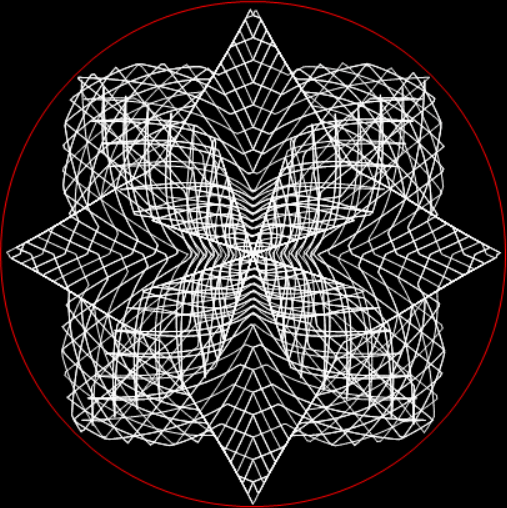
Speed-ratio 7/3 : 6/7 (circular)
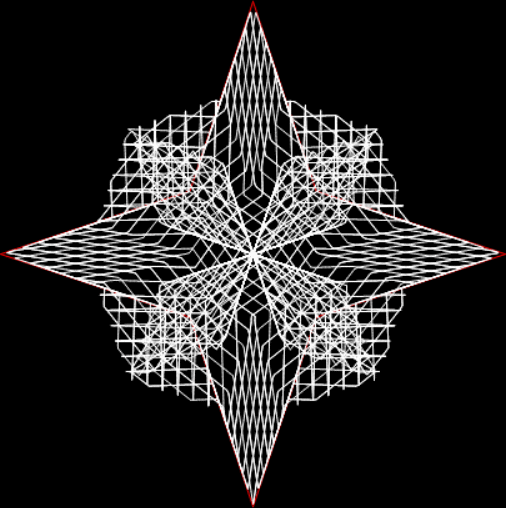
Speed-ratio -7/3 : 6/7
↓
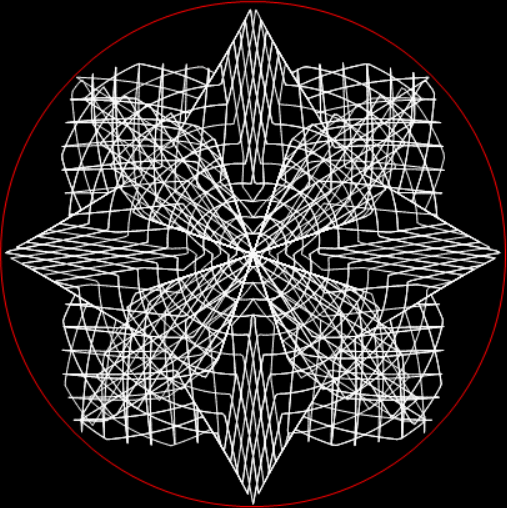
Speed-ratio -7/3 : 6/7 (circular)
If the star is adjusted like this:
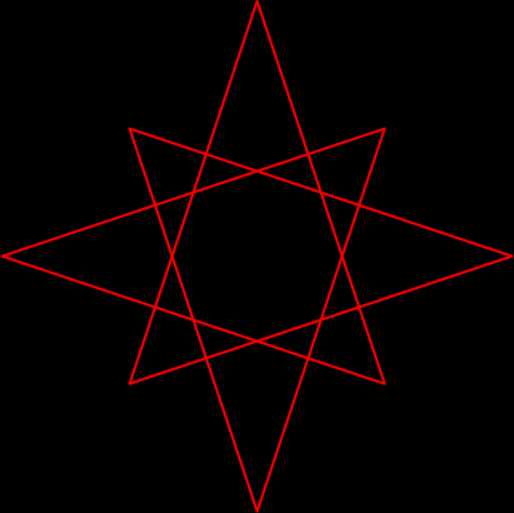
Variant on four-pointed star
You can get mid-traces like this:
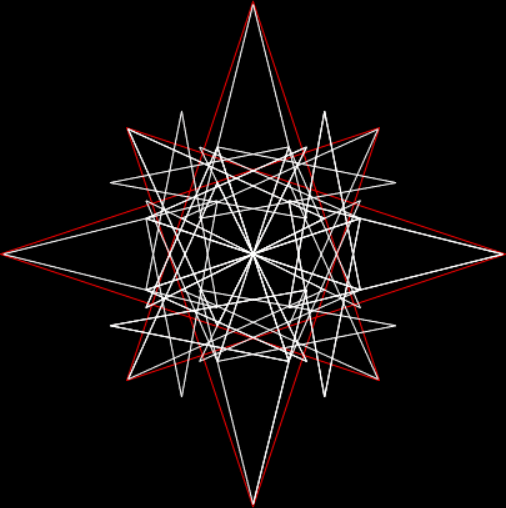
Speed-ratio -1/7 : 1 (adjusted star)
↓
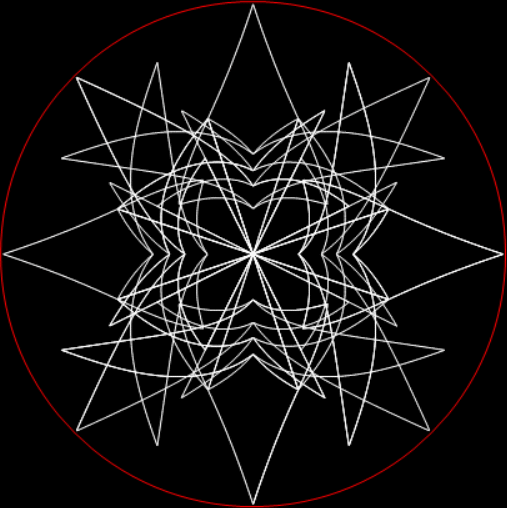
Speed-ratio -1/7 : 1 (adjusted star) (circular)
Here’s a three-pointed star:
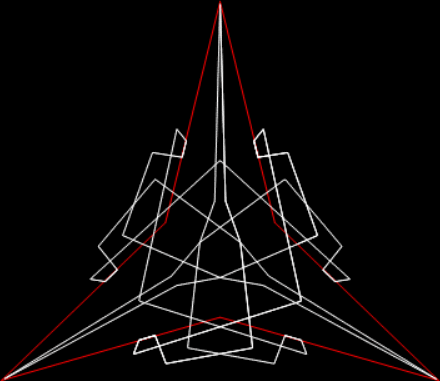
Speed-ratio -4/5 : 1 (3p star)
↓
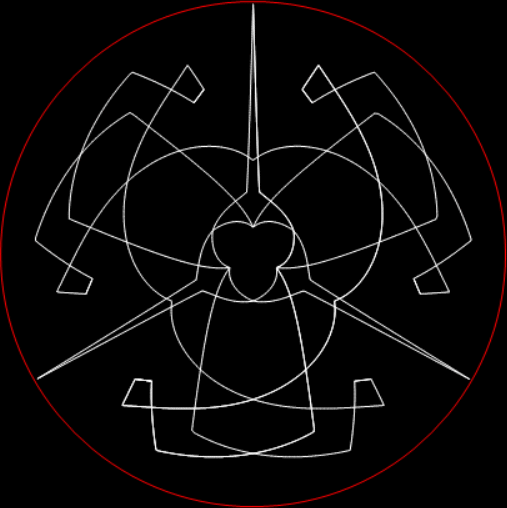
Speed-ratio -4/5 : 1 (3p star) (circular)
And some five-pointed stars:

Speed-ratio 2/7 : 1 (5p star)
↓
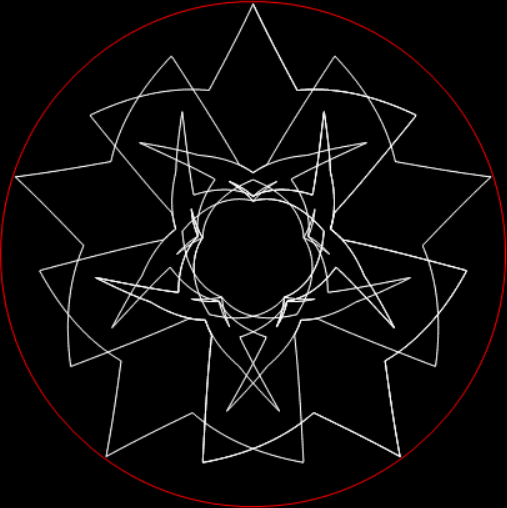
Speed-ratio 2/7 : 1 (5p star) (circular)
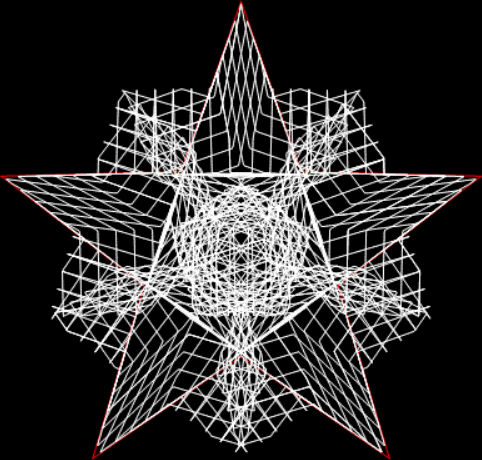
Speed-ratio -7/5 : 3/7 (5p star)
↓
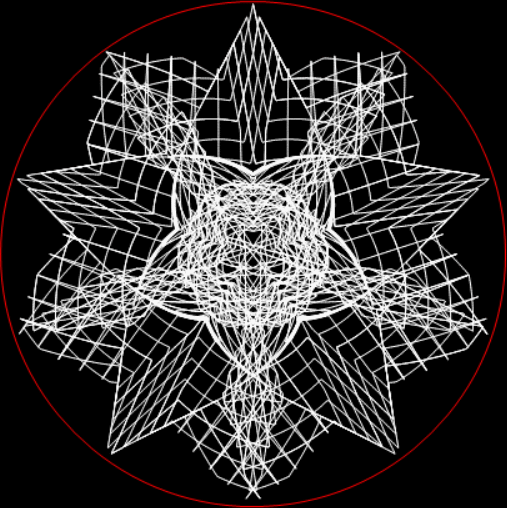
Speed-ratio -7/5 : 3/7 (5p star) (circular)
Elsewhere Other-Accessible…
• First Whirled Warp — an earlier look at points performativizing on perimeters
• Third Whirled Warp — a later look at points performativizing on perimeters
Mot d’un Moucheron
« Que me proposent-ils là, les imprudents ! Parce que j’ai remué quelques grains de sable sur le rivage, suis-je en état de connaître les abîmes océaniques ? La vie a des secrets, insondables. Le savoir humain sera rayé des archives du monde avant que nous ayons le dernier mot d’un moucheron. » — Souvenirs entomologiques de Jean-Henri Fabre (1823-1915)
— “What do they want from me, those imprudent ones? Because I’ve lifted a few grains of sand on the shore, am I ready to sound the ocean’s depths? Life has secrets, unfathomable secrets. Human knowledge will be erased from the world’s archives before we have the last word on a gnat.”
Fib and Let Eye

An ox-eye daisy (Leucanthemum sp.) with a harlequin ladybird, Harmonia axyridis, sitting at its center
Peri-Performative Post-Scriptum…
The title of this incendiary intervention refers to
1) The Fibonacci sequence present in the beautiful interlocking curves at the heart of the
2) daisy, whose name comes from Anglo-Saxon dæges ēage, meaning “day’s eye”.
3) The eye-like appearance of the daisy, with the ladybird like a slightly off-centered pupil
Fog on a Blog
The Fog Prince: Interrogating Core Themes around Positive Orality and Negative Textuality In Terms Of Evelyn Waugh’s Put Out More Flags (1942)
“This is the only book I have written purely for pleasure.” — Put Out More Flags, Waugh’s preface of 1966.1
It’s an old conceit of fantastic fiction: the library of lost books or of books that never were. If I were ever in a Library of Lost Books, I’d postpone a visit to the B’s, O’s, and S’s, where works by Richard Burton, Wilfred Owen, and Sappho2 would wait, unupburnt3 by wife, mother, and Church, respectively. Instead, I’d proceed direct to the W’s, where Evelyn Waugh’s The Temple at Thatch would wait, unupburnt by the author himself. It was Waugh’s first novel, dealt with madness and black magic,4 and must have cast fascinating light on his early career. Why else should he have burnt it?
As for a Library of Books That Never Were: again I’d proceed direct to the W’s, looking for the further adventures of Basil Seal, Waugh’s most engaging and amoral character. Seal appears in the novels Black Mischief (1932) and Put Out More Flags (1942),5 and the latter tells us that:
From time to time he disappeared from the civilized area and returned with tales to which no one attached much credence – of having worked for the secret police in Bolivia and advised the Emperor of Azania on the modernization of his country. Basil was in the habit, as it were, of conducting his own campaigns, issuing his own ultimatums, disseminating his own propaganda, erecting about himself his own blackout […]6
Black Mischief describes Basil’s adventures in the fictional state of Azania; his adventures in the actual state of Bolivia are known only from fragmentary references in Put Out More Flags. Basil’s brother-in-law, Freddy Sothill, describes him as “living in a gin palace in La Paz and seeing generals shoot one other.”7 Later in the book, Basil himself daydreams of being summoned for special service by “a lean, scarred man with hard grey eyes”, a shadowy intelligence chief who has followed his “movements with interest ever since that affair in La Paz in ’32.”8 In Spanish, La Paz literally means “The Peace.” It is a singularly inappropriate name for anywhere frequented by the mischief-maker Basil, particularly in 1932, when Bolivia went to war with Paraguay over a disputed border region called the Chaco Boreal.9
That is all we know of Basil’s Bolivian adventures, for Waugh never wrote a book about them. Basil himself never wrote a book about anything:
For years now, whenever things were very bad with Basil, he had begun writing a book. It was as near surrender as he ever came and the fact that these books – two novels, a book of travel, a biography, a work of contemporary history – never got beyond the first ten thousand words was testimony to the resilience of his character.10
This description is an important part of Put Out More Flags, which is a text about, inter alia, the power of speech and the impotence of text. Basil cannot complete a book, but he can spin word-webs in many languages. After the outbreak of World War Two, his victim-to-be Ambrose Silk, a homosexual Jewish Sinophile, comes across him in the Ministry of Information. Basil is:
[…]talking a foreign language which sounded like a series of expectorations to a sallow man in a tarboosh.
“That’s not one of my personal friends,” said Mr. Bentley bitterly.
“Does he work here?”
“I don’t suppose so. No one works in the Near East department. They just lounge about talking.”
“The tradition of the bazaar.”
“The tradition of the Civil Service […]”11
But in the “new, busy, secretive world which developed in the first days of the war”, Basil is feeling, “for the first time in his life”, at a disadvantage: “It was like being in Latin America at a time of upheaval, and, instead of being an Englishman, being oneself a Latin American.”12 He has also fallen out with his “remarkably silly”13 girlfriend Poppet Green:
“You’ll be in more danger crossing the Atlantic than staying in London,” said Basil. “There won’t be any air raids on London.”
“For God’s sake don’t say that.” Even as she spoke the sirens wailed. Poppet stood paralysed with horror. “Oh God,” she said. “You’ve done it. They’ve come.”14
This is the first example in the novel of what might be called oral hex. Fear drives the communist Poppet into superstition: Basil has broken a primitive taboo and invoked disaster by speaking of it. Fallen out with Poppet, rejected by officialdom, Basil despairs of London and joins his sister Barbara at Malfrey, his brother-in-law’s sumptuous country-house, whose name means “Bad Brother” in Spanish. He leaves the blackout and arrives with a blankout, “a great fall of snow”15 in which the country is like a vast blank page. The snow prefigures the fate of the “book on strategy”16 he has come to write while Freddy is away serving in the army. Barbara, knowing her brother well, hopes that he doesn’t “have to write the book for long.”17 Nor does he:
That night Basil began his book; that is to say he lay on the rug before the column of smoke that rose from the grate of the octagonal parlour, and typed out a list of possible titles.18
His smoke-presided work is soon interrupted: the Connollies, a grotesque trio of children evacuated from Birmingham to wreak havoc in the country, have been returned to Malfrey from the “institution”19 to which Barbara managed to have them assigned. Basil is eager to see the children, about whom he has already “heard a great deal”,20 but they have disappeared to begin their mischief anew:
The Connollies were found at last and assembled. Doris had been in Barbara’s bedroom trying out her make-up, Micky in the library tearing up a folio, Marlene grovelling under the sink eating the remains of the dogs’ dinner. When they were together again, in the lobby, Basil inspected them. Their appearance exceeded anything
he had been led to expect.21
Micky tears up a text and Basil can now abandon one: he assumes Barbara’s role as “billeting officer”22 and uses the Connollies to extort money from Barbara’s genteel neighbours. His first victims are “the Harknesses of Old Mill House, North Grappling”,23 who have advertised for paying guests. Basil, a “specialist in shocks”,24 delays informing them of his official purpose and Mr. Harkness makes assumptions he is soon to regret:
“[…]You saw our terms in the advertisement?”
“Yes.”
“They may seem to you a little heavy, but you must understand that our guests live exactly as we do ourselves. Fires,” he said, backing slightly from the belch of aromatic smoke which issued into the room as he spoke […]25
Oral hex again. Basil is a man of snow and smoke, of blankness and confusion, and Mr. Harkness has invoked a symbol of his own downfall. Shortly afterwards, Basil springs his shock, overrides all protests, and returns to Malfrey “with a deep interior warmth”26 of fulfilled mischief, having deposited the Connollies on their unwilling hosts. That night there is an “enormous fall of snow”, turning the countryside again into a vast blank page, and North Grappling is “cut off […] from all contact with the modern world.”27 Eight days later, Basil is reading aloud to Barbara from his never-to-be-completed book in the orangery, where “the smoke” from his cigar hangs “on the humid air.” The book sends Barbara to sleep, but she wakes to remark:
“[…]I hear they’ve dug through to North Grappling this morning.”
“There was providence in that fall of snow. It’s let the Connollies and the Harknesses get properly to grips. Otherwise, I feel, one or other side might have despaired.”
“I daresay we shall hear something of the Harknesses shortly.”
And immediately, as though they were on the stage, Benson came to the door and announced that Mr. Harkness was in the little parlour.28
Oral hex: speech has again invoked reality. Basil extorts thirty pounds from the “abject” Mr. Harkness to have the Connollies removed. He makes more money from more unwilling hosts until, sated by a fortuitous adultery and having learnt of Freddy’s and the cuckold’s imminent return, he sells the Connollies at “five pounds a leg”29 and returns to London. Here, by claiming to be a member of “M.I.13”,30 he gains access to the War Office for himself and “the little lunatic with the suitcase”31 whom he first met “hawking bombs” at the Ministry of Information. Inside the War Office, Basil joins Internal Security, exploiting for his own ends first the lunatic, whose bombs nearly account for the Deputy Assistant Chaplain General,32 then his communist ex-girlfriend Poppet Green.33 But spying on lunatics and communists earns him only a second-lieutenancy; his superior Colonel Plum will consider higher rank only if he catches a fascist.34
Basil begins to search for one and learns from Poppet that Ambrose Silk is “bringing out a fascist paper.”35 He investigates further, hunting down Ambrose and his publisher Mr. Bentley in the Café Royal. As he joins them, Ambrose is animadverting on the “decline of England”, which he blames on the lifting of “the splendid, luminous, tawny fogs”36 for which English architecture and literature were designed. Ambrose’s publisher explains the topic to Basil:
“We are talking of fogs,” said Mr. Bentley.
“They’re eaten rotten with communism,” said Basil, introducing himself in the role of agent provocateur. “You can’t stop a rot that’s been going on twenty years by imprisoning a handful of deputies. Half the thinking men in France have begun looking to Germany as their real ally.”
“Please Basil,[” said Ambrose. “D]on’t start politics. Anyway, we were talking of Fogs, not Frogs.”37
The mishearing is authorial irony. Basil is a Fog Prince, a master of subterfuge and misdirection, of suppressio veri and suggestio falsi. He soon decides he can exploit Ambrose’s new paper. It is a literary review called The Ivory Tower, espousing “Art for Art’s sake”, seeking a return to “the lily and the lotus”,38 expressing “contempt and abhorrence” for “the military” and “all statesman of an energetic and war-like disposition.”39
But Basil cannot convince Colonel Plum that the review represents fascist subversion. Accordingly, he tries to persuade Ambrose to include “a little poem in praise of Himmler”40 in the first issue. Ambrose doesn’t think this would be a good idea. After all, a poem would be positive text; it is negative text, absent text, that will do for Ambrose. He plans to end the first issue with Monument to a Spartan, a “delicate and precise” record of his doomed love-affair with a naïve young German called Hans, who gives “his simple and generous acceptance to all the nonsense of Nazi leaders.”41 Ambrose describes Hans as
lapped in a kind of benighted chivalry, bemused in a twilight where the demagogues and party hacks loomed and glittered like Wagnerian heroes […] The Wagnerians shone in Ambrose’s story as they did in Hans’ eyes. He austerely denied himself any hint of satire. The blustering, cranky, bone-headed party men were all heroes and philosophers.42
But Hans, despite his Nazism, “remains faithful to his old friend” until his “Storm Troop comrades discover that his friend is a Jew.”43 Hans is despatched to a concentration camp;44 a grieving Ambrose returns by train to England. As it stands in proof, the story will not suit Basil’s purposes: it is a tragedy, a subtle yet powerful indictment of Nazi cruelty, ignorance, and bigotry. Accordingly, Basil tells Ambrose that Monument begins as “a first-class work of art” but “degenerates into mere propaganda”, becoming an “atrocity story – the sort of stuff American journalists turn out by the ream.”45 Ambrose is dismayed by the critique and Basil suggests that he delete the coda, leaving “Hans still full of his illusions, marching into Poland.”46
A week later by the simple process of going to Rampole and Bentley’s office and asking for one, Basil obtained an advance copy of the new magazine. He turned eagerly to the last page and found that Monument to a Spartan now ended as he had suggested; he read it again with relish; to anyone ignorant of Ambrose’s private history it bore one plain character – the triumphant paean of Hitler Youth; Doctor Ley himself might have been the author. Basil took the magazine with him to the War Office; before approaching Colonel Plum he marked with a red chalk the Monument to a Spartan and passages in the preceding articles which cast particular ridicule upon the army and War Cabinet and which urged on the artist the duty of non-resistance to violence.47
Colonel Plum now accepts that The Ivory Tower is the work of a “fifth column nest”48 and begins to organize the arrest of Ambrose and his confederates. But Basil cannot savour the fruit of his trickery. Plum is stealing “all the credit and all the fun”; “being on the side of the law” is “novel to Basil and not the least agreeable”; he realizes that Ambrose will “be allowed to give an account of himself” and will reveal “Basil’s share in editing Monument to a Spartan”; last and least, Ambrose is an old acquaintance and Basil wishes him “well rather than ill”, “other things being equal.”49
Moved by “these considerations, in that order of importance”, Basil visits Ambrose’s flat the same night, warns him of the impending arrests, and oversees his flight to Ireland on a stolen passport. Once there, Ambrose enters a Celtic twilight, a world where “mist and smoke never lifted and the sun never fell direct.”50 He intends to “write a book, to take up the broken fragments of his artistic life”,51 but he is still in thrall to the Fog Prince. In the inn of a “soft, green valley”:
He spread foolscap paper on a dining-room table and the soft, moist air settled on it and permeated it so that when, on the third day, he sat down to make a start, the ink spread and the lines ran together, leaving what might have been a brush stroke of indigo paint where should have been a sentence of prose. Ambrose laid down the pen and because the floor sloped where the house had settled, it rolled down the table, and down the floor-boards and under the mahogany sideboard, and lay there among napkin rings and small coins and corks and the sweepings of half a century. And Ambrose wandered out into the mist and the twilight, stepping soundlessly on the soft, green turf.52
Ambrose is an atheist Jewish intellectual travelling on a passport stolen from a Jesuit priest. He is in Ireland on false pretences and espouses what were, in Waugh’s eyes, false principles: l’art pour l’art, homosexual love, the eremitism of Confucian China rather than the monasticism of Catholic Europe.53 He is helpless at the hands of the Fog Prince, the glib and amoral Basil. A mutilated text worked against him in England; in Ireland he cannot even create a text. This textual negation contrasted Waugh and other Christian artists with atheist intellectuals like Brian Howard, Harold Acton, and Cyril Connolly, the real friends and acquaintances whose lives Waugh drew upon to create Ambrose Silk.54 In the “summer of 1941”,55 as he was writing Put Out More Flags, Nazism stood triumphant across most of Europe and Britain’s defeat seemed more likely than not. His text was militarily impotent and would not contribute materially or measurably to victory. In earthly terms, it was at best a jeu d’esprit, at worst a folly. But Waugh did not think in earthly terms; like Basil’s mother, Lady Seal, he had faith in something transcendent:
England had fought many and recondite enemies with many and various allies, often on quite recondite pretexts, but always justly, chivalrously, and with ultimate success. Often, in Paris, Lady Seal had been proud that her people had never fallen to the habit of naming streets after their feats of arms; that was suitable enough for the short-lived and purely professional triumphs of the French, but to put those great manifestations of divine rectitude which were the victories of England to the use, for their postal addresses, of milliners and chiropodists, would have been a baseness to which even the radicals had not stooped.56
Unlike Lady Seal, Waugh would not, in the first years of the war, have had faith in England’s “ultimate success.” Hitler, that “small and envious mind”, that “creature of the conifers”,57 might have conquered England and begun hunting down the names on the “black list” that so worries Ambrose Silk.58 Whether or not Waugh himself was on the list like H.G. Wells and other prominent writers, he would have been very unlikely to survive Nazi victory. But he had faith, did not despair, and could continue to exercise his God-given literary gifts. Poppet Green and her friends are without faith and react to the war without hope: “It’s the end of my painting […] it’s always been the choice for us between a concentration camp and being blown up, hasn’t it?”59 For Waugh, the Church would survive even total Nazi victory and his faith in the Church allowed him to sustain the “peppercorn lightness of soul”, the “deep unimpressionable frivolity”60 that underlie, in this neglected but far from negligible novel, some of the funniest passages ever written in English.
NOTES
1 pg. 7 of the 1967 Chapman and Hall hardback.
2 The Anglo-Irish explorer Sir Richard Burton (1821-90), the English poet Wilfred Owen (1893-1918), and the Greek poetess Sappho (fl. 7th century BC). Burton’s wife and Owen’s mother made bonfires of much of their work after their deaths; Sappho’s poetry has come down to us through the Christian centuries only in fragments.
3 “NURSE UNUPBLOWN” was a telegram sent by Waugh when he worked as a journalist in Abyssinia during the Italian invasion. He had been unable to substantiate a rumor that an English nurse had been killed in an Italian bombing raid.
4 Waugh’s grandson Alexander admits in Fathers and Sons, his study of five generations of the Waugh family, that it is likely that EW dabbled in black magic as an Oxford undergraduate.
5 And in the short story “The Rake’s Regress”, written in the 1960s.
6 Op. cit., ch. I, “Autumn”, sec. 6, pg. 52-3.
7 Loc. cit., sec. 2, pg. 19.
8 Loc. cit., sec. 6, pg. 54-5.
9 According to the Encarta Encyclopedia, Bolivia set up small forts in the Chaco Boreal from 1906. In response, Paraguay built its own forts and in the 1920s encouraged Canadian Mennonites to settle in the region. The two nations finally went to war in 1932, before agreeing a treaty in 1938 that gave Paraguay three-quarters of the Chaco.
10 Op. cit., ch. II, “Winter”, sec. 1, pg. 81.
11 Op. cit., ch. I, “Autumn”, sec. 7, pg. 66-7. A “tarboosh” is a brimless felt hat with a tassel worn by Muslims.
12 Loc. cit., sec. 6, pg. 53.
13 Loc. cit., sec. 4, pg. 33.
14 Loc. cit., pg. 34.
15 ch. II, “Winter”, sec. 1, pg. 80.
16 Loc. cit., pg. 81.
17 Loc. cit., pg. 82-3.
18 Loc. cit., pg. 83.
19 Loc. cit., pg. 88.
20 Loc. cit., pg. 84.
21 Loc. cit., pg. 89.
22 Loc. cit., pg. 84.
23 Loc. cit., sec. 5, pg. 94.
24 Loc. cit., sec. 3, pg. 101.
25 Loc. cit., pg. 100-1.
26 Loc. cit., pg. 103.
27 Ibid.
28 Loc. cit., sec. 4, pg. 103.
29 ch. III, “Spring”, sec. 1, pg. 148.
30 The British secret service has two arms: MI6, responsible for espionage overseas, and MI5, for counter-espionage at home. M.I. originally stood for “Military Intelligence.” M.I.13 has never existed.
31 ch. III, sec. 2, pg. 152.
32 Loc. cit., pg. 156-7.
33 Loc. cit., pg. 157-8.
34 Loc. cit., pg. 158.
35 Loc. cit., sec. 4, pg. 183.
36 Loc. cit., pg. 184.
37 Loc. cit., pg. 185.
38 ch. II, “Winter”, sec. 6, pg. 117.
39 ch. III, “Spring”, sec. 5, pg. 196-7.
40 Loc. cit., pg. 201.
41 Loc. cit., pg. 197.
42 Loc. cit., pg. 198.
43 Ibid.
44 “And Hans, who at last, after so long a pilgrimage, had seemed to promise rest, Hans so simple and affectionate, like a sturdy young terrier, Hans lay in the unknown horrors of a Nazi concentration camp.” (ch. I, “Autumn”, sec. 5, pg. 45-6.)
45 ch. III, “Spring”, sec. 5, pg. 202.
46 Ibid.
47 Loc. cit., pg. 202-3.
48 Loc. cit., pg. 203.
49 Loc. cit., pg. 204-5.
50 Loc. cit., sec. 5, pg. 215.
51 Ibid.
52 Loc. cit., pg. 215-6.
53 “‘European culture has never lost its monastic character,’ he [Ambrose] said. ‘Chinese scholarship deals with taste and wisdom, not the memorizing of facts […] European culture has become conventual; we must make it hermetic.’” (Loc. cit., sec. 4, pg. 186.)
54 The homosexual Brian Howard had a doomed love-affair with a young German; Harold Acton was learned in Chinese poetry; Cyril Connolly was the editor of the literary journal Horizon during the war.
55 “Preface” of 1966, pg. 7.
56 ch. I, “Autumn”, sec. 2, pg. 22.
57 So Barbara Sothill thinks of Hitler in ch. 1, sec. 1, pg. 11-2.
58 ch. I, “Autumn”, sec. 7, pg. 75.
59 Loc. cit., sec. 4, pg. 34 and 37.
60 Attributes of Lady Seal’s friend and confidant Sir Joseph Mainwaring, “Epilogue: Summer”, pg. 224.
Trust in Crust

Rob Middleton of Deviated Instinct trusts in the loud
Pyramids for Pi
These are the odd numbers:
1, 3, 5, 7, 9, 11, 13, 15, 17, 19, 21, 23, 25, 27, 29, 31, 33, 35, 37, 39, 41, 43, 45, 47, 49, 51, 53, 55, 57, 59...
If you add the odd numbers, 1+3+5+7…, you get the square numbers:
1, 4, 9, 16, 25, 36, 49, 64, 81, 100, 121, 144, 169, 196, 225, 256, 289, 324, 361, 400, 441, 484, 529, 576, 625, 676, 729, 784, 841, 900...
And if you add the square numbers, 1+4+9+16…, you get what are called the square pyramidal numbers:
1, 5, 14, 30, 55, 91, 140, 204, 285, 385, 506, 650, 819, 1015, 1240, 1496, 1785, 2109, 2470, 2870, 3311, 3795, 4324, 4900, 5525, 6201, 6930, 7714, 8555, 9455...
There’s not a circle in sight, so you wouldn’t expect to find π amid the pyramids. But it’s there all the same. You can get π from this formula using the square pyramidal numbers:
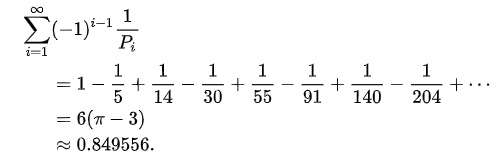
π from a formula using square pyramidal numbers (Wikipedia)
Here are the approximations getting nearer and near to π:
3.1415926535897932384... = π
3.1666666666666666666... = sqpyra2pi(i=1) / 6 + 3
1 = sqpyra(1)3.1415926535897932384... = π
3.1452380952380952380... = sqpyra2pi(i=3) / 6 + 3
14 = sqpyra(3)3.1415926535897932384... = π
3.1412548236077647842... = sqpyra2pi(i=8) / 6 + 3
204 = sqpyra(8)3.1415926535897932384... = π
3.1415189855952756236... = sqpyra2pi(i=14) / 6 + 3
1,015 = sqpyra(14)3.1415926535897932384... = π
3.1415990074057163751... = sqpyra2pi(i=33) / 6 + 3
12,529 = sqpyra(33)3.1415926535897932384... = π
3.1415920110950124679... = sqpyra2pi(i=72) / 6 + 3
127,020 = sqpyra(72)3.1415926535897932384... = π
3.1415926017980070553... = sqpyra2pi(i=168) / 6 + 3
1,594,684 = sqpyra(168)3.1415926535897932384... = π
3.1415926599504002195... = sqpyra2pi(i=339) / 6 + 3
13,043,590 = sqpyra(339)3.1415926535897932384... = π
3.1415926530042565359... = sqpyra2pi(i=752) / 6 + 3
142,035,880 = sqpyra(752)3.1415926535897932384... = π
3.1415926535000384883... = sqpyra2pi(i=1406) / 6 + 3
927,465,791 = sqpyra(1406)3.1415926535897932384... = π
3.1415926535800054618... = sqpyra2pi(i=2944) / 6 + 3
8,509,683,520 = sqpyra(2944)3.1415926535897932384... = π
3.1415926535890006043... = sqpyra2pi(i=6806) / 6 + 3
105,111,513,491 = sqpyra(6806)3.1415926535897932384... = π
3.1415926535897000092... = sqpyra2pi(i=13892) / 6 + 3
893,758,038,910 = sqpyra(13892)3.1415926535897932384... = π
3.1415926535897999990... = sqpyra2pi(i=33315) / 6 + 3
12,325,874,793,790 = sqpyra(33315)3.1415926535897932384... = π
3.1415926535897939999... = sqpyra2pi(i=68985) / 6 + 3
109,433,980,000,485 = sqpyra(68985)3.1415926535897932384... = π
3.1415926535897932999... = sqpyra2pi(i=159563) / 6 + 3
1,354,189,390,757,594 = sqpyra(159563)3.1415926535897932384... = π
3.1415926535897932300... = sqpyra2pi(i=309132) / 6 + 3
9,847,199,658,130,890 = sqpyra(309132)3.1415926535897932384... = π
3.1415926535897932389... = sqpyra2pi(i=774865) / 6 + 3
155,080,688,289,901,465 = sqpyra(774865)3.1415926535897932384... = π
3.1415926535897932384... = sqpyra2pi(i=1586190) / 6 + 3
1,330,285,259,163,175,415 = sqpyra(1586190)
Summer Samer
10 can be represented in exactly 10 ways as a sum of distinct integers:
10 = 1 + 2 + 3 + 4
10 = 2 + 3 + 5
10 = 1 + 4 + 5
10 = 1 + 3 + 6
10 = 4 + 6 (c=5)
10 = 1 + 2 + 7
10 = 3 + 7
10 = 2 + 8
10 = 1 + 9
10 = 10 (c=10)
But there’s something unsatisfying about including 10 as a sum of itself. It’s much more satisfying that 76 can be represented in exactly 76 ways as a sum of distinct primes:
76 = 2 + 3 + 7 + 11 + 13 + 17 + 23
76 = 5 + 7 + 11 + 13 + 17 + 23
76 = 2 + 3 + 5 + 11 + 13 + 19 + 23
76 = 3 + 7 + 11 + 13 + 19 + 23
76 = 2 + 3 + 5 + 7 + 17 + 19 + 23 (c=5)
76 = 2 + 3 + 5 + 7 + 13 + 17 + 29
76 = 2 + 3 + 5 + 7 + 11 + 19 + 29
76 = 3 + 5 + 7 + 13 + 19 + 29
76 = 11 + 17 + 19 + 29
76 = 11 + 13 + 23 + 29 (c=10)
76 = 2 + 5 + 17 + 23 + 29
76 = 7 + 17 + 23 + 29
76 = 2 + 3 + 19 + 23 + 29
76 = 5 + 19 + 23 + 29
76 = 2 + 3 + 5 + 7 + 11 + 17 + 31 (c=15)
76 = 3 + 5 + 7 + 13 + 17 + 31
76 = 3 + 5 + 7 + 11 + 19 + 31
76 = 2 + 11 + 13 + 19 + 31
76 = 2 + 7 + 17 + 19 + 31
76 = 2 + 7 + 13 + 23 + 31 (c=20)
76 = 2 + 3 + 17 + 23 + 31
76 = 5 + 17 + 23 + 31
76 = 3 + 19 + 23 + 31
76 = 2 + 3 + 11 + 29 + 31
76 = 5 + 11 + 29 + 31 (c=25)
76 = 3 + 13 + 29 + 31
76 = 3 + 5 + 7 + 11 + 13 + 37
76 = 2 + 7 + 13 + 17 + 37
76 = 2 + 7 + 11 + 19 + 37
76 = 2 + 5 + 13 + 19 + 37 (c=30)
76 = 7 + 13 + 19 + 37
76 = 3 + 17 + 19 + 37
76 = 2 + 3 + 11 + 23 + 37
76 = 5 + 11 + 23 + 37
76 = 3 + 13 + 23 + 37 (c=35)
76 = 2 + 3 + 5 + 29 + 37
76 = 3 + 7 + 29 + 37
76 = 3 + 5 + 31 + 37
76 = 2 + 5 + 11 + 17 + 41
76 = 7 + 11 + 17 + 41 (c=40)
76 = 2 + 3 + 13 + 17 + 41
76 = 5 + 13 + 17 + 41
76 = 2 + 3 + 11 + 19 + 41
76 = 5 + 11 + 19 + 41
76 = 3 + 13 + 19 + 41 (c=45)
76 = 2 + 3 + 7 + 23 + 41
76 = 5 + 7 + 23 + 41
76 = 2 + 7 + 11 + 13 + 43
76 = 2 + 3 + 11 + 17 + 43
76 = 5 + 11 + 17 + 43 (c=50)
76 = 3 + 13 + 17 + 43
76 = 2 + 5 + 7 + 19 + 43
76 = 3 + 11 + 19 + 43
76 = 2 + 3 + 5 + 23 + 43
76 = 3 + 7 + 23 + 43 (c=55)
76 = 2 + 31 + 43
76 = 2 + 3 + 11 + 13 + 47
76 = 5 + 11 + 13 + 47
76 = 2 + 3 + 7 + 17 + 47
76 = 5 + 7 + 17 + 47 (c=60)
76 = 2 + 3 + 5 + 19 + 47
76 = 3 + 7 + 19 + 47
76 = 29 + 47
76 = 2 + 3 + 7 + 11 + 53
76 = 5 + 7 + 11 + 53 (c=65)
76 = 2 + 3 + 5 + 13 + 53
76 = 3 + 7 + 13 + 53
76 = 23 + 53
76 = 2 + 3 + 5 + 7 + 59
76 = 17 + 59 (c=70)
76 = 3 + 5 + 7 + 61
76 = 2 + 13 + 61
76 = 2 + 7 + 67
76 = 2 + 3 + 71
76 = 5 + 71 (c=75)
76 = 3 + 73
Summer Sets (and Truncated Triangulars)
Here is the sequence of triangular numbers, created by summing consecutive integers from 1 (i.e., 1+2+3+4+5…):
1, 3, 6, 10, 15, 21, 28, 36, 45, 55, 66, 78, 91, 105, 120, 136, 153, 171, 190, 210, 231, 253, 276, 300, 325, 351, 378, 406, 435, 465, 496, 528, 561, 595, 630, 666, 703, 741, 780, 820, 861, 903, 946, 990, 1035, 1081, 1128, 1176, 1225, 1275, 1326, 1378, 1431, 1485, 1540, 1596, 1653, 1711, 1770, 1830, 1891, 1953, 2016, 2080, 2145, 2211, 2278, 2346, 2415, 2485, 2556, 2628, 2701, 2775, 2850, 2926, 3003, 3081, 3160, 3240, 3321, 3403, 3486, 3570, 3655, 3741, 3828, 3916, 4005, 4095, 4186, 4278, 4371, 4465, 4560, 4656, 4753, 4851, 4950, 5050, 5151, 5253, 5356, 5460, 5565, 5671, 5778, 5886, 5995...
And here is a sequence of truncated triangulars, created by summing consecutive integers from 15 (i.e., 15+16+17+18+19…):
15, 31, 48, 66, 85, 105, 126, 148, 171, 195, 220, 246, 273, 301, 330, 360, 391, 423, 456, 490, 525, 561, 598, 636, 675, 715, 756, 798, 841, 885, 930, 976, 1023, 1071, 1120, 1170, 1221, 1273, 1326, 1380, 1435, 1491, 1548, 1606, 1665, 1725, 1786, 1848, 1911, 1975, 2040, 2106, 2173, 2241, 2310, 2380, 2451, 2523, 2596, 2670, 2745, 2821, 2898, 2976, 3055, 3135, 3216, 3298, 3381, 3465, 3550, 3636, 3723, 3811, 3900, 3990, 4081, 4173, 4266, 4360, 4455, 4551, 4648, 4746, 4845, 4945, 5046, 5148, 5251, 5355, 5460, 5566, 5673, 5781...
It’s obvious that the sequences are different at each successive step: 1 ≠ 15, 3 ≠ 31, 6 ≠ 48, 10 ≠ 66, 21 ≠ 85, and so on. But seven numbers occur in both sequences: 15, 66, 105, 171, 561, 1326 and 5460. And that’s it — 7 is the 14-th entry in A309507 at the Encyclopedia of Integer Sequences:
0, 1, 1, 1, 3, 3, 1, 2, 5, 3, 3, 3, 3, 7, 3, 1, 5, 5, 3, 7, 7, 3, 3, 5, 5, 7, 7, 3, 7, 7, 1, 3, 7, 7, 11, 5, 3, 7, 7, 3, 7, 7, 3, 11, 11, 3, 3, 5, 8, 11, 7, 3, 7, 15, 7, 7, 7, 3, 7, 7, 3, 11, 5, 3, 15, 7, 3, 7, 15, 7, 5, 5, 3, 11, 11, 7, 15, 7, 3, 9, 9, 3, 7 — A309507
I decided to take create graphs of shared numbers in compared sequences like this. In the 135×135 grid below, the brightness of the squares corresponds to the count of shared numbers in the sequence-pair sum(x..x+n) and sum(y..y+n), where x and y are the coordinates of each individual square. I think the grid looks like a city of skyscrapers bisected by a highway:
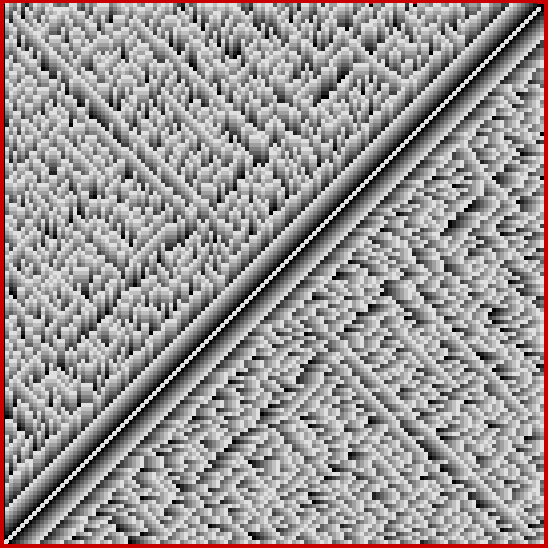
Count of shared numbers in sequence-pairs sum(x..x+n) and sum(y..y+n)
Note that the bright white diagonal in the grid corresponds to the sequence-pairs where x = y. Because the sequences are identical in each pair, the count of shared numbers is infinite. The grid is symmetrically reflected along the diagonal because, for example, the sequence-pair for x=12, y=43, where sum(12..12+n) is compared with sum(43..43+n), corresponds to the sequence pair for x=43, y=12, where sum(43..43+n) is compared with sum(12..12+n). The scale of brightness runs from 0 (black) to 255 (full white) and increases by 32 for each shared number in the sequence. Obviously, then, the brightness can’t increase indefinitely and some maximally bright squares will represent sequence-pairs that have different counts of shared pairs.
Now try altering the size of the step in brightness. You get grids in which the width of the central strip increases (smaller step) or decreases (bigger step). Here are grids for steps for 1, 2, 4, 8, 16, 32 and 64 (I’ve removed the bright x=y diagonal for the first few grids, because it’s too prominent against duller shades):

Brightness-step = 1

Brightness-step = 2

Brightness-step = 4

Brightness-step = 8
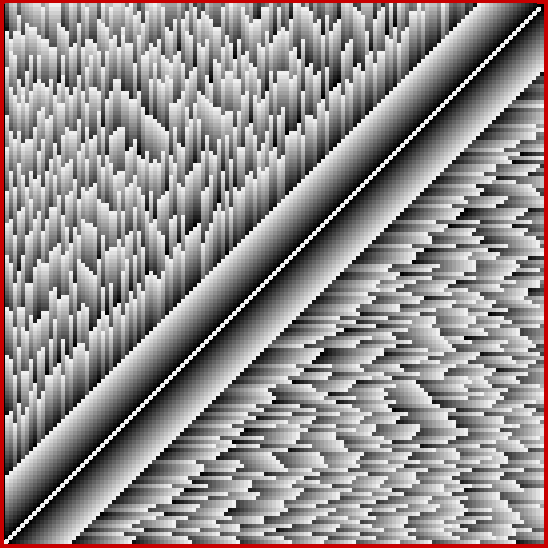
Brightness-step = 16
Brightness-step = 32
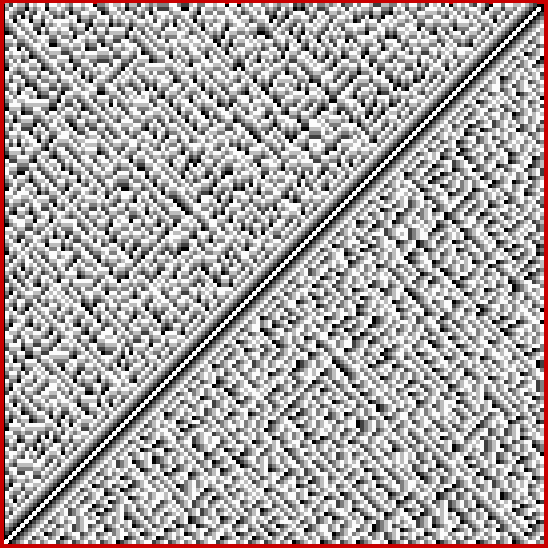
Brightness-step = 63

Brightness-step = 1, 2, 4, 8, 16, 32, 63 (animated)


