Σκιᾶς ὄναρ ἄνθρωπος.
Skias onar anthrōpos.
“Man is the dream of a shadow.” — Pindar (518-438 BC).

Soft teeth at last of gnawing hour
Grind sternest stone to finest flour.
Nor any mage, with puissant art,
Deflects Time’s final venom’d dart.
“Tempus edax rerum…”, Ovid, Metamorphoses, xv, 234.
The leaves break forth in merry green:
Far on the hill their laughter’s seen.
The moons roll by; their story’s told:
They fall in evanescent gold.
One of Swinburne’s most powerful, but least-known, poems is “The Last Oracle”, from Poems and Ballads, Second Series (1878). A song in honour of the god Apollo, it begins in lamentation:
Years have risen and fallen in darkness or in twilight,
Ages waxed and waned that knew not thee nor thine,
While the world sought light by night and sought not thy light,
Since the sad last pilgrim left thy dark mid shrine.
Dark the shrine and dumb the fount of song thence welling,
Save for words more sad than tears of blood, that said:
Tell the king, on earth has fallen the glorious dwelling,
And the watersprings that spake are quenched and dead.
Not a cell is left the God, no roof, no cover
In his hand the prophet laurel flowers no more.
And ends in exultation:
For thy kingdom is past not away,
Nor thy power from the place thereof hurled;
Out of heaven they shall cast not the day,
They shall cast not out song from the world.
By the song and the light they give
We know thy works that they live;
With the gift thou hast given us of speech
We praise, we adore, we beseech,
We arise at thy bidding and follow,
We cry to thee, answer, appear,
O father of all of us, Paian, Apollo,
Destroyer and healer, hear! (“The Last Oracle”)
The power, grandeur and beauty of this poem remind me of the music of Beethoven. Swinburne is also, on a smaller scale and in a different medium, one of the geniuses of European art. He and Beethoven were both touched by Apollo, but Apollo was more than the god of music and poetry: he also presided mathematics. But then mathematics is much more visible, or audible, in music and poetry than it is in other arts. Rhythm, harmony, scansion, melody and rhyme are mathematical concepts. Music is built of notes, poetry of stresses and rhymes, and the rules governing them are easier to formalize than those governing, say, sculpture or prose. Nor do poetry and music have to make sense or convey explicit meaning like other arts. That’s why I think a shape like this is closer to poetry or music than it is to painting:

(Image from Wikipedia.)
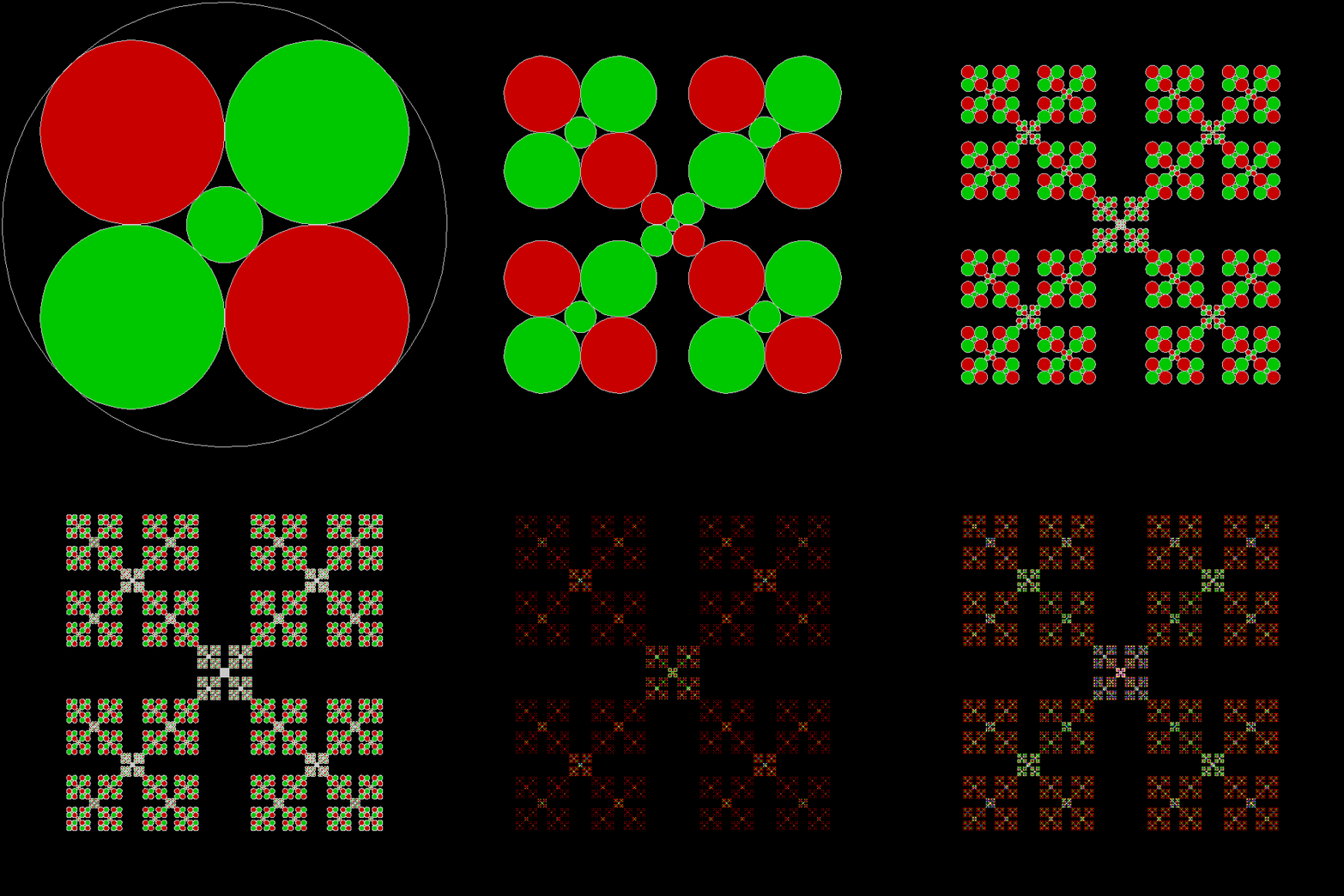
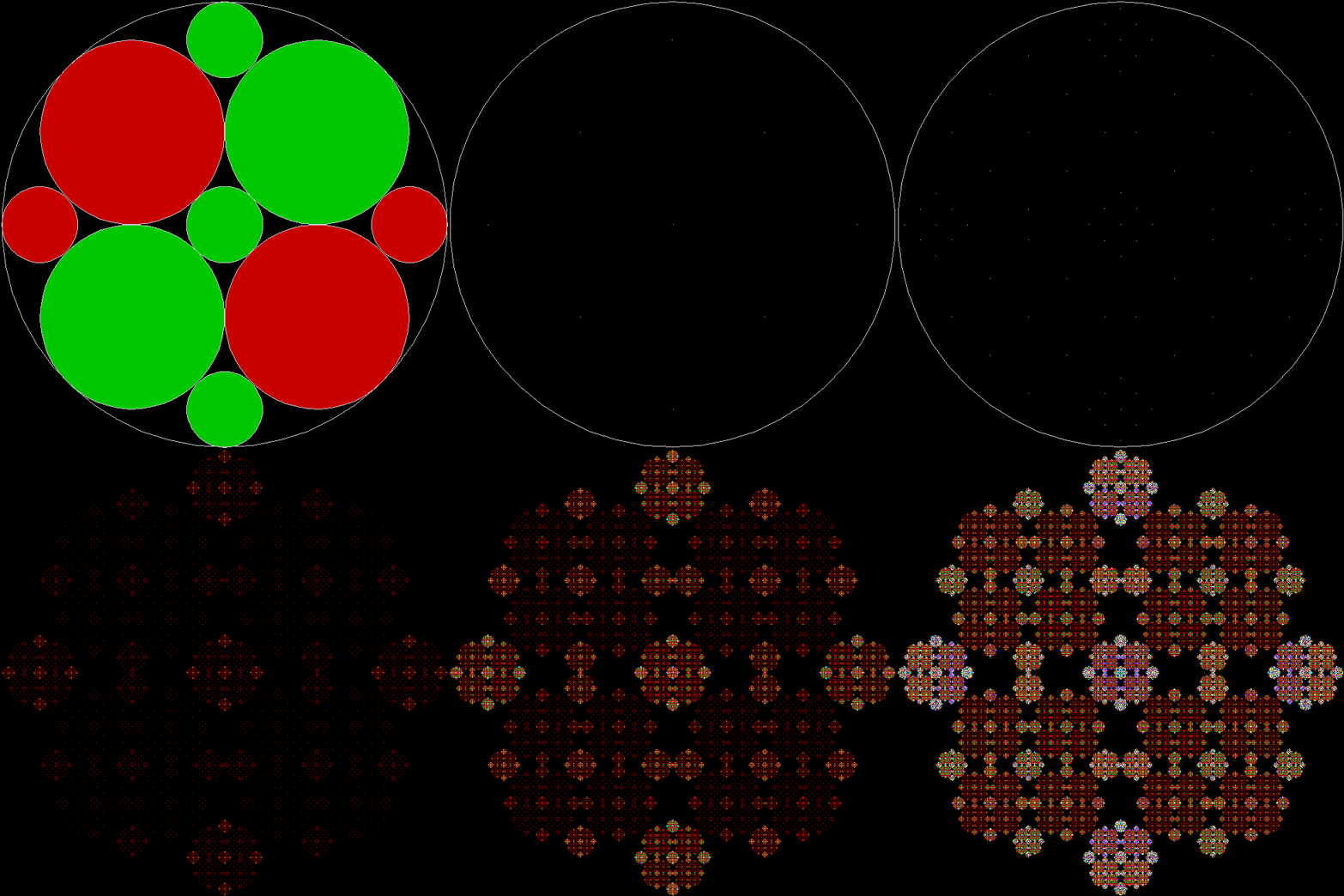
This shape has formal structure and beauty, but it has no explicit meaning. Its name has a divine echo: the Apollonian gasket or net, named after the Greek mathematician Apollonius of Perga (c.262 BC–c.190 BC), who was named after Apollo, god of music, poetry and mathematics. The Apollonian gasket is a fractal, but the version above is not as fractal as it could be. I wondered what it would look like if, like fleas preying on fleas, circles appeared inside circles, gaskets within gaskets. I haven’t managed to program the shape properly yet, but here is my first effort at an Intra-Apollonian gasket:

(If the image does not animate or looks distorted, please try opening it in a new window)
When the circles are solid, they remind me of ice-floes inside ice-floes:

Simpler gaskets can be interesting too:

Numbered Days: Literature, Mathematics and the Deus Ex Machina
Think French. Think genius. Think rebellious, tormented, iconoclastic. Finally, think dead tragically young in the nineteenth century… And if you’re thinking of anyone at all, I think you’ll be thinking of Rimbaud.
And you’d be right to do so. But only half-right. Because there were in fact two rebellious, tormented, iconoclastic French geniuses who died tragically young in the nineteenth century. One was called Arthur Rimbaud (1854-91) and the other Évariste Galois (1811-32). Rimbaud is still famous, Galois never has been. At least not to the general educated public, though on all objective criteria – but one – you might expect his fame to be greater. In every way – but one – Galois has the more powerful appeal.
Continue reading Numbered Days…
Poetry and Putridity: Interrogating Issues of Narrativistic Necrocentricity in A.E. Housman and Clark Ashton Smith
Thanatic fanatic. Say it. Savour it, if you’re that way inclined. I certainly am: I am obsessed with words. The sound of them, the shape of them, their history, meaning and flavours. If I were a Guardianista, I’d say I was “passionate about” words. But it’s partly because I’m obsessed with words that I’m not a Guardianista. The Guardian and its readers use them badly. I like people who use them well: A.E. Housman and Clark Ashton Smith, for example. AEH (1859-1936) was an English classicist, CAS (1893-1961) a Californian jack-of-all-trades. But they were both masters of the English language.
They were also thanatic fanatics: obsessed with death. But in different ways. You could say that Housman was more death-as-dying, Smith more death-as-decaying. Not that Smith didn’t deal in dying too: he wrote powerfully and disturbingly about our departure from life, not just about what happens to us beyond it. But Housman didn’t dabble in decomposition and decay. In A Shropshire Lad (1896), the death is fresh, not foetid: necks break, throats are slit, athletes die young, men muse on drowning, fiancées arrive at church in coffins, not coaches. Sometimes the effect, and affect, are ludicrous. Sometimes they’re not. Sometimes it’s hard to decide:
On moonlit heath and lonesome bank
The sheep beside me graze;
And yon the gallows used to clank
Fast by the four cross ways.A careless shepherd once would keep
The flocks by moonlight there,*
And high amongst the glimmering sheep
The dead man stood on air.They hang us now in Shrewsbury jail:
The whistles blow forlorn,
And trains all night groan on the rail
To men that die at morn.There sleeps in Shrewsbury jail to-night,
Or wakes, as may betide,
A better lad, if things went right,
Than most that sleep outside.And naked to the hangman’s noose
The morning clocks will ring
A neck God made for other use
Than strangling in a string.And sharp the link of life will snap,
And dead on air will stand
Heels that held up as straight a chap
As treads upon the land.So here I’ll watch the night and wait
To see the morning shine,
When he will hear the stroke of eight
And not the stroke of nine;And wish my friend as sound a sleep
As lads’ I did not know,
That shepherded the moonlit sheep
A hundred years ago.*Hanging in chains was called keeping sheep by moonlight.
That poem mingles beauty and bathos as it contemplates death. Other poems have more or less of one or the other, but for Housman death is metaphor and metaphysics, not morbidity and mephitis. He uses it as a symbol of loss and despair and those are his real concerns. There is no literal death here:
’Tis time, I think, by Wenlock town
The golden broom should blow;
The hawthorn sprinkled up and down
Should charge the land with snow.Spring will not wait the loiterer’s time
Who keeps so long away;
So others wear the broom and climb
The hedgerows heaped with may.Oh tarnish late on Wenlock Edge,
Gold that I never see;
Lie long, high snowdrifts in the hedge
That will not shower on me.
That is an example of multum in parvo: “much in little”. Using simple words and simple metre, Housman creates great beauty and can conjure overwhelming emotion. He was one of the greatest classicists in history, an expert in the rich and complex literature of the ancient world, a profound scholar of Latin and Greek. But his poetry is remarkable for its lack of classical vocabulary. There is no Latin or Greek in the poem above and only two words of French. Clark Ashton Smith was quite different:
“Look well,” said the necromancer, “on the empire that was yours, but shall be yours no longer.” Then, with arms outstretched toward the sunset, he called aloud the twelve names that were perdition to utter, and after them the tremendous invocation: Gna padambis devompra thungis furidor avoragomon.
Instantly, it seemed that great ebon clouds of thunder beetled against the sun. Lining the horizon, the clouds took the form of colossal monsters with heads and members somewhat resembling those of stallions. Rearing terribly, they trod down the sun like an extinguished ember; and racing as if in some hippodrome of Titans, they rose higher and vaster, coming towards Ummaos. Deep, calamitous rumblings preceded them, and the earth shook visibly, till Zotulla saw that these were not immaterial clouds, but actual living forms that had come forth to tread the world in macrocosmic vastness. Throwing their shadows for many leagues before them, the coursers charged as if devil-ridden into Xylac, and their feet descended like falling mountain crags upon far oases and towns of the outer wastes.
Like a many-turreted storm they came, and it seemed that the world shrank gulfward, tilting beneath the weight. Still as a man enchanted into marble, Zotulla stood and beheld the ruining that was wrought on his empire. And closer drew the gigantic stallions, racing with inconceivable speed, and louder was the thundering of their footfalls, that now began to blot the green fields and fruited orchards lying for many miles to the west of Ummaos. And the shadow of the stallions climbed like an evil gloom of eclipse, till it covered Ummaos; and looking up, the emperor saw their eyes halfway between earth and zenith, like baleful suns that glare down from soaring cumuli.
“The Dark Eidolon” (1935).
Smith’s logomania could not be satisfied beyond the bounds of English, in Latin, Greek and French: he stepped outside history altogether and created his own languages to weave word-spells with. If you didn’t know CAS or AEH or their writing, who would seem more like the world-famous classicist? Based on what I have quoted so far, it would perhaps be Smith. But that is part of what is astonishing about his writing: he wasn’t merely a Beethoven of prose, creating gigantic melodies with rich and rolling words, he was a poorly educated Beethoven. Here is another contrast with his fellow thanatic fanatic. Housman was not poorly educated and was given a chance Smith never had: to attend and adorn one of the world’s greatest universities. The chance was dropped. Housman attended, but he didn’t adorn:
After showing himself, as an undergraduate [at Oxford], to be a brilliant – even arrogantly brilliant – student of Latin and Greek, apparently set for a lifetime of scholarship, he produced a performance in his final examination that astonished all who knew him. He handed in a series of blank, or nearly blank, papers and was failed outright. Retrieving the situation as best he could, he completed the requirements for a pass degree, got through the Civil Service examination, and secured a post at the Patent Office. (The Collected Poems of A.E. Housman, Wordsworth, 2005, Michael Irwin’s Introduction, pg. 8)
Housman would end his life, laden with honours, as a Professor of Latin at Cambridge, but that isn’t surprising. The fiasco at Oxford certainly was. Why did it happen? A nervous breakdown or failure to work, perhaps, because of his unrequited love for a fellow student: Moses Jackson, who was healthy, heterosexual, and had no time for classical scholarship. In later life, travelling to cities like Paris and Venice, Housman would indulge much more than his gastronomic and aesthetic appetites. But he seems to have believed that sex without love is like food without flavour. And he never ceased loving Jackson. When he completed volume one of his magnum opus, a definitive edition of the Roman poet Manilius (fl. 1st century A.D.), he dedicated it to Jackson in Latin, dubbing him harum litterarum contemptor, “a scorner of these writings”. That was in 1903, when Jackson was married and living in India. Jackson would later move to Canada, where he died of anaemia in 1923. His death was anticipated by this cri du cœur from Housman:
The half-moon westers low, my love,
And the wind brings up the rain;
And wide apart lie we, my love,
And seas between the twain.I know not if it rains, my love,
In the land where you do lie;
And oh, so sound you sleep, my love,
You know no more than I.Last Poems (1922), XXVI.
But cri du cœur is not the mot juste: it is a very simple poem with only a single foreign word. That is, if “apart” can be called foreign, after centuries on the tongues and lips of English-speakers. Almost everything else has been there millennia and that is part of Housman’s word-magic. His poems are really about depth, not distance. One of the most famous says, in the same simple vocabulary, that far away is close at hand:
On Wenlock Edge the wood’s in trouble;
His forest fleece the Wrekin heaves;
The gale, it plies the saplings double,
And thick on Severn snow the leaves.’Twould blow like this through holt and hanger
When Uricon the city stood:
’Tis the old wind in the old anger,
But then it threshed another wood.Then, ’twas before my time, the Roman
At yonder heaving hill would stare:
The blood that warms an English yeoman,
The thoughts that hurt him, they were there.There, like the wind through woods in riot,
Through him the gale of life blew high;
The tree of man was never quiet:
Then ’twas the Roman, now ’tis I.The gale, it plies the saplings double,
It blows so hard, ’twill soon be gone:
To-day the Roman and his trouble
Are ashes under Uricon.
Death for Housman, as it was for Swinburne, is “a sleep”: when the body is ashes, the brain is troubled no more. Death does not necessarily sleep in Clark Ashton Smith:
Natanasna (chanting):
Muntbauut, maspratha butu, [Mumbavut, lewd and evil spirit,]
Varvas runu, vha rancutu. [Wheresoever thou roamest, hear me.]
Incubus, my cousin, come,
Drawn from out the night you haunt,
From the hollow mist and murk
Where discarnate larvae lurk,
By the word of masterdom.
Hell will keep its covenant,
You shall have the long-lost thing
That you howl and hunger for.
Borne on sable, sightless wing,
Leave the void that you abhor,
Enter in this new-made grave,
You that would a body have:
Clothed with the dead man’s flesh,
Rising through the riven earth
In a jubilant rebirth,
Wend your ancient ways afresh,
By the mantra laid on you
Do the deed I bid you do.
Vora votha Thasaidona [By (or through) Thasaidon’s power]
Sorgha nagrakronitlhona. [Arise from the death-time-dominion.](After a pause)
Vachat pantari vora nagraban [The spell (or mantra) is finished by the necromancer.]
Kalguth: Za, mozadrim: vachama vongh razan. [Yes, master: the vongh (corpse animated by a demon) will do the rest. (These words are from Umlengha, an ancient language of Zothique, used by scholars and wizards.)]
(The turf heaves and divides, and the incubus-driven Lich of Galeor rises from the grave. The grime of interment is on its face, hands, and clothing. It shambles forward and presses close to the outer circle, in a menacing attitude. Natanasna raises the staff, and Kalguth the arthame, used to control rebellious sprits. The Lich shrinks back.)
The Lich (in a thick, unhuman voice): You have summoned me,
And I must minister
To your desire.Natanasna: Heed closely these instructions:
By alleys palled and posterns long disused,
Well-hidden from the moon and from men’s eyes,
You shall find ingress to the palace. There,
Through stairways only known to mummied kings
And halls forgotten save by ghosts, you must
Seek out the chamber of the queen Somelis,
And woo her lover-wise till that be done
Which incubi and lovers burn to do.
That is from Smith’s The Dead Will Cuckold You (1951), “A Drama in Six Scenes”. It is also a drama with a sex-scene, by implication, at least. The re-animated corpse follows its instructions, seeks out the palace and enters the “chamber of the queen Somelis”, who addresses it thus as her husband, King Smaragd, beats on the locked door:
Poor Galeor, the grave has left you cold:
I’ll warm you in my bed and in my arms
For those short moments ere the falling sword
Shatter the fragile bolts of mystery
And open what’s beyond. (Op. cit., Scene IV)
I read the play daunted by its erudition, delighted by its epeolatry, and disturbed by its emetic extremity. Some of Smith’s work is about something other than death. This play is about nothing but death. Compare it with Smith’s short-story “The Isle of Torturers” (1933), which contains both poetry and putridity. It’s part richness, part retching. There is poetry like this:
Creaming with a winy foam, full of strange murmurous voices and vague tales of exotic things, the halcyon sea was about the voyagers now beneath the high-lifting summer sun. But the sea’s enchanted voices and its long languorous, immeasurable cradling could not soothe the sorrow of Fulbra; and in his heart a despair abided, black as the gem that was set in the red ring of Vemdeez.
Howbeit, he held the great helm of the ebon barge, and steered as straightly as he could by the sun toward Cyntrom. The amber sail was taut with the favoring wind; and the barge sped onward all that day, cleaving the amaranth waters with its dark prow that reared in the carven form of an ebony goddess. And when the night came with familiar austral stars, Fulbra was able to correct such errors as he had made in reckoning the course.
“The Isle of Torturers” (1933).
There is also putridity like this:
Anon the drowned and dripping corpses went away; and Fulbra was stripped by the Torturers and was laid supine on the palace floor, with iron rings that bound him closely to the flags at knee and wrist, at elbow and ankle. Then they brought in the disinterred body of a woman, nearly eaten, in which a myriad maggots swarmed on the uncovered bones and tatters of dark corruption; and this body they placed on the right hand of Fulbra. And also they fetched the carrion of a black goat that was newly touched with beginning decay; and they laid it down beside him on the left hand. Then, across Fulbra, from right to left, the hungry maggots crawled in a long and undulant wave…
In The Dead Will Cuckold You, the poetry never escapes the putridity. After reading it, you will understand why L. Sprague de Camp remarked this of Smith: “Nobody since Poe has so loved a well-rotted corpse” (Literary Swordsmen and Sorcerers: the Makers of Heroic Fantasy, Arkham House 1976, pg. 206). Nor has anyone since Poe so loved an ingenious torture: in Scene V of the play, King Smaragd threatens his guards with a “douche” of “boiling camel-stale”. There’s humour in Smith’s morbidity, but I think that he dwelt too long on unhealthy themes. It shows both in his stories and in his popularity: the Weird Tales Big Three, H.P. Lovecraft (1890-1937), Robert E. Howard (1906-36), and Clark Ashton Smith, are rather like the three stars in the belt of Orion. Lovecraft and Howard are bright Alnilam and Mintaka, Smith is dimmer Alnitak. His luxuriant lexicon explains part of this, but his necrocentric narratives must repel people too.
Housman wrote about death more delicately and distantly. His work doesn’t so much narrativize the necrotic as thematicize the thanatic. It talks about dying, not decaying, and it doesn’t relish the repellent as Smith’s work often did. This helps explain why Housman is a bigger name in English literature than Smith, though I don’t think he was a greater writer. Housman is a minor poet with a major name. I think he deserves it for the beauty and simplicity of his verse. He’s a word-magician who can conjure tears. Smith is a word-magician who can conjure titans. He did more with English and deserves some of Housman’s fame. With his poetry, he might have won it; with his putridity, he lost his chance.
Each year the patient hand of time
Plucks bare the oak, the ash, the lime,
And sharp against the Autumn sky
The subtle branches soothe the eye.
When Winter’s spell is fast on earth
The trees await the sun’s rebirth,
And pearled in frost, they stand and seem
Designed for beauty in a dream.
Then Spring revokes the spell and wills
The early leaves, the silver rills:
And symbol’d songs, more sweet than words,
Fill air with urgence of the birds.
Last, Summer’s lion roars his heat:
And pollen drifts and leaves compete
To drink the golden tide of light
Ere fall the sable drought of night.
…nec corpus remanet, quondam quod amaverat Echo.*
P. Ovidi Nasonis Metamorphoses, Liber Tertius, 493.
He sits to gaze his selfish pool
Whilst I, his fond, besotted fool,
Grow hateful of the air that sips
The sweetness of his yearning lips.
They yearn for him as mine do yearn,
Or sun or stars above me burn.
The kisses of Narcissus I
Shall never taste: ’tis thus I die.
And tho’ ye’ll hear my voice down time
Recall the burden of this rhyme,
Yet know that I am gone and he
Lies loveless where ye too shall be.
*Nor the form remains, belovèd once of Echo.
The wild marine music of the airy gulls,
Crucified on the cold wind,
Rears ancient seas and vanished tides within our skulls:
And the walls of time are thinned.
Our Lady of the Gutter
Walking on the shaded side of Longsands Avenue, he saw a small lady’s-mantle in the gutter. Alchemilla mollis. The soft little alchemical one. It was new-grown and its pleated leaves were fresh and green against the cement. He wished he could spin a poem out of it, out of the unexpected sight, something deep and mysterious and Larkinesque. A line, or two lines, occurred to him. The line of the gutter/Stutters with green. But where to go after that? Later, walking back along Longsands Road, he heard a twittering, or thought he did, and looked up to see swifts high up, swirling, swooping, seeking insects he couldn’t see. Aëroplankton. Again he wished he could capture the moment, condense the sight into potent language. He thought a little. Sickle-wing swifts/Reap the insected air. But again, where to go after that? He liked “insected air”, though. It had an assonance of “infected air”. But why not a portmanteau? Reap the insfected air. He’d always liked words that started with sph and sf. Sphinx. Sphragistics. Sfumato. Sforzando. “Insfected air” would be air that had insects and pollution in it. Reaped by sickle-wing swifts, fluttering their wings like eyelashes. He remembered that Ted Hughes had written a poem about swifts, but he didn’t like it. It had reminded him of Gerard Manley Hopkins, left out in the rain for a week or two. Perhaps Larkin had written about swifts too, or mentioned them. He hadn’t finished The Complete Poems yet.
Later in the day, he was walking along the promenade. The tide was out, but a tongue of water had been left at the foot of the gold-lichen-splashed sea-wall. He climbed down the steps to it, squatting on his haunches and looking into the wind-rippled water. He saw a shrimp first, then, perhaps when the shock of his shadow or the tremors of his arrival had subsided, tiny flounder began to flick to and fro over the sandy mud. When you saw them move and settle, you could just see their outlines. Otherwise it would be impossible to know where they were. The previous year, on a very hot day, another flounder had been defeated by its camouflage: not protected by it, but doomed. The same tongue of water had stretched along the foot of the sea-wall, but it had been shrinking in the fierce sun. He had rescued some of the dozens of shrimp that crowded the damp but drying sand at one end of the tongue. They were flicking themselves into the air as they dried, hoping to land in water, disappointed again and again. He collected them on his palm and threw them into the deeper water in the middle of the tongue.
As always when he did something like that, he wondered whether it was better not to interfere. Perhaps preserving the weak just means greater misery in future. But they weren’t weak, they were unlucky. Probably. But perhaps unluckiness was weakness too. Because weakness led to unluckiness. Then he left the sand and the shrimps to walk to Merrimont Park. Later, walking back along the promenade, he walked down the steps again and looked at the sand where he had rescued the shrimps. It was completely dry now and he saw what he hadn’t seen before: a tiny dead flounder. If he had seen it before, he would have rescued it, but its camouflage had been too good, defeating his eye, so it had dried and died with dozens of shrimp, hundreds of them, thousands. A hammic hecatomb. Unnoticed and unmourned, except by him. Nature was always sacrificing her self to herself. Insects, arthropods, myriad little lives lost daily, hourly. Presided by whom? Perhaps Our Lady of the Gutter. Nostra Signora della Cunetta. Nuestra Señora de la Cuneta. Our Lady of the Overlooked and Interstitial. He wished he could write a poem about her, complete the poems he had begun about the lady’s mantle and the swifts, but perhaps it was better that he couldn’t. Prose was better for stumbling, for incompleteness, for the rhythmless and rhymeless way the world threw fragments of beauty and consolation at you.
 Overlord In Terms of Core Issues Around Maximal Engagement with Key Notions of the Über-Feral