
Illustrations from Teach Yourself Greek by F. Kinchin Smith and T.W. Melluish (1947), with accents added by another (and presumably Hispanophone) hand. (Is a “Hispanophone hand” like a “pivotal voice”?)

Illustrations from Teach Yourself Greek by F. Kinchin Smith and T.W. Melluish (1947), with accents added by another (and presumably Hispanophone) hand. (Is a “Hispanophone hand” like a “pivotal voice”?)
I don’t know any exceptions to the rule that someone who likes William Burroughs will also be a member in terms of core issues around the hive-mind. From Kurt Cobain to Will Self: if you get a buzz outa Burroughs, that won’t be the only buzzing you’re corely acquaintanced with… And I predict that you’ll frequently use, hear and read core items from the hive-mind term-set such as “in terms of”, “prior to”, “issues around”, “engagement with”, “spike”, “skill-set”, “core”, “key”, “toxic” and “edgy”… You’ll also like italics and trailing dots…
“There was a certain edgy excitement to turning on the computer every morning and immediately checking to see what Mark had thrown down in terms of an ideas-gauntlet.” – Simon Reynolds in the foreword to K-Punk: The Collected and Unpublished Writings of Mark Fisher (2004–2016), edited by Darren Ambrose, Repeater Books 2018.
Elsewhere other-engageable:
• Ex-term-in-ate!
• Don’t Do Dot…
• Prior Analytics
• Spike-U-Like?
• « S’il est un homme tourmenté par la maudite ambition de mettre tout un livre dans une page, toute une page dans une phrase, et tout une phrase dans un mot, c’est moi. » — Joseph Jourbet (1754-1824)
• “If there is a man tormented by the cursed ambition to compress an entire book into a page, an entire page into a phrase, and that phrase into a word, it is I.” — Joseph Jourbet
« Quelle chimère est-ce donc que l’homme, quelle nouveauté, quel monstre, quel chaos, quel sujet de contradiction, quel prodige, juge de toutes choses, imbécile ver de terre, dépositaire du vrai, cloaque d’incertitude et d’erreur, gloire et rebut de l’univers ! » — Pascal
“What a Chimera is man! What a novelty, a monster, a chaos, a contradiction, a prodigy! Judge of all things, an imbecile worm; depository of truth, and sewer of error and doubt; the glory and refuse of the universe.”
In terms of ugly, pretentious phrases used by members of the Guardian-reading community, the “signature” phrase is undoubtedly “in terms of”. But there’s another phrase habitually deployerized by Guardianistas that is perhaps even worse in terms of its core Guardianisticity. To get to it, let’s first engage issues around the title of this post: “Prior Analytics”. I took it from the title of a book on logic by Aristotle, Prior Analytics, known in Latin as Analytica Priora.
Are you surprised to learn that Prior Analytics has a companion called Posterior Analytics, or Analytica Posteriora? No, of course you aren’t. “Prior” and “posterior” are high-falutin’ words that go together: when the first appears, the second naturally follows. And you might think that this obvious pairing would alert Guardianistas to the ugliness and pretension of another of their signature phrases, “prior to”:
• Foreign press warn over dangers of new UK media laws prior to Leveson report — headline in The Observer, 24xi2012
• “Prior to its emergence the trend was not to talk truth to power but to slur the powerless.” — The Great Gary Younge in The Observer, 6xi2011
• “Prior to a prang outside Tesco which, for insurance purposes, wasn’t actually my fault”… — The Great Zoë Williams in The Guardian, 8ii2005
Why do I think “prior to” may be even worse than “in terms of”? There are times when “in terms of” isn’t particularly bad English. I don’t like to admit it, but there are even times when it’s the best phrase to use. But “prior to”? It’s almost always just an ugly and pretentious way of saying “before”. I say “almost always” because you can make an exception for a technical usage like “Existence is logically prior to essence.” But that’s a rare exception, so I repeat: “prior to” is almost always just an ugly and pretentious way of saying “before”.
And guess what? You’ll find this in the Guardian and Observer style guide under “P”:
prior to, previous to
the word you want is “before” (see Guardian and Observer style guide: P)
Guardianistas should be able to realize that for themselves, because “prior to” naturally suggests “posterior to”. However, even Guardianistas don’t habitually say “posterior to” instead of “after”. Even a Guardianista’s ugliness-and-pretension-o-meter is tripped by “posterior to”. But only in the flesh, as it were. Guardianistas are apparently incapable of two-step logic: first, noticing that “prior to” rather than “before” naturally suggests “posterior to” rather than “after”; second, deciding that because “posterior to” is ugly and pretentious, they shouldn’t use “prior to” either.
Elsewhere other-engageable:
• All posts interrogating issues around “in terms of”
• All posts interrogating issues around the Guardian-reading community and its affiliates
It isn’t the best possible phrase to be governed by “in terms of” in the pages of
The Guardian, but the combination below may be the archetypal item of Guardianese:
And what about the leather? Was that also a signal? [Rob Halford:] “It wasn’t conscious. But how ironic that I chose that look – Glenn, the biker from the Village People. That wasn’t my attachment, in terms of the gay community, but I understood the power of that look.” — How Judas Priest invented heavy metal, The Guardian, 10×2010.
Elsewhere other-engageable:
• All posts interrogating issues around “in terms of”
• All posts interrogating issues around the Guardian-reading community and its affiliates
Poovy Postscript
The title of this post was originally “Highway to Hal”, which is feeble. I don’t know why I didn’t think a bit longer and come up with the present title, which has a double entendre (your actual French, ducky).
As I pointed out in Ex-Term-In-Ate!, my excoriating interrogation of “in terms of”, this ugly and pretentious phrase is especially “popular among politicians, who need ways to sound impressive and say little”. But I’ve rarely seen even a politician blether like this:
Cox’s predecessor, Mike Wood, the town’s Labour MP from 1997 to 2015, has said he felt it prudent not to rise to Lockwood’s provocation while in office. But, breaking his silence, [he] told the Observer: “Lockwood has never been anything other than a major issue in terms of trying to unstick what a lot of people were trying to do in terms of community relations.” — Tommy Robinson and the editor: how a newspaper ‘sows division’ where Jo Cox died, The Observer, 2ix2018.
Elsewhere other-engageable:
• Oh My Guardian #6 — the previous entry in this award-winning series
• All posts interrogating issues around “in terms of”
• All posts interrogating issues around the Guardian-reading community and its affiliates
He’s been mixing with the wrong people:
“Our supporters and our country has had a long time suffering in terms of football. […] Our country has been through some difficult moments recently in terms of unity but sport has the power to unite — and football in particular has the power to do that.” — England manager Gareth Southgate, BBC Sport, 10vii2018.
Elsewhere other-engageable:
• Oh My Guardian #6 — the latest in the award-winning series
• All posts interrogating issues around the Guardian-reading community and its affiliates
• Ex-term-in-ate! — interrogating arguably the keyliest and coreliest Guardianista phrase
• All posts interrogating issues around “in terms of”
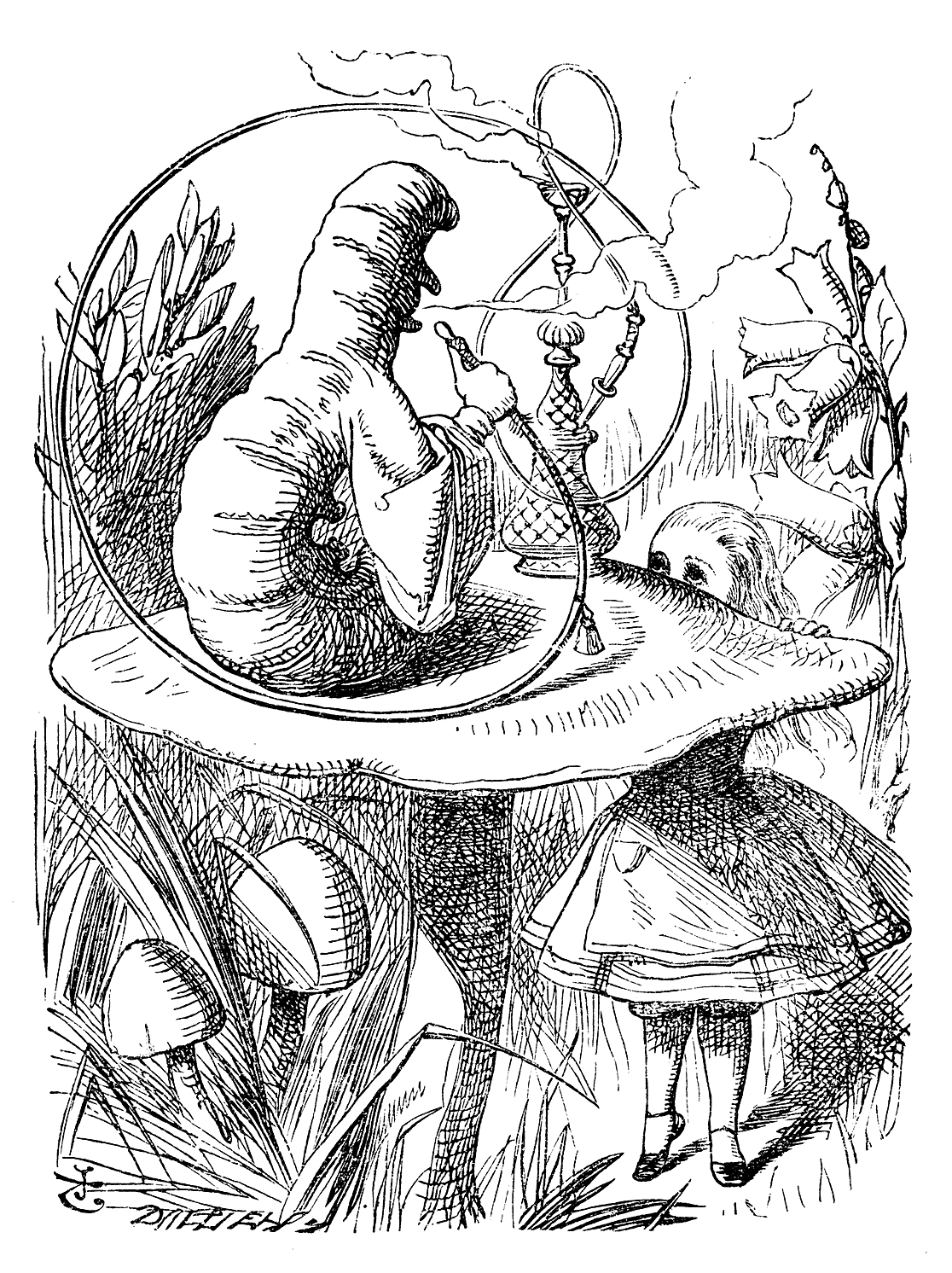
“Alice and the Caterpillar” by John Tenniel (1820-1914), from Lewis Carroll’s Alice in Wonderland (1865)
Ratschläge einer Raupe is one possible German translation of “Advice from a Caterpillar”, which is the title of chapter five of Alice in Wonderland. But the drawing above doesn’t need a translation. John Tenniel and Lewis Carroll were a classic combination, like Quentin Blake and J.P. Martin or Thomas Henry and Richmal Crompton. Tenniel drew fantastic things in a matter-of-fact way, which was just right.
But that makes me wonder about Ratschläge einer Raupe. In German, Rat-schlag means “piece of advice” and Ratschläge is the plural. At first glance, the title is more fun in German: it alliterates and trips off the the tongue in a way the English doesn’t. And Schlag literally means “blow, stroke”, which captures the behaviour of the caterpillar well. Like many of the characters Alice encounters in Wonderland, he is a prickly and aggressive interlocutor. “Advice from a Caterpillar” is plain by comparison.
So perhaps that makes it better: it’s a matter-of-fact title for a surreal chapter. Tenniel’s art echoes that.
[…] the whole vintage package – which started as essentially a rediscovery of simple skills, tying generations together and serving as a visual cake-based bulwark against modern turbulence – has been used to sugar-coat a free-market nationalism that isn’t sweet at all. — Zoë Williams, Let’s ditch the nostalgia that’s invaded our TV and seeped into our politics, The Guardian, 30iv2018.
Elsewhere other-engageable:
• Oh My Guardian #5
• Zo with the Flow
• Reds under the Thread (more on mixed metaphory)
 Overlord In Terms of Core Issues Around Maximal Engagement with Key Notions of the Über-Feral