The Conqueror Term

True story. I saw a copy of Rub Out the Words (2012) on a library shelf. It’s a collection of letters by core counter-cultural colossus William S. Burroughs. I pulled the book off the shelf, opened it, and began to search for a hit of heresiarchal heroin. Exactly 23 seconds later, my eyes fell on this phantasmagoric phraseology:

I do not think a writer should be called upon to defend his work in terms of a legal system that dates back to the middle ages.

I was stunned. Exactly 23 seconds. Well, I didn’t actually time it, but it would have been exactly 23 seconds if you choose the right base. And it was round-about 23 seconds in base 10. So I think reality was trying to tell me something: that Burroughs was part of the Hive Mind. He used a toxic term that good writers shouldn’t use – never, nunca, nohow, nowhere.

And it wasn’t the sole example in the book, I have since learnt. Here, then, are my suggestions for how Burroughs should have rubbed out the offending words and replaced them with something shorter and less vague (the final two examples are by the book’s editor and by someone Burroughs is quoting):

• I do not think a writer should be called upon to defend his work in terms of a legal system that dates back to the middle ages. → in a legal system
• All this is quite possible in terms of existing techniques. → with / by existing techniques
• I am not talking in terms of a thousand years. I am talking in NOW terms. → not talking of a thousand years. I am talking NOW.
• I am thinking in terms of the no-paying far-out magazines like Yugen and Kulchur. → thinking of / about no-paying far-out magazines
• When two or more letters covered the same ground, I selected the best in terms of quality of writing and completeness of thought. → in quality of writing
• Mr Burroughs writes enthusiastically about apomorphine treatment but I do not feel his enthusiasm is justified in terms of published results. → by published results

Okay, there are a lot of letters in the collection and Burroughs himself used “in terms of” only four (or five) times, which isn’t too bad. However, each use is an echt Guardianism, so Burroughs was undoubtedly a victim of the Conqueror Term, like millions of others, then and now. But it isn’t only English-speakers who can be victims of the Conqueror Term: it has infected usage in French too. This is from a speech by the new French president Emmanuel Macron:

… c’est ensuite les routes des trafics multiples qui nécessitent des réponses aussi en termes de sécurité et de coordination régionale … – Emmanuel Macron empêtré dans une folle polémique, Mediaguinee, 10/vii/2017.

… it is then the roads of multiple trafficking which also require answers in terms of security and regional coordination … – French President Emmanuel Macron is in the middle of a social media firestorm, Vox, 10/vii/2017.

The French and English can be shortened in the same way:

• des réponses aussi en termes de sécurité → des réponses aussi en sécurité
• answers in terms of security → in security

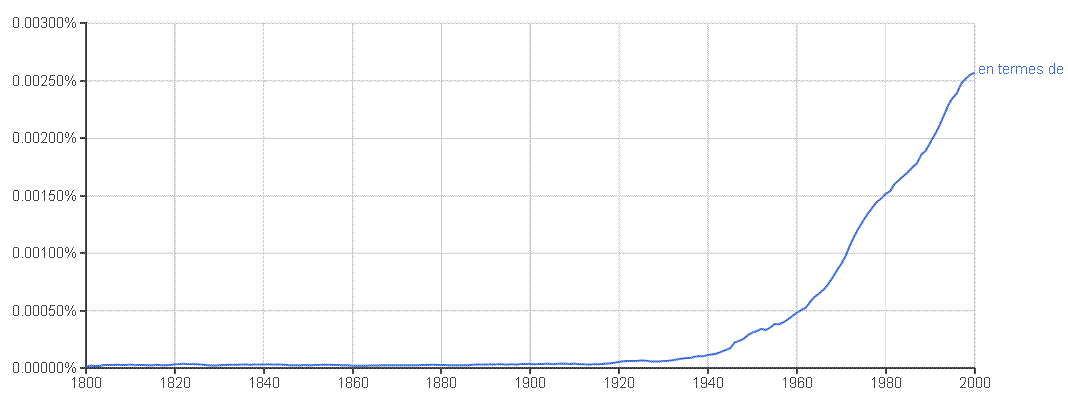
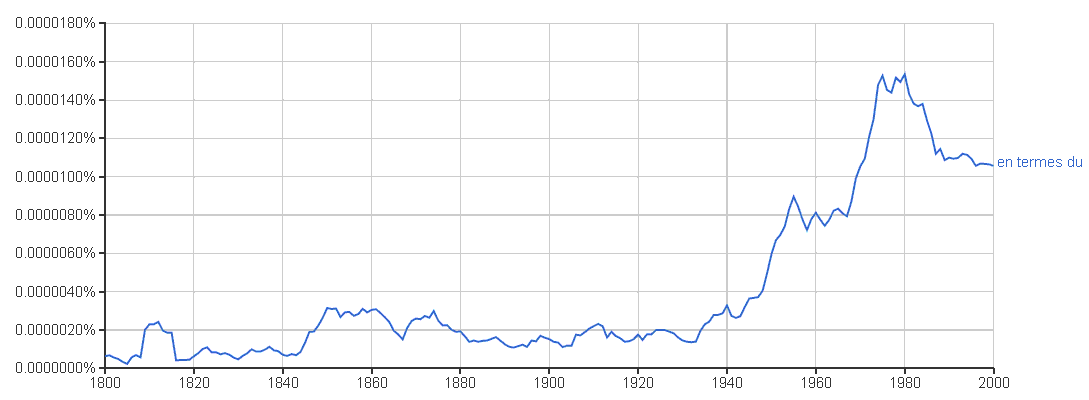
Macron, as you’d expect, is part of the Hive Mind too. He and many other Francophones have succumbed to the Conqueror Term, as you can see from these graphs at Google nGrams (“en termes du” behaves in an interesting way):

En termes de

En termes du

But there are termicides in French too:

Attention, on confond souvent la signification de “en termes de”. Cette expression signifie « dans le vocabulaire de », « dans le langage de » et ne veut pas dire « en ce qui concerne », « en matière de », « sur le plan de ». Cette confusion est sûrement due à l’expression anglaise “in terms of” qui elle a le sens de “en matière de”. Faut-il écrire “en termes de” ou “en terme de” ?, La Langue Française, Nicolas Le Roux, août 31, 2015.

Take care: people often confuse the meaning of “en termes de”. This expression means “in the vocabulary of”, “in the language of”, and does not mean “in what concerns”, “in the matter of”, “after the form of”. This confusion is surely due to the English expression “in terms of”, which has the sense of “in the matter of”. (My translation, so not reliable)

Things were worse than I thought. Pero… ¡La lucha continúa!


Elsewhere other-posted:

The Conqueror Worm — the title of the incendiary intervention above is of course a reference to the famous poem by Edgar Allan In Terms Of Poe
Paradigms Loused

Maxed Messages

Terminal Trio – Robert Burchill on “in terms of”
Mixed Messages – the Joy of Guardian prose
Paradigms Loused

He Say, He Sigh, He Sow #45

…ψάμμος ἀριθμὸν περιπέφευγεν… — Πίνδαρου Ολυμπιόνικος ΙΙ, 98

   “…the sand escapes all numbering…” — Pindar, Second Olympian Ode, line 98

Performativizing Papyrocentricity #54

Papyrocentric Performativity Presents:

Protean ProseThe Water-Babies: A Fairy Tale for a Land Baby, Charles Kingsley (1863)

SchmetterlingsschmuckButterfly, Thomas Marent (Dorling Kindersley 2013)

Criblia – ბიბლია / Biblia (Georgian Bible) (2013)

Micro MacroSuper Bugs: The Biggest, Fastest, Deadliest Creepy Crawlies on the Planet, John Woodward with Dr George McGavin (Dorling Kindersley 2016)

Chute: The LotThe Fallen: Life In and Out of Britain’s Most Insane Group, Dave Simpson (Canongate paperback 2009)

Twice Has Thrice the VicePisces, Peter Sotos, with an introduction by Dr Miriam B. Stimbers (TransVisceral Books 2017)


• Or Read a Review at Random: RaRaR

Zo with the Flo

I had high hopes when I engaged issues recently around a Zoë Williams article in the Guardian interrogating issues around notions of rape in popular culture. And Zoë — what a thinker! — nearly fulfilled those hopes. I nearly had another scintillating sample for my award-winning “Oh My Guardian” series. This is nearly a perfect opening for a sentence of echt Guardianese:

In terms of narrative tropes…

But it should of course have been:

In terms of core narrative tropes…

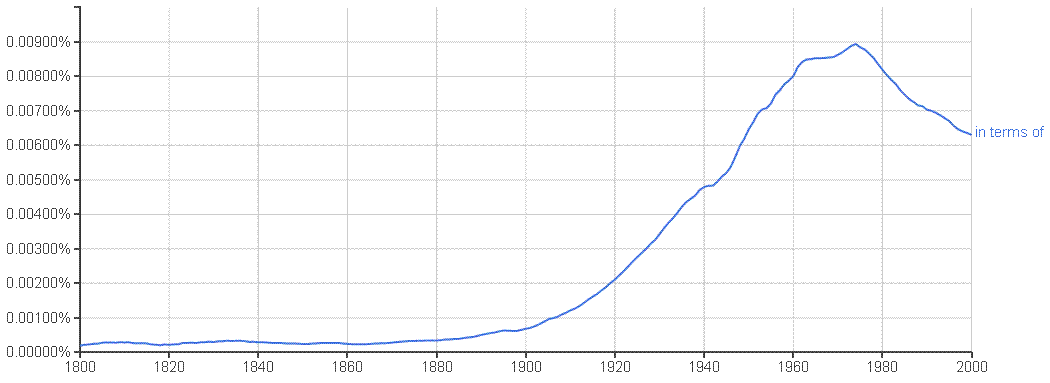
So near — and yet so far. Still, “In terms of narrative tropes” is pretty darn good, worthy of the Great Gary himself. And it prompted me to interrogate issues around one of the core linguistic enigmas of our day. Here are two graphs from Google nGrams:

In terms of (UK English)

In terms of (US English)


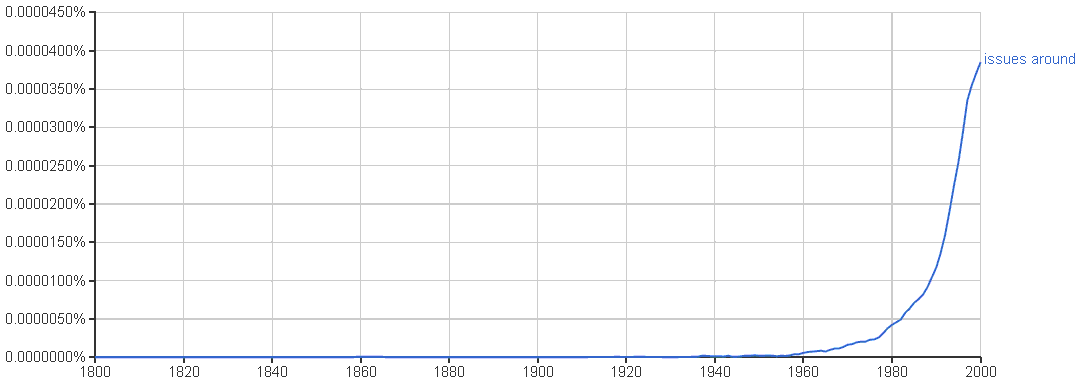
What on earth is going on? Why have ITO usage metrics continued to rise in British English while peaking and falling in American English? This hasn’t happened with other core items of progressive English, like “issues around”:

Issues around (UK English)

Issues around (US English)


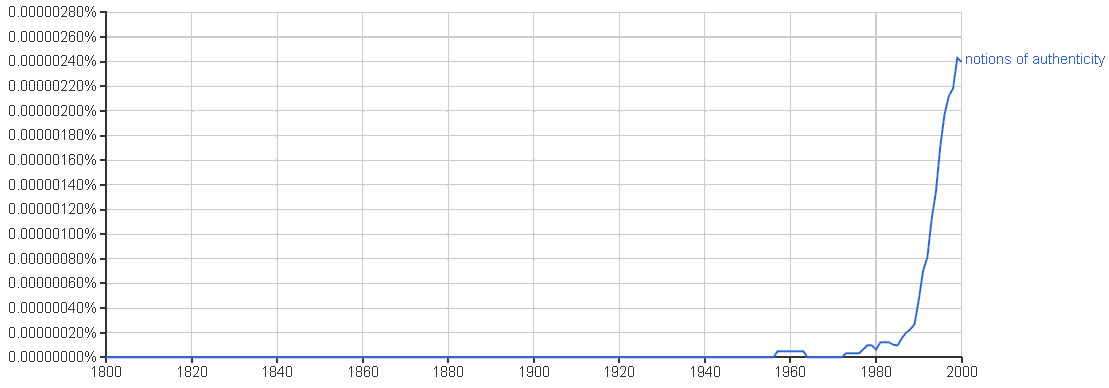
And “notions of authenticity”:

Notions of authenticity (UK English)

Notions of authenticity (US English)


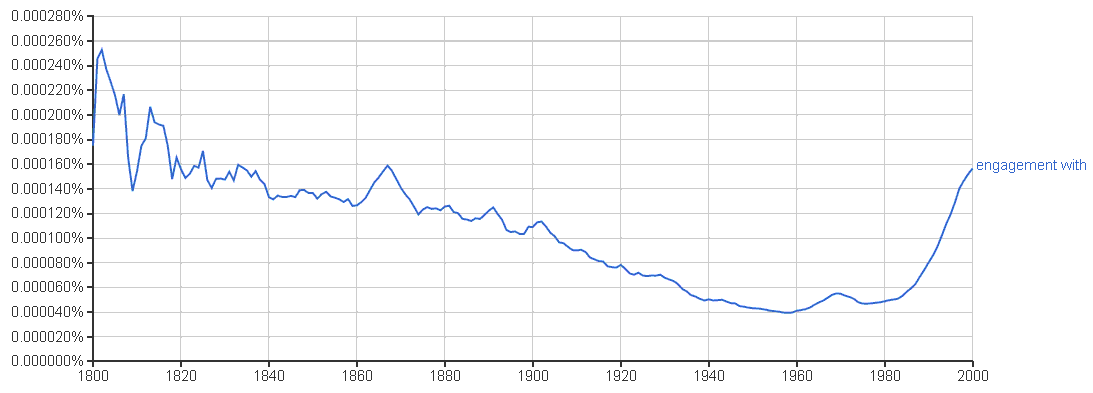
And “engagement with” (in its progressive sense):

Engagement with (UK English)

Engagement with (US English)


If those keyly core items of Progressivese are “spiking” so healthily on both sides of the Atlantic, why is the even keylier corer “in terms of” not doing so? At least, I would say ITO is keylier corer, but does the ITO fall in America suggest that it isn’t?

Maybe not. One possibility is that “in terms of” has been depreciated in an influential (and anti-progressive) American manual of style that hasn’t been influential in the UK. However, American speakers have failed to see that the same grounds for rejection apply to “issues around” and so on.

But it’s hard to see why American progressives would take any notice of sensible advice about rejecting ITO. It’s also hard to see why the American drop in “in terms of” shouldn’t have influenced the UK even if this hypothetical style-manual (or arbiter) isn’t influential in the UK.

Something mysterious is going on and more research is plainly needed.


Post-Performative Post-Scriptum

Termed Out Nice Again — the mystery is solved…


Previously pre-posted:

Septics vs Dirties
Get Your Tox Off
Guardianistas — all posts referencizing this core progressive demographic and their glossocentric performativity

Performativizing Papyrocentricity #53

Papyrocentric Performativity Presents:

Pocket to LaroussiaLarousse de Poche (Librarie Larousse 1954)

Translated to HeavenLes Hommes Volants, Valerie Moolman, trans. Madeleine Astorkia (Time-Life Books 1981)

The Eyes of the Infinite MindFicciones, Jorge Luis Borges

Caught by the FurzeFrancis Walker’s Aphids, John P. Doncaster (British Museum 1961)

Commit to CrunchMaverick Munch: Selecting a Sinisterly Savory Snack to Reinforce Your Rhizomatically Radical Reading, Will Self (TransVisceral Books 2016)


Or Read a Review at Random: RaRaR

Are U Worthy?

If you’re nagged by doubts as to whether you really are a keyly committed core component of the counter-cultural community, then simply engage issues around the following issues…

1. In terms of “in terms of”, how often do you hear this phantasmagoric phrase in terms of a daily basis?

2. Please hierarchialize the following core components of the counter-cultural icon community in terms of their “in-terms-of”-usage metrics: Will Self, J.G. Ballard, William Burroughs, Alan Moore, Miriam Stimbers, Michael Moorcock, Kathy Acker, Genesis P. Orridge, Alan Ginsberg, Stewart Home, Hubert Selby Jr., Norman Foreman (B.A.). (I.e., if you think Foreman uses “in terms of” most in terms of usage metrics, put him first; if you think Acker uses it second-most, put her second; etc.)

3. Engage issues around 1 and 2 again, replacing “in terms of” with “prior to”…

4. Engage issues around 1 and 2 again, replacing “in terms of” with “issues around”……

5. Engage issues around 1 and 2 again, replacing “in terms of” with “Vote Corbyn”………

Once you’ve engaged issues around the above issues, email your answers to Evaluator!@NakedKrunch and you should have your doubts laid to rest within 23 working days…


Previously pre-posted on Overlord of the Über-Feral…

Les Sez
Don’t Do Dot…
Terminator!
Metricizing Michael…
Terminal Breach
More Termination…

Sphere Hear

οὐσίαν θεοῦ σφαιροειδῆ, μηδὲν ὅμοιον ἔχουσαν ἀνθρώπωι· ὅλον δὲ ὁρᾶν καὶ ὅλον ἀκούειν, μὴ μέντοι ἀναπνεῖν· σύμπαντά τε εἶναι νοῦν καὶ φρόνησιν καὶ ἀίδιον. — Διογένης Λαέρτιος, Βίοι καὶ γνῶμαι τῶν ἐν φιλοσοφίᾳ εὐδοκιμησάντων

    “The substance of God is spherical, in no way resembling man. He is all eye and all ear, but does not breathe; he is the totality of mind and thought, and is eternal.” — Xenophanes’ concept of God in Diogenes Laërtius’ Lives of Eminent Philosophers (c. 280-320 AD), Book IX, chapter 2 (translated by R.D. Hicks, 1925)

He Say, He Sigh, He Sow #42

« Il n’y avait plus dans la rue que les boutiquiers et les chats. » — Albert Camus, L’Étranger (1942).

    “There was no longer anything in the street but shopkeepers and cats.” — Camus, The Outsider.

He Say, He Sigh, He Sow #41

κατ’ ἐπακολούθημα δὲ καὶ περὶ τῆς ἐγκυκλίου καλουμένης παιδείας, εἰς ὅσα εὔχρηστος, περί τε ἀστρολογικῆς καὶ μαθηματικῆς καὶ μαγικῆς γοητείας τε ἐπιδραμητέον. αὐχοῦσι γὰρ δὴ καὶ ἐπὶ ταῖσδε οἱ Πανέλληνες ὡς μεγίσταις ἐπιστήμαις. — Κλήμης ὁ Ἀλεξανδρεύς, Στρώματα.

   “By consequence, also we must treat of what is called the curriculum of study — how far it is serviceable; and of astrology, and mathematics, and magic, and sorcery. For all the Greeks boast of these as the highest sciences.” — Clement of Alexandria, The Stromata, Book II.