Performativizing Papyrocentricity #53

Papyrocentric Performativity Presents:

Pocket to LaroussiaLarousse de Poche (Librarie Larousse 1954)

Translated to HeavenLes Hommes Volants, Valerie Moolman, trans. Madeleine Astorkia (Time-Life Books 1981)

The Eyes of the Infinite MindFicciones, Jorge Luis Borges

Caught by the FurzeFrancis Walker’s Aphids, John P. Doncaster (British Museum 1961)

Commit to CrunchMaverick Munch: Selecting a Sinisterly Savory Snack to Reinforce Your Rhizomatically Radical Reading, Will Self (TransVisceral Books 2016)


Or Read a Review at Random: RaRaR

Are U Worthy?

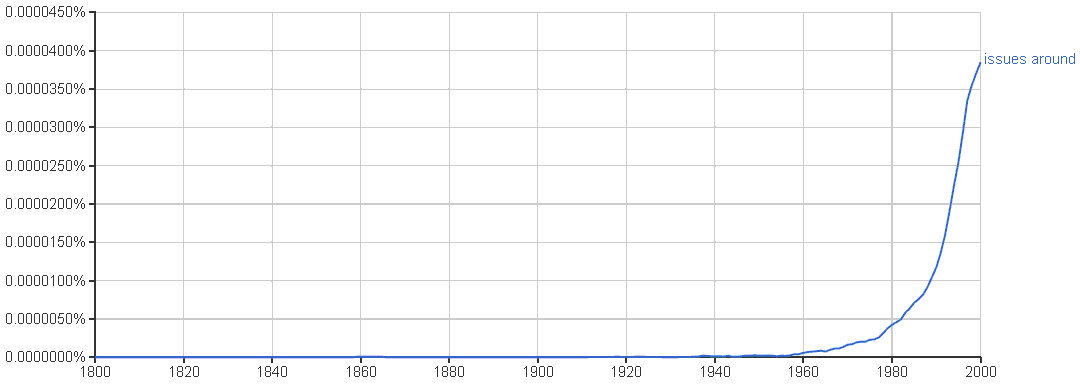
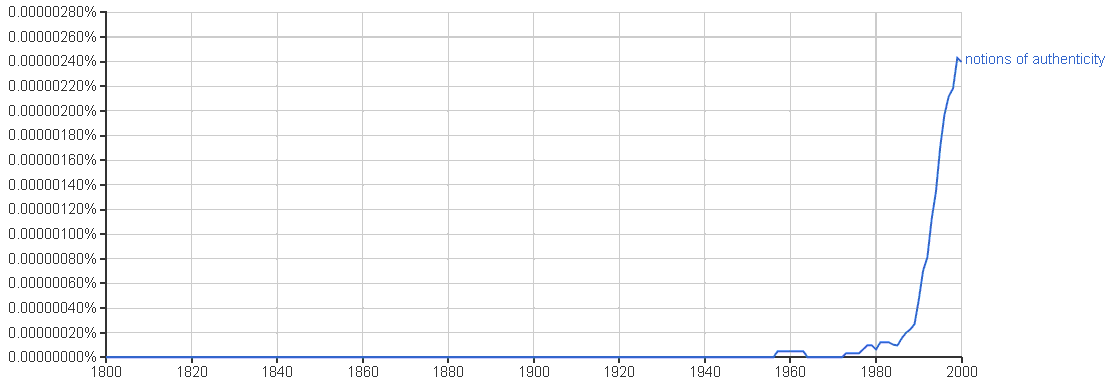
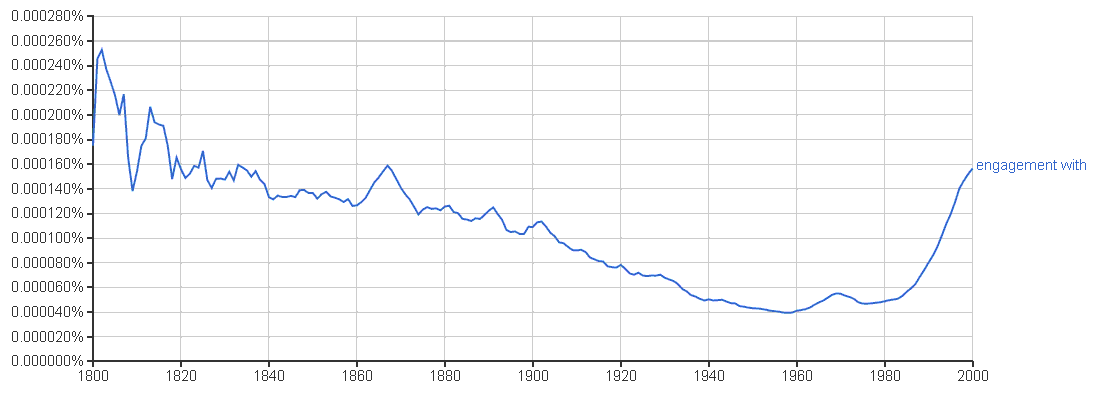
If you’re nagged by doubts as to whether you really are a keyly committed core component of the counter-cultural community, then simply engage issues around the following issues…

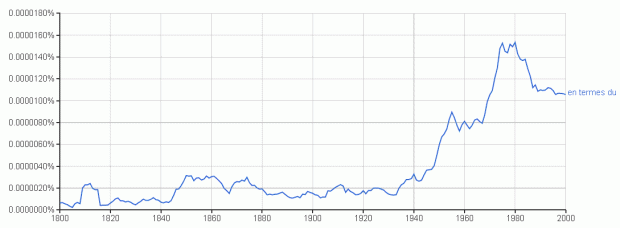
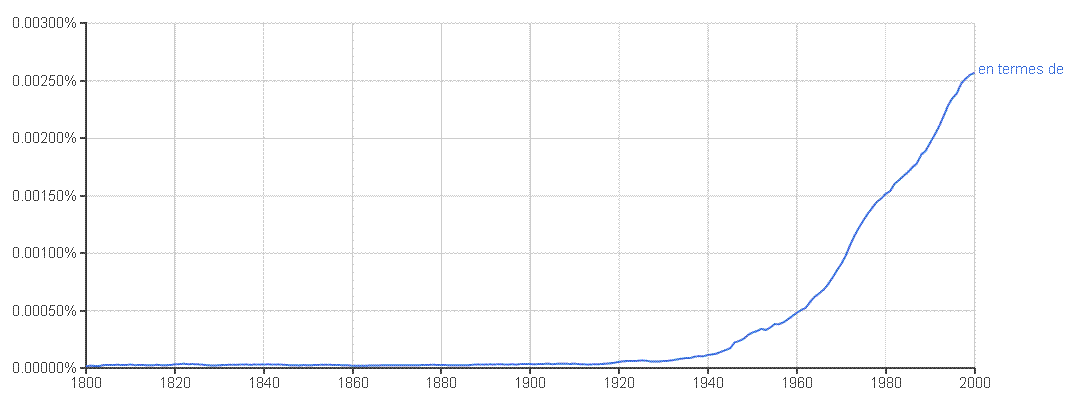
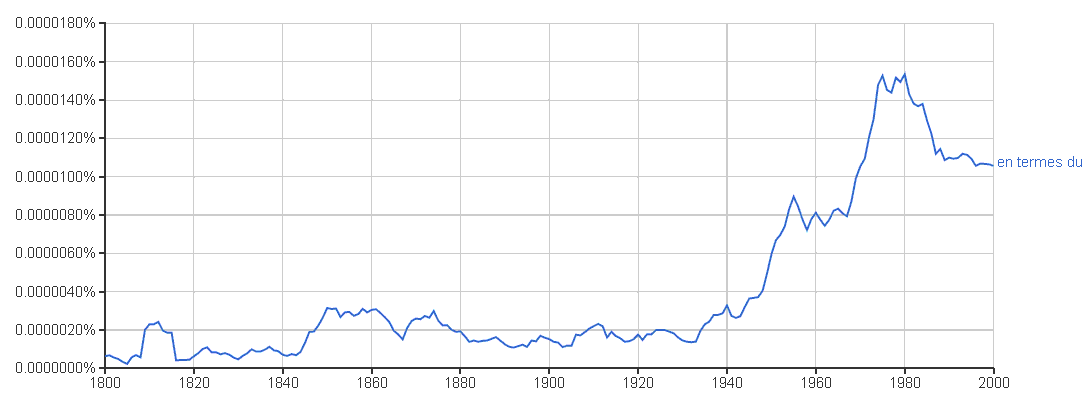
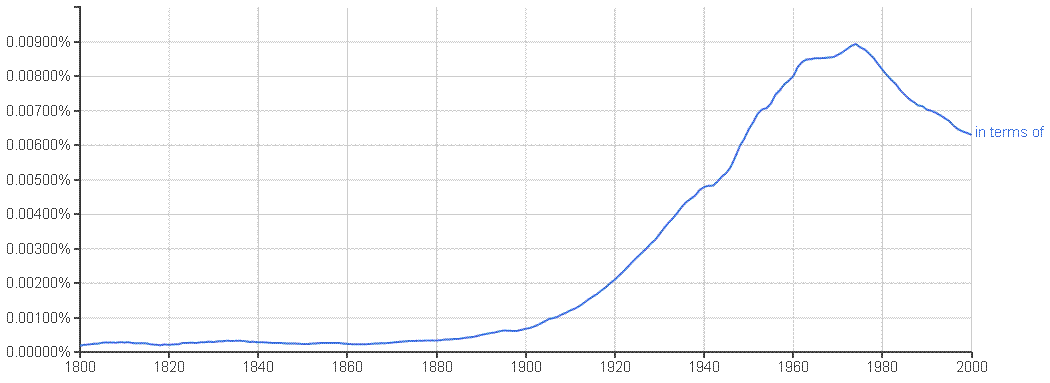
1. In terms of “in terms of”, how often do you hear this phantasmagoric phrase in terms of a daily basis?

2. Please hierarchialize the following core components of the counter-cultural icon community in terms of their “in-terms-of”-usage metrics: Will Self, J.G. Ballard, William Burroughs, Alan Moore, Miriam Stimbers, Michael Moorcock, Kathy Acker, Genesis P. Orridge, Alan Ginsberg, Stewart Home, Hubert Selby Jr., Norman Foreman (B.A.). (I.e., if you think Foreman uses “in terms of” most in terms of usage metrics, put him first; if you think Acker uses it second-most, put her second; etc.)

3. Engage issues around 1 and 2 again, replacing “in terms of” with “prior to”…

4. Engage issues around 1 and 2 again, replacing “in terms of” with “issues around”……

5. Engage issues around 1 and 2 again, replacing “in terms of” with “Vote Corbyn”………

Once you’ve engaged issues around the above issues, email your answers to Evaluator!@NakedKrunch and you should have your doubts laid to rest within 23 working days…


Previously pre-posted on Overlord of the Über-Feral…

Les Sez
Don’t Do Dot…
Terminator!
Metricizing Michael…
Terminal Breach
More Termination…

Sphere Hear

οὐσίαν θεοῦ σφαιροειδῆ, μηδὲν ὅμοιον ἔχουσαν ἀνθρώπωι· ὅλον δὲ ὁρᾶν καὶ ὅλον ἀκούειν, μὴ μέντοι ἀναπνεῖν· σύμπαντά τε εἶναι νοῦν καὶ φρόνησιν καὶ ἀίδιον. — Διογένης Λαέρτιος, Βίοι καὶ γνῶμαι τῶν ἐν φιλοσοφίᾳ εὐδοκιμησάντων

    “The substance of God is spherical, in no way resembling man. He is all eye and all ear, but does not breathe; he is the totality of mind and thought, and is eternal.” — Xenophanes’ concept of God in Diogenes Laërtius’ Lives of Eminent Philosophers (c. 280-320 AD), Book IX, chapter 2 (translated by R.D. Hicks, 1925)

He Say, He Sigh, He Sow #42

« Il n’y avait plus dans la rue que les boutiquiers et les chats. » — Albert Camus, L’Étranger (1942).

    “There was no longer anything in the street but shopkeepers and cats.” — Camus, The Outsider.

He Say, He Sigh, He Sow #41

κατ’ ἐπακολούθημα δὲ καὶ περὶ τῆς ἐγκυκλίου καλουμένης παιδείας, εἰς ὅσα εὔχρηστος, περί τε ἀστρολογικῆς καὶ μαθηματικῆς καὶ μαγικῆς γοητείας τε ἐπιδραμητέον. αὐχοῦσι γὰρ δὴ καὶ ἐπὶ ταῖσδε οἱ Πανέλληνες ὡς μεγίσταις ἐπιστήμαις. — Κλήμης ὁ Ἀλεξανδρεύς, Στρώματα.

   “By consequence, also we must treat of what is called the curriculum of study — how far it is serviceable; and of astrology, and mathematics, and magic, and sorcery. For all the Greeks boast of these as the highest sciences.” — Clement of Alexandria, The Stromata, Book II.

He Say, He Sigh, He Sow #39

— Croyez-vous aux idées dangereuses ?
— Qu’entendez-vous par là ?
— Croyez-vous que certaines idées soient aussi dangereuses pour certains esprits que le poison pour le corps ?
— Mais, oui, peut-être.

  Guy de Maupassant, « Divorce » (1888)


“Do you believe in dangerous ideas?”
“What do you mean by that?”
“Do you believe that certain ideas are as dangerous for some minds as poison is for the body?”
“Well, yes, perhaps.”

Oh My Guardian #2

“Instead, Mr Comey has rocket-fuelled a venomous contest just when Mr Trump was desperate for a lifeline…” — The Guardian view on the FBI’s Clinton probe: exactly the wrong thing to do


Previously pre-posted…

Oh My Guardian #1
Reds under the Thread

Which Switch

Why didn’t George Orwell sort his relatives out? I don’t mean his family: I mean his pronouns. In The King’s English (1906), the Fowler brothers say this:

The few limitations on ‘that’ and ‘who’ about which every one is agreed all point to ‘that’ as the defining relative, ‘who’ or ‘which’ as the non-defining.

Here are some examples:

• The cat that sat on the mat ate a rat. (Defining)
• The cat, which is three, never sits on mats. (Non-defining)
• The cat that you see on the mat eats rats. (D)
• The cat, which you saw yesterday on a mat, eats rats. (N-D)
(The third example can also be written without an explicit relative: “The cat you see on the mat eats rats.”)


But Orwell doesn’t follow these simple rules consistently in Nineteen Eighty-Four (1949). In the opening chapter of the book, you can find many defining relatives using “which”:

• …one of those pictures which are so contrived that the eyes follow you about when you move
• …a list of figures which had something to do with the production of pig-iron
• …an oblong metal plaque like a dulled mirror which formed part of the surface of the right-hand wall
• …the blue overalls which were the uniform of the party

But you can also find defining relatives using “that”:

• …his skin roughened by coarse soap and blunt razor blades and the cold of the winter that had just ended
• …there seemed to be no colour in anything, except the posters that were plastered everywhere
• You had to live – did live, from habit that became instinct – in the assumption that every sound you made was overheard (note implicit relative after “sound”)

Here Orwell uses “that” and “which” as defining relatives in the same sentence:

• Any sound that Winston made, above the level of a very low whisper, would be picked up by it, moreover, so long as he remained within the field of vision which the metal plaque commanded, he could be seen as well as heard.

I can’t see any clear reason for the alternation, but it would be interesting to analyse the sentences more carefully and see if it’s possible to discover what conditions his use now of “which”, now of “that”. When I looked at the same phenomenon in the work of Evelyn Waugh, I found that “that” seemed to occur more often when the noun was governed by a preposition. That may also apply to Orwell.

Now let’s move from a particular writer to something more general. It’s possible to use a modification of the rules given above. If the noun and its defining relative are separated by several other words, I sometimes prefer “which” to “that”. Here’s an example from Orwell:

• He had a trick of resettling his spectacles on his nose which was curiously disarming…

The noun is “trick”, not “his nose”, so “which” doesn’t seem so bad to me, because it helps to disassociate the relative from the nouns that separate it from its antecedent. In its non-defining form “which” has what might be called a disjunctive role, and the disjunctive association is still there when it’s used as a defining relative. That’s why “which” doesn’t seem right as a defining relative when its antecedent stands directly before it.

But the possessive of “his nose” also helps to dissociate the relative, so I would also be happy to use “that” in this particular case. In the other examples, “that” is the clear winner (except perhaps in “an oblong metal plaque like a dulled mirror which formed part…”).

Do many foreign learners of English feel the same way about “that”? I doubt it. It must often be difficult to separate the three meanings of “that”: the demonstrative pronoun, the defining relative, and the coordinator. Not many foreign speakers of English would understand this sentence easily:

• It’s confusing that that “that” that’s a relative pronoun is written in exactly the same way as that “that” that’s not.

If English had a governing academy, we might spell the three thats differently: that, thæt and thatt, for example. And if I had my way, we wouldn’t use a digraph for the dentals. That is, the opening sentence of Nineteen Eighty-Four would look like this:

• It was a bright cold day in April, and ðe clocks were striking Þirteen.

Performativizing Papyrocentricity #50

Papyrocentric Performativity Presents:

Life LocomotesRestless Creatures: The Story of Life in Ten Movements, Matt Wilkinson (Icon 2016)

Heart of the MotherJourney to the Centre of the Earth: A Scientific Exploration into the Heart of Our Planet, David Whitehouse (Weidenfeld & Nicolson 2015)

LepidopterobibliophiliaBritish Butterflies: A History in Books, David Dunbar (The British Library 2012)

Minimal Manual – Georgisch Wörterbuch, Michael Jelden (Buske 2016)


Or Read a Review at Random: RaRaR

Terminal Breach

It’s said that, if you hear “in terms of” 23 times in 23 hours on the 23rd of the month, the ghost of William Burroughs will appear and offer you a heroin enema.

I don’t know whether this is true.


Elsewhere other-engageable:

William S. Burroughs
Alan Moore, C.B.E.
Michael Moorcock
Will Self
Stewart Home
Cormac McCarthy
Dr Joan Jay Jefferson
Serpent’s Tail
Titans of Trangression