Who sees with equal eye, as God of all,
A hero perish, or a sparrow fall,
Atoms or systems into ruin hurl’d,
And now a bubble burst, and now a world.
• An Essay on Man (1734), Alexander Pope

Who sees with equal eye, as God of all,
A hero perish, or a sparrow fall,
Atoms or systems into ruin hurl’d,
And now a bubble burst, and now a world.
• An Essay on Man (1734), Alexander Pope
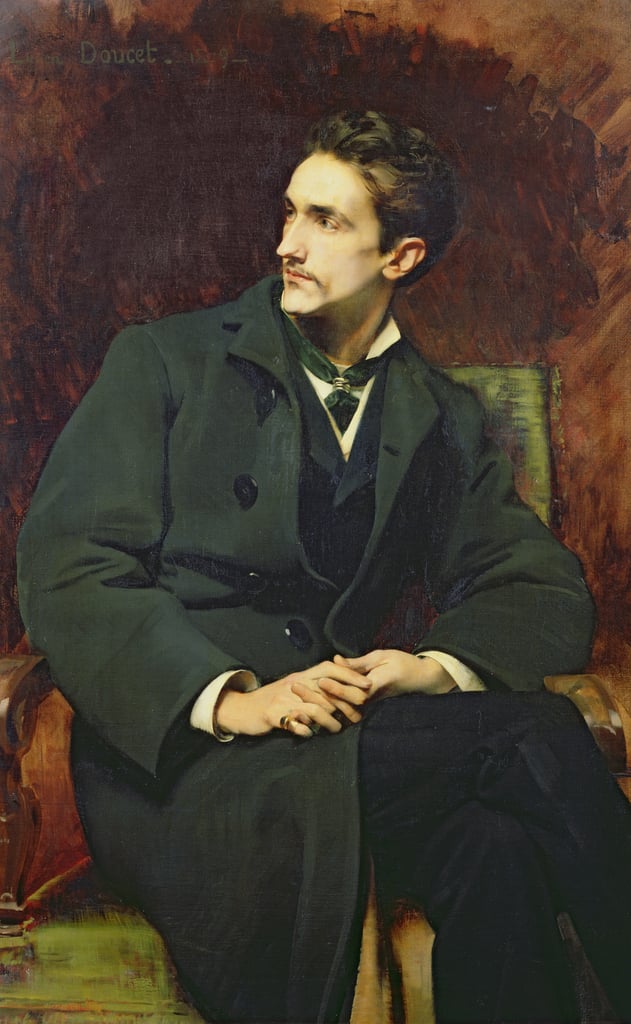
Comte Robert de Montesquiou-Fézensac, Henri Lucien Doucet (1879)
Passionately Pre-Posted…
• Portrait of a Peacock — Cornelia Otis Skinner’s biographical sketch of Montesquiou
• Le Paon dans les Pyrénées — review of Julian Barnes’ The Man in the Red Coat (2019)
Elsewhere Other-Accessible…
• The hands of Robert de Montesquiou at Strange Flowers
“In a very real sense, the Holocaust, as the ultimate moral and aesthetic obscenity, was also the ultimate drum-solo.” — Simon Whitechapel, 31i18
ვარდები
მე, ზამთრისაგან ჯაჭვაწყვეტილი,
ნაცნობ ბაღისკენ მივემართები,
სად ფერად უცხო, ყნოსვად კეთილი,
ზამთარ და ზაფხულ ჰყვავის ვარდები.
Roses
Unchained from winter,
I walk to a long-known garden,
Where, sweet-scented and bright,
Roses grow winter and summer through.
• ვარდები, გალაკტიონ ტაბიძე
• “Roses”, Galaktion Tabidze — a translation into English
“U2 are a band who believe in meetings, so everything has a meeting. With Depeche, it’s an exception to have a meeting at all. When I did visuals for The Joshua Tree 30th anniversary tour, I also filmed the show in Mexico City. After the concert, U2 all came to look at the footage. At midnight! For two hours! I mean, Depeche – you couldn’t get them to watch a minute. It’s an incredible difference in attitude. But that’s also the charm of Depeche. They don’t do many interviews, there’s no big plans, they just make a record and tour.”
• ‘They had soul’: Anton Corbijn on 40 years shooting Depeche Mode, The Intermzinator, 1vi21
Post-Performative Post-Scriptum
The peri-parapractic paronomasia in the title of this post corely references key Kulturkampf “Mods vs Rockers” in terms of 1960s Britain.
Papyrocentric Performativity Presents…
• Clive Drive – Unreliable Memoirs (1980) and Always Unreliable: The Memoirs (2001), Clive James
• Nou’s Who – Art Nouveau, Camilla de la Bedoyere (Flame Tree Publishing 2005)
• Hit and Mistletoe – Through It All I’ve Always Laughed, Count Arthur Strong (Faber & Faber 2013)
• Beauties and Beasts — Shardik, Richard Adams (1974)
Or Read a Review at Random: RaRaR
From the depths of the crypt at St Giles
Came a scream that resounded for miles…
Said the vicar: “Good gracious!
Has Father Ignatius
Forgotten the Bishop has piles?”
(Anonymous)
Elsewhere other-accessible…
• Doc Proc — a review of Dr Miriam B. Stimbers’ Botty: An Unnatural History of the Backside (2014)
«Il mare è la civiltà», disse [Franco Scoglio] una volta, «il sentimento, la passione, le tempeste, ma l’amore, gli sbarchi, le partenze, il mare è tutto. La follia va di pari passo con il mare». — Ultrà. Il volto nascosto delle tifoserie di calcio in Italia, Tobias Jones (2020)
• “The sea is civilization,” [Franco Scoglio] said once, “sentiment, passion, storms, love, landings, leavings, the sea is everything… madness walks with the sea.” — Ultra: The Underworld of Italian Football, Tobias Jones (2019)
Post-Performative Post-Scriptum
I’m not sure if the Italian is the original Italian or an Italian translation of Jones’s English translation of the original Italian. But it seems to be the former.
Elsewhere other-accessible…
• Franco Scoglio en italiano
• Franco Scoglio in English
“Libs of TikTok is shaping our entire political conversation about the rights of LGBTQ people to participate in society,” [Ari] Drennen said. “It feels like they’re single-handedly taking us back a decade in terms of the public discourse around LGBTQ rights. It’s been like nothing we’ve ever really seen.” — “Meet the woman behind Libs of TikTok, secretly fueling the right’s outrage machine”, The Washington Post, 19iv22.
Elsewhere other-accessible
• Ex-Term-In-Ate! — interrogating issues around “in terms of”…
• All posts interrogating issues around “in terms of”…
“The Garden of Prosperpine”
By Algernon Charles Swinburne
Here, where the world is quiet;
Here, where all trouble seems
Dead winds’ and spent waves’ riot
In doubtful dreams of dreams;
I watch the green field growing
For reaping folk and sowing,
For harvest-time and mowing,
A sleepy world of streams.
I am tired of tears and laughter,
And men that laugh and weep;
Of what may come hereafter
For men that sow to reap:
I am weary of days and hours,
Blown buds of barren flowers,
Desires and dreams and powers
And everything but sleep.
Here life has death for neighbour,
And far from eye or ear
Wan waves and wet winds labour,
Weak ships and spirits steer;
They drive adrift, and whither
They wot not who make thither;
But no such winds blow hither,
And no such things grow here.
No growth of moor or coppice,
No heather-flower or vine,
But bloomless buds of poppies,
Green grapes of Proserpine,
Pale beds of blowing rushes
Where no leaf blooms or blushes
Save this whereout she crushes
For dead men deadly wine.
Pale, without name or number,
In fruitless fields of corn,
They bow themselves and slumber
All night till light is born;
And like a soul belated,
In hell and heaven unmated,
By cloud and mist abated
Comes out of darkness morn.
Though one were strong as seven,
He too with death shall dwell,
Nor wake with wings in heaven,
Nor weep for pains in hell;
Though one were fair as roses,
His beauty clouds and closes;
And well though love reposes,
In the end it is not well.
Pale, beyond porch and portal,
Crowned with calm leaves, she stands
Who gathers all things mortal
With cold immortal hands;
Her languid lips are sweeter
Than love’s who fears to greet her
To men that mix and meet her
From many times and lands.
She waits for each and other,
She waits for all men born;
Forgets the earth her mother,
The life of fruits and corn;
And spring and seed and swallow
Take wing for her and follow
Where summer song rings hollow
And flowers are put to scorn.
There go the loves that wither,
The old loves with wearier wings;
And all dead years draw thither,
And all disastrous things;
Dead dreams of days forsaken,
Blind buds that snows have shaken,
Wild leaves that winds have taken,
Red strays of ruined springs.
We are not sure of sorrow,
And joy was never sure;
To-day will die to-morrow;
Time stoops to no man’s lure;
And love, grown faint and fretful,
With lips but half regretful
Sighs, and with eyes forgetful
Weeps that no loves endure.
From too much love of living,
From hope and fear set free,
We thank with brief thanksgiving
Whatever gods may be
That no life lives for ever;
That dead men rise up never;
That even the weariest river
Winds somewhere safe to sea.
Then star nor sun shall waken,
Nor any change of light:
Nor sound of waters shaken,
Nor any sound or sight:
Nor wintry leaves nor vernal,
Nor days nor things diurnal;
Only the sleep eternal
In an eternal night.
 Overlord In Terms of Core Issues Around Maximal Engagement with Key Notions of the Über-Feral