
“When you run and jump on rocks, your entire brain and body are at work; you stretch your back better than with yoga; every muscle in your body is involved; no two movements will be identical (unlike running in gyms); you become yourself.” — Nassim Taleb, Opacity: A Philosophical Notebook.
Category Archives: Science
He Say, He Sigh, He Sow #27
Cry’ Me A Shiver
It’s not true that Cryogénie are best experienced live. That would imply their music can be experienced some other way. It can’t. The live experience is the only experience. And it’s guaranteed unique. These French avant-gardists aren’t the only band to hand out earplugs on the door, but they don’t do it for the conventional reason: that they play so loud.
In fact, they don’t play loud. They don’t play soft either. In the conventional sense, they don’t play at all. Here’s an interview from 2008 with Tïurbeau magazine:
Tïurbeau: I’ve got your latest album in front of me now. Words fail me.
Alexandre: And us too.
François: As usual.
Tïurbeau: Then one has to ask: why do you bother to release albums?
Alexandre: We see it, you could say, as a little ritual, something solid, something material––
François: Something permanent.
Alexandre: Yes, something permanent, to mark the occasion, that will remain with our audience. Often, we hear, they will buy an album after they have attended a concert, as a souvenir, almost. And they will truly play it!
Tïurbeau: They will play thirty-seven minutes of silence?

Cryogénie, Nix Sonica (2008)*
François: Yes. The silence creates a space, a kind of opening in the present, for memories of the concert.
Alexandre: Yes, for memories, exactly so. Although, of course, in one sense we have pride in the irreproducibility of our music, in another sense we are recording every moment we are on stage. On the brain.
François: On the brains of the audience.
Alexandre: We are recording memories.
Tïurbeau: And the albums are designed to trigger the memories?
Alexandre: Trigger?
Tïurbeau: Bring the memories back.
Alexandre: Ah, yes, exactly so. The albums are a focus for memories of a concert.
François: Almost talismans.
Tïurbeau: In a magical sense?
Alexandre: Yes, why not? For us, experience is the ultimate magic. In the moment, but also in memory.
Tïurbeau: And does this relate to the sensory restrictions of your concerts, the way you try to turn down some senses in order to heighten the sense you are seeking to stimulate?
François: Yes, exactly so. Earplugs.
Alexandre: No aftershave, no perfume.
François: And please shower carefully before you attend.
Alexandre: Yes, shower carefully. And we ourselves, we will take care of the light. Remove it, make the scene very dark. You are not at a Cryogénie concert for pleasing your ears, your nose, eyes, mouth. Non, vous êtes là pour la chair!
François: Oui, pour la chair.
Tïurbeau: For the flesh.
Alexandre: Yes, the flesh. And how do we stimulate the flesh when we may not use another mode, not exploit another sense? No vibration, no infra-bass even. Then what?
François: Yes, this was the question we faced in our formative days.
Tïurbeau: And the answer…

Cryogénie, Rois du Froid (1996)**
Alexandre: The cold!
François: Cold.
Alexandre: Please remember a question in the Gay Science of Nietzsche: Ist es nicht kälter geworden?
François: “Has it not become colder?”
Alexandre: And we want, if you attend a Cryogénie concert, for you to say: Ja! Oui! Yes! Kälter, kälter! Plus froid, plus froid! Colder, colder!
Tïurbeau: The triumph of the chill?
François: Yes. Triumph of the chill!
Alexandre: I don’t understand.
François: [Explains briefly in French]
Alexandre: Ah, yes, a triumph.
Tïurbeau: And with the concept came the name?
Alexandre: Yes, and so we had our name also. Cryogénie. With several meanings. Cryogénie is “creation of cold”, but also, for us, “genius of cold”, “spirit of cold”. Remember the concept of ritual. Our concerts, you might say, are rituals of cold, invocations of cold.
François: And: “If it’s too cold, you’re too old!”
Alexandre: Yes, so it’s said. Of course, in truth we welcome all ages, but if you are in poor health, perhaps better not to attend.
François: Nevertheless, visits to the pharmacy surely increase after we have passed through a city.
Tïurbeau: How cold do you go?
Alexandre: Ah, we prefer not to speak of that. No numbers, no statistics. You are there for the music, not to watch le thermomètre.
François: We get cold enough for our purposes.
Tïurbeau: That sounds rather sinister!
François: Yes, perhaps so. But would that not be the ultimate experience, to die pour une grêlodie, for a grêlodie?
Tïurbeau: Grêlodie?
Alexandre: It’s a joke, un calembour, a mixing of words.
François: A pun. In French, grêle is “hail”, you know, the little balls of ice, and mélodie is “melody”, of course, and so you have grêlodie, for a tune as performed by Cryogénie, a tune of ice, a tune of cold.
Tïurbeau: But not literal hail?
Alexandre: No, not literal. Though sometimes the breath of our audience will freeze and fall as a kind of snow. It makes a sound, that, a very delicate sound, le chuchotement des étoiles, comme on dit en Sibérie.
François: Yes, the whisper of the stars, as they say in Siberia. But of course, no-one will hear it, if they have followed their instructions.
Alexandre: Earplugs in!

Cryogénie, Blanchette (2003)***
François: But the snow, the breath-snow, can be felt on the skin as it falls. This is acceptable, though it is an indirect effect of our music, not something we have planned for.
Tïurbeau: I have felt it. In the middle section of “Frissonique”, particularly.
Alexandre: Yes, and in “Bruitmal”.
François: When the framplifiers are cooking, as you might say.
Tïurbeau: Framplifiers? Can you explain for the benefit of our readers?
François: It is from froid and amplificateur. Framplicateur, framplifier. Amplifiers of cold, or generators of cold.
Tïurbeau: That is one of the most widely discussed aspects of your music, isn’t it? Your equipment.
Alexandre: Yes.
François: Yes, certainly.
Tïurbeau: But you’re rather secretive about it, aren’t you?
Alexandre: Yes!
François: You discuss, we are sphinxes.
Tïurbeau: Silent?
François: Yes. We have our – what is the term? – our trade-secrets. It’s not in our interests to expose our techniques. Nor in yours, we think.
Tïurbeau: You want to preserve that air of mystery?
Alexandre: Yes, precisely so. The experience is more strong when you don’t understand.
François: Like magic.
Alexandre: Yes, magic. We perform a ritual. The invocation of the cold. We invoke the cold and we throw the cold, we throw it on the audience.
François: Waves of cold. Cryorrhythms. Chords of cold, congelations, grêlodies, chills, thrills, rivers of shivers. That is the Cryogénie experience.
Tïurbeau: But there’s some serious technology behind the experience, isn’t there?
Alexandre: Yes.
François: Yes.
Tïurbeau: And you’re saying no more?
Alexandre: Yes, no more.
François: It’s not in our interests to explain. Or yours.
Tïurbeau: Nothing?
Alexandre: Nothing.
Tïurbeau: Not even a little?
François: Well, maybe a little. We had problems, in the early days, with unwanted noise, from the equipment.
Alexandre: Just a little.
François: I mean, if you think of a refrigerator, there is noise, of course. And we didn’t want noise, we wanted silence, pure silence.
Tïurbeau: A blank canvas, sensorily speaking?
François: Yes, a blank canvas, for us to paint with cold. So there was that problem to solve. The noise, unwanted noise.
Tïurbeau: And you solved it?
François: Yes, I think we did.
Alexandre: I think so.
Tïurbeau: But the earplugs are still necessary?
Alexandre: Yes, necessary, we think. Because, of course, with silent equipment there is still the movement of people, our movement on the stage, movement of the audience.
François: And the whisper of the stars, with some other effects. There are many things to create noise at a concert. We cannot eliminate them all, or we choose not to, because the earplugs are in themselves symbolic. To use them, you say: “See? I choose to close this door, this sensory mode.”
Alexandre: And you give yourself to us, to Cryogénie, to exploit another sense.
François: To submit you to our chill.
Tïurbeau: Esclaves du froid?
François: Yes, very good. Slaves of cold! But equally we are the slaves.
Alexandre: Yes, esclaves du froid. I like it. Perhaps we will write a song of that title one day.
Elsewhere Other-Engageable:
• Rois du Froid — Cryogénie’s official site
*Sonic Snow.
**Kings of Cold.
***Little White One.
He Say, He Sigh, He Sow #26
“What he said often had double and even triple meanings so that, while the rest of us speak and think in single notes, he thought in chords.” — Robert Trivers on W.D. Hamilton, Vignettes of Famous Evolutionary Biologists, Large and Small, Unz Review, 27/iv/2015.
Performativizing Papyrocentricity #37
Papyrocentric Performativity Presents:
• Maths and Marmosets – The Great Mathematical Problems: Marvels and Mysteries of Mathematics, Ian Stewart (Profile Books 2013)
• Be Ear Now – Sonic Wonderland: A Scientific Odyssey of Sound, Trevor Cox (Vintage 2015)
• Exquisite Bulgarity – The Future of Architecture in 100 Buildings, Mark Kushner (Simon & Schuster 2015)
• Stellar Story – Discovering the Universe: The Story of Astronomy, Paul Murdin (Andre Deutsch 2014)
• Terms of Endrearment – She Literally Exploded: The Daily Telegraph Infuriating Phrasebook, Christopher Howse and Richard Preston (Constable 2007)
Or Read a Review at Random: RaRaR
Heads and Tells
I have a natural history book that has a photograph of a mole as it emerges from a patch of bare soil, digging itself up with its forepaws. But the photograph has been posed: the mole’s obviously dead. Its colour is wrong and you can see that there’s no tension in its body.
But the photograph might fool a hasty glance. The difference between tense life and flaccid death is small and there’s no clue in the mole’s eyes, because you can’t see them. It’s a mole, after all. In this photo, on the other hand, you can’t miss the eyes:
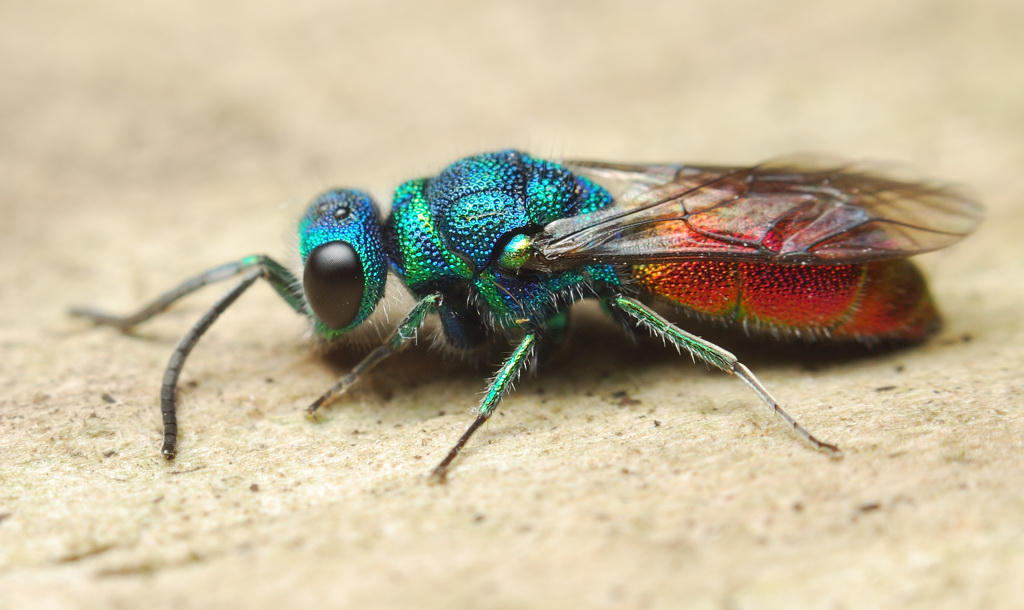
Chrysis ignita, Ruby-tailed wasp
But an insect’s eyes don’t generally change when it dies, so the wasp’s eyes don’t refute or confirm a suspicion I have about the photo: that it’s also posed with a dead subject. I’m much less certain than I am about the mole, but then a dead insect is harder to read than a dead mammal. Insects have chitinous exoskeletons, not skin or fur over muscles, so their bodies don’t obviously lose tonus when they’re dead.
But something about the posture of the wasp looks wrong to me. So do its antennae: trailing on the ground, not held up. I’m far less certain than I am about the mole, but I’m suspicious. And I’m interested in my suspicion. Photographs are usually harder to read than moving pictures. There’s less information in them, because they record an object in an instant of time. You might say that you have to go by the geometry, not the trajectory.
Or lack of it. Dead things don’t have trajectories, unless an external force imposes one on them. So it’s the geometry – slumped limbs, slightly twisted heads – that betrays the true status of some of the subjects in the book Living Jewels, which collects photographs of tropical beetles. They’re museum specimens and some may have been dead for years or decades. Exoskeletons don’t corrupt and decay like skin and muscle, so the beetles retain their beauty.
And they don’t look blatantly dead. Not the way mammals would. There’s less information in an insect’s exoskeleton, so the difference between life and death is harder to read. Emotions are harder to read in an insect too. What would a photo of an angry beetle look like? Insects’ faces are immobile, like masks, which is one reason they seem so eerie and alien.
People are different: there’s lots of information in our faces and postures, let alone our voices. And sometimes imposture (and im-posture) is easy to read. We’re all familiar with false smiles and fake laughs. For me, it gets interesting when information is restricted and you can’t see someone’s face. How much can you tell from the back of a head, for example? Or a hand? Sometimes a lot. That’s why I’m interested in these photos of people adopting a stereotyped attitude of despair: slumped and heads-in-hands:
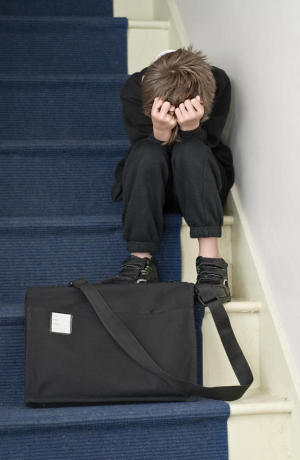





I don’t think any of the photos are of genuine emotion: they’re too clean and carefully lit, for one thing. And you wouldn’t expect them to be real. But the difference between posed despair and the real thing is often very slight. There are subtle differences in the outline of the body and its muscle tension. There’s a term for this in poker: tells, or slight give-aways in the posture or expression of an opposing player. The heads above tell me that the despair is being acted. So do the hands. And the outline of the bodies.
This photo I’m less certain about:

Deserter by Charles Glass
That might be real despair in a real soldier — I haven’t read the book, so I don’t know what the provenance of the photo is. The way his right foot is pointing slightly inward looks convincing to me. But I’m not certain. The photo might have been posed. If it was, the soldier was a good actor. With a posture like that, there’s little scope to express emotion: with less to do, you have to act more.
And with less information, the mind has to work harder. That’s why I find this an interesting topic. How do we read falsity or veracity in very small things like the angle of a hand or outline of a body? And will computers be able to imitate us? And then surpass us? If so, there must be mines of information buried beneath the surface of old photographs. At the moment, we intuit that information or miss it altogether. One day, computers may be able to trawl archives and come up with new facts about the psychology and relationships of historical figures, simply by reading tiny tells in expressions and postures.
I Say, I Sigh, I Sow #12
The quickest way to improve your life is to stop watching TV.
• White Dot — the International Campaign against Television
Life in Vein
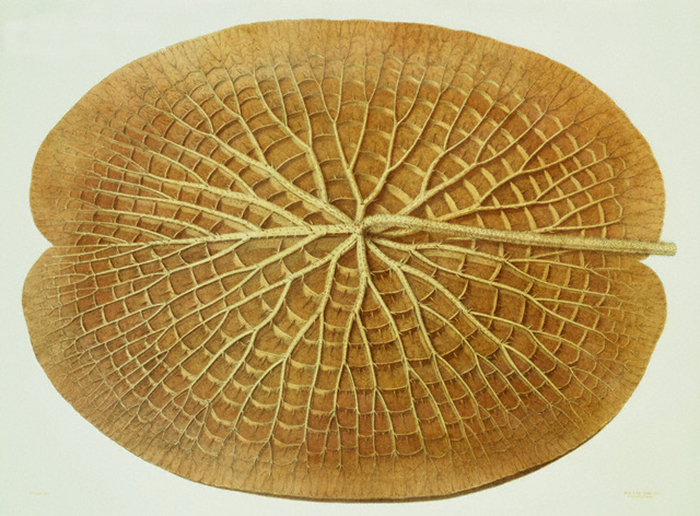
William Sharp, “Victoria Regia or the Great Water Lily of America (Underside of a Leaf)” (1854), viâ Jeff Thompson
Eight Speech
OCTOPUS
By Algernon Charles Sin-burn
STRANGE beauty, eight-limbed and eight-handed,
Whence camest to dazzle our eyes?
With thy bosom bespangled and banded
With the hues of the seas and the skies;
Is thy home European or Asian,
O mystical monster marine?
Part molluscous and partly crustacean,
Betwixt and between.
Wast thou born to the sound of sea trumpets,
Hast thou eaten and drunk to excess
Of the sponges — thy muffins and crumpets;
Of the seaweed — thy mustard and cress?
Wast thou nurtured in caverns of coral,
Remote from reproof or restraint?
Art thou innocent, art thou immoral,
Sinburnian or Saint?
Lithe limbs, curling free, as a creeper
That creeps in a desolate place,
To enroll and envelop the sleeper
In a silent and stealthy embrace,
Cruel beak craning forward to bite us,
Our juices to drain and to drink,
Or to whelm us in waves of Cocytus,
Indelible ink!
O breast, that ’twere rapture to writhe on!
O arms, ’twere delicious to feel
Clinging close with the crush of the Python,
When she maketh her murderous meal!
In thy eightfold embraces enfolden,
Let our empty existence escape;
Give us death that is glorious and golden,
Crushed all out of shape!
Ah! thy red lips, lascivious and luscious,
With death in their amorous kiss,
Cling round us, and clasp us, and crush us,
With bitings of agonized bliss;
We are sick with the poison of pleasure,
Dispense us the potion of pain;
Ope thy mouth to its uttermost measure
And bite us again!
Arthur Clement Hilton (1851–77), written at the Crystal Palace Aquarium.
Performativizing Papyrocentricity #34
Papyrocentric Performativity Presents:
• Roy des Fleurs – Scented Flora of the World: An Encyclopedia, Roy Genders (Robert Hale 1977)
• Art to Hart – Lives in Writing, David Lodge (Vintage Books 2015)
• Could Yew Kudzu? – Wicked Plants: The A-Z of Plants that Kill, Maim, Intoxicate and Otherwise Offend, Amy Stewart (Timber Press 2010)
Or Read a Review at Random: RaRaR
He Say, He Sigh, He Sow #25
When the biologist E.O. Wilson was asked by a friend what to do about the ants that had invaded his kitchen, Wilson said: “Watch where you step.” — Christopher Potter, How to Make a Human Being: A Body of Evidence (2014), pg. 214
 Overlord In Terms of Core Issues Around Maximal Engagement with Key Notions of the Über-Feral