And turning purrple…







Elsewhere Other-Accessible…
• Royal Mail: New cat stamps released — BBC News

The quickened glass
Of sculpted sea
That two slight mews
Sit rockingly.
Here’s the famous Sierpiński triangle, a fractal named after the Polish mathematician Wacław Sierpiński (1882-1969):
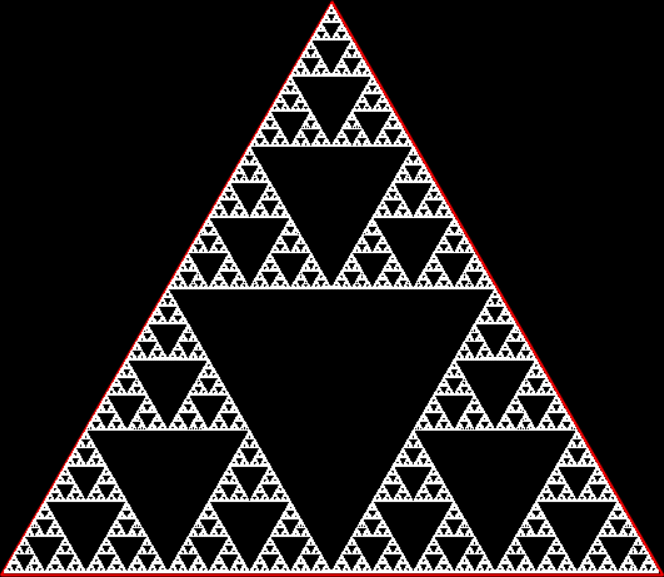
You can create it by following all the possible paths of a point jumping half-way towards the vertices of the triangle. But what if the point can jump towards the center of the triangle too? Then you get another fractal, one that looks like this:
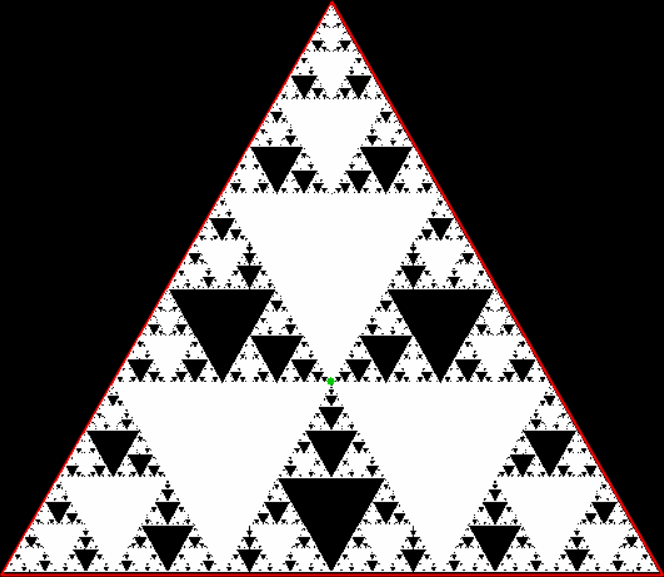
Sierpiński triangle when point can jump towards center of triangle too
Now, as a keyly committed core component of the trans-entitial community, I wondered whether triangles and triangular fractals might identify as other geometrical shapes…
I mean, what’s to stop a triangle identifying as a circle? Nothing. And obvs, if one of the Sierpiński triangles above identifies as a circle, it is a circle — trans-circles are circles (get over it). That is, there’s no need for Sierpiński surgery.
But what if a trans-circular Sierpiński triangle wanted to affirm its circularity with surgery? What would it look like then? Well, you can use elementary trig based on the angles of points within the triangle to stretch it into what might be called a trircle, i.e. a trans-circular triangle that has affirmed its inner circular identity:
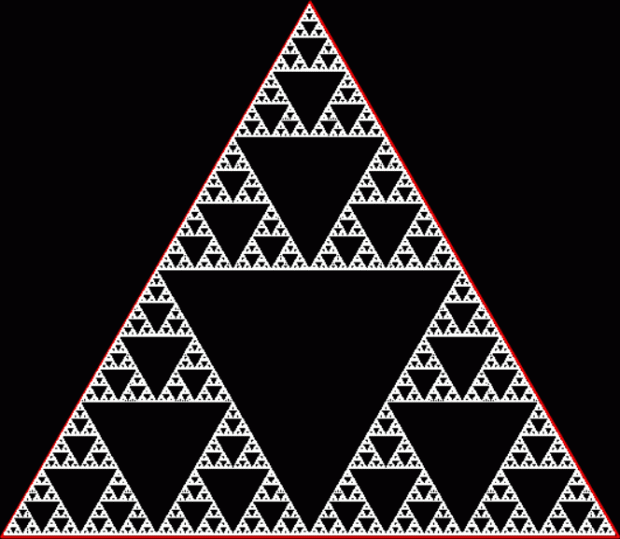
A pre-op trans-circular Sierpiński triangle
🡇
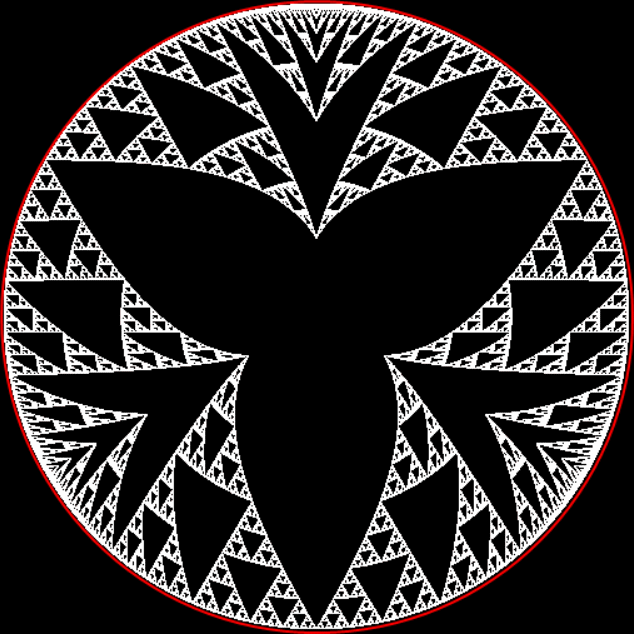
A post-op trans-circular Sierpiński triangle or Sierpiński trircle
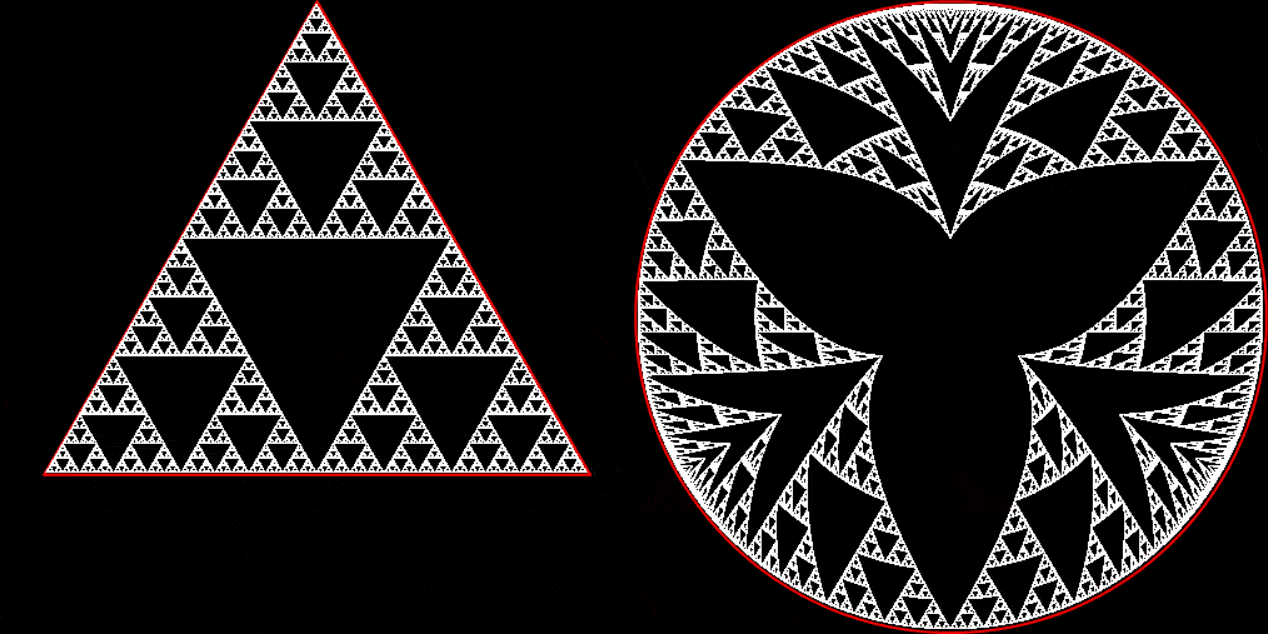
Sierpiński triangle → Sierpiński trircle (animated at EZgif)
On the other hand, the trircle might be a pre-op trans-triangular circle that has NOT affirmed its inner triangular identity with surgery. It’s complicated. But if we suppose it’s a post-op trans-circle rather than a pre-op trans-triangle, we could nickname it an Angular Trerkel, punning on the name of the great German Bundeskanzlerin Angela Merkel. Here’s the same Sierpiński surgery on the centered Sierpiński triangle (the second fractal looked at above):
A pre-op trans-circular centered Sierpiński triangle
🡇
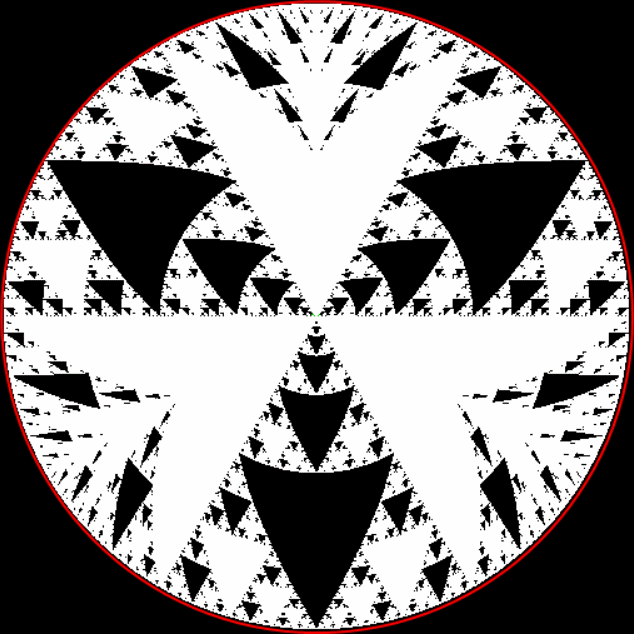
A post-op trans-circular centered Sierpiński triangle or centered Sierpiński trircle
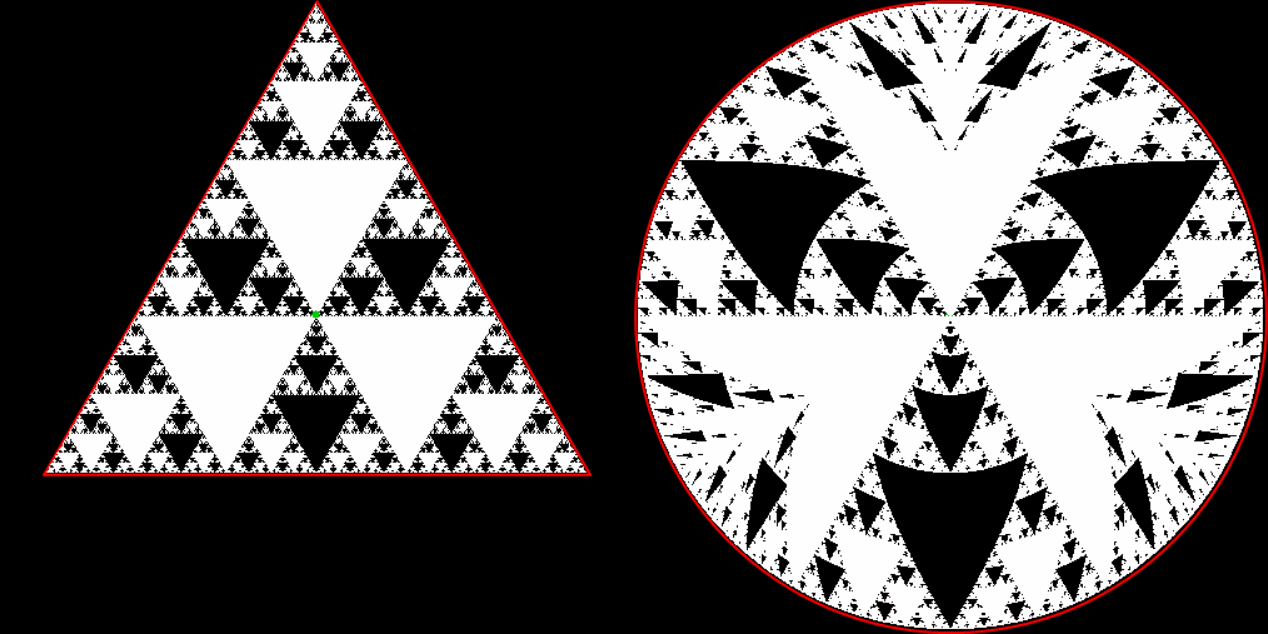
Centered Sierpiński triangle → centered Sierpiński trircle (animated at EZgif)
Again, the post-op trans-circular centered Sierpiński triangle might in fact be a pre-op trans-triangular centered Sierpiński circle. When it comes to the trans-entitial community, always remember: In dubio, interrogāte entitatem! — “In case of doubt, ask the entity!”
“To accept everything is an exercise, to understand everything a strain. The poet only desires exaltation and expansion, a world to stretch himself in. The poet only asks to get his head into the heavens. It is the logician who seeks to get the heavens into his head. And it is his head that splits.” — G.K. Chesterton, Orthodoxy (1908)
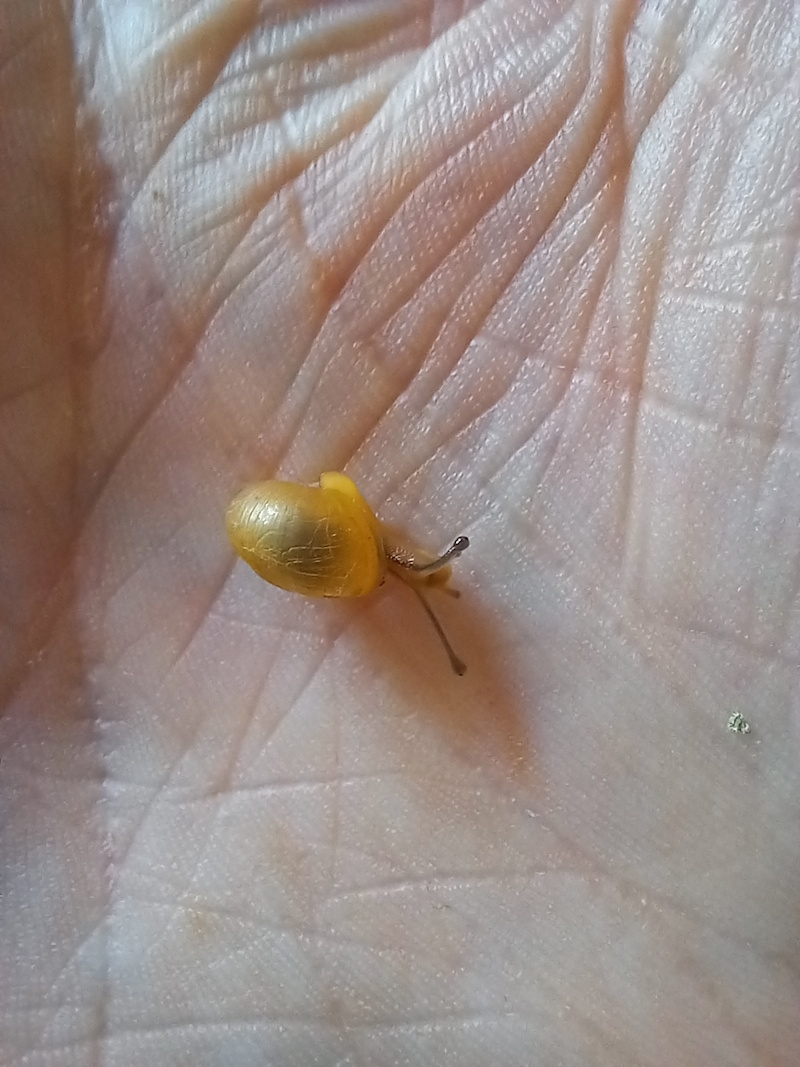
Small yellow snail, possibly juvenile White-lipped Snail, Cepaea hortensis
Elsewhere Other-Accessible…
• Snail ID in UK — a good simple guide at the NHBS
’Tis a green scene
With many white mouths:
The trumpet-mouths
Of bindweed
Begoddening
The sun-begoldened air.
And the hoverfly
To the fleabane’s eye
Sweets soft songs
I catch nor match.
Yet fleabane’s eye
To hoverfly:
Παντοπόρνη!

Illustrating Moser’s Circle Problem
• 1, 2, 4, 8, 16, 31, 57, 99, 163, 256, 386, 562, 794, 1093, 1471, 1941, 2517, 3214, 4048, 5036, 6196, 7547, 9109, 10903, 12951, 15276, 17902, 20854, 24158, 27841, 31931, 36457, 41449, 46938, 52956, 59536, 66712, 74519, 82993, 92171, 102091, 112792, 124314, 136698 — A000127, “Maximal number of regions obtained by joining n points around a circle by straight lines”, at The Online Encyclopedia of Integer Sequences
Inky Bloaters (1987) is the name of an album by psycho-songstress Danielle Dax. Frinky growthers are those who are interested in frincremental growth. That’s growth by fractions, as in the equation x = x + 1/x. If the initial x = 1, its frincremental growth looks like this:
1
1 + 1/1 = 1 + 1 = 2
2 + 1/2 = 2_1/2
2_1/2 + 1/2_1/2 = 2_9/10
2_9/10 + 1/2_9/10 = 3_71/290
3_71/290 + 1/3_71/290 = 3_150911/272890
3_150911/272890 → 3_220789390391/264588959090 → 4_25570190327910692085061/268440386798659418988490 → 4_100170363026578204006507990129853967021051645381/295105036840595214385430531020664149472669868290
As you can see, the numerators and denominators of the fractional part of x get very large very quickly. So you can’t track the frincremental growth of x with perfect accuracy. Even the most compendious computer will run out of space. But representing x as a decimal is usually enough for us frinky growthers:
1 + 1 = 2
2 + 1/2 = 2 + 0.5 = 2.5
2.5 + 1/2.5 = 2.9
3.244827586206896551724137931…
3.553010370478947561288431236…
3.834461842815967366750790750…
4.095254632258778985771918456…
4.339439692724345181049239663…
4.569884190357676650018985962…
4.788708116379690742064597208…
4.997532704493448986664559639…
5.197631445038131469095668466…
5.390026771750770995914851381…
5.575554607204394029915651664…
5.754908962142979073283550015…
5.928673657045750549124213874…
6.097345447373015508408978797…
6.261351244425377152997703626…
6.421061179383957004641284553…
6.576798676981813718180627345…
The larger x gets, the slower it grows. But it never stops growing and will pass any finite integer in finite time. I was interested in the fractional part of x += 1/x (a shorthand for x = x + 1/x). Plainly, it’s almost unique for every integer seed (the fractional part is identical, just displaced by one step, for initial x = 1 = 2). I graphed the fractional part of x += 1/x for 1, 2, 3, 4, 5… and discovered some interesting patterns:

frac(x) of x += 1/x for x = 1, 2, 3, 4, 5…

Later frac(x) of x += 1/x



In time, the rounded patterns disappear for lower initial x. But you also get symmetrical patterns for x += sqrt(x), that is, x = x + square_root(x). And they last longer:
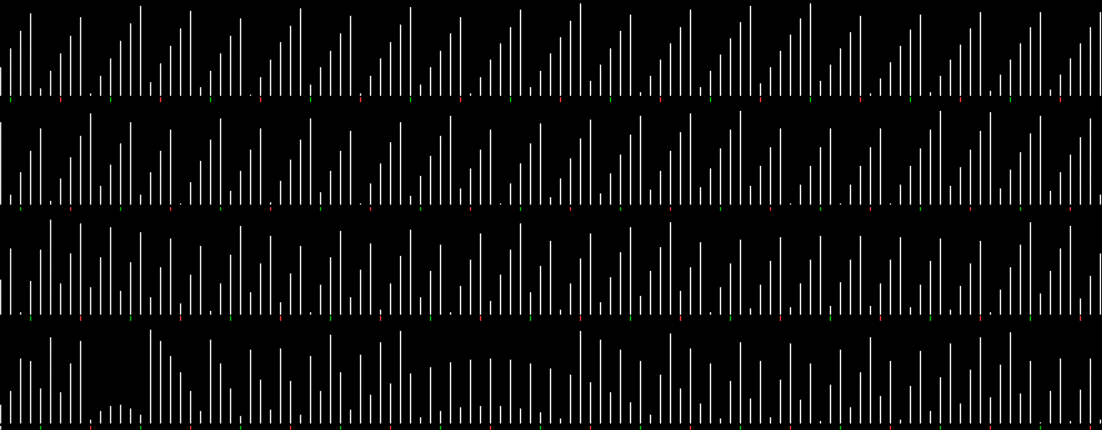
frac(x) of x += sqrt(x) for 1, 2, 3, 4, 5… #1

frac(x) of x += sqrt(x) for 1, 2, 3, 4, 5… #2

frac(x) of x += sqrt(x) for 1, 2, 3, 4, 5… #3

frac(x) of x += sqrt(x) for 1, 2, 3, 4, 5… #4

frac(x) of x += sqrt(x) for 1, 2, 3, 4, 5… #5
Here’s an animation of the first fifty steps of x += sqrt(x):
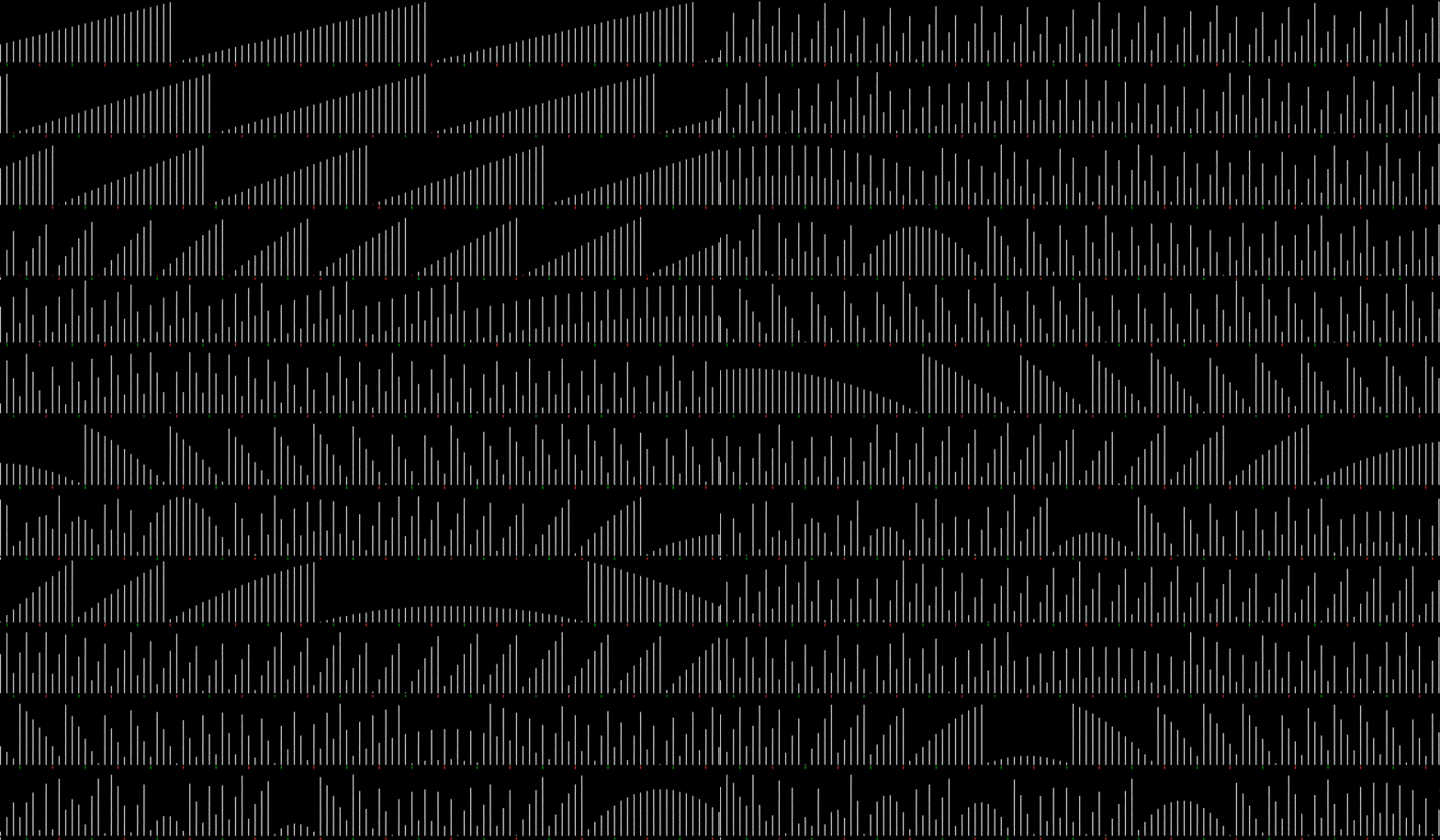
animated frac(x) of x += sqrt(x) for 1, 2, 3, 4, 5… (animated at EZgif) (click for larger image)
And what about x += ln(x), or x = x + natural_logarithm(x)? The patterns are both more dynamic and longer-lasting for lower initial x:

frac(x) of x += ln(x) for 1, 2, 3, 4, 5… #1

frac(x) of x += ln(x) for 1, 2, 3, 4, 5… #2

frac(x) of x += ln(x) for 1, 2, 3, 4, 5… #3

frac(x) of x += ln(x) for 1, 2, 3, 4, 5… #4
And two animations of x += ln(x), one slower, one faster:

animated frac(x) of x += sqrt(x) for 1, 2, 3, 4, 5… (EZgif) (click for larger)

faster animated frac(x) of x += sqrt(x) for 1, 2, 3, 4, 5… (click for larger)
O blade-wing bird
No wisest word
Can capture in thy grace!
Thou soar’dst the air
And cleans’dst the care
That clustered in this place.
O blade-wing bird,
The Muse hath stirred
My brain to wingèd verse:
So sword the sky
And sweet for aye
Our swarm’d Pandoric curse!
O blade-wing bird
No wisest word
Can capture in tha grace!
Tha soar’d the air
An’ cleans’d the care
That cloostered in this place.
O blade-wing bird,
The Muse ’as stirred
Mah brain to wingèd verse:
So sword the sky
An’ sweet for aye
Owr swarm’d Pandoric curse!
While I play New Order, let’s view order. Below are some rational fractions ordered by increasing size of denominator (the lower part of the fraction, e.g. the 7 in 3/7) and numerator (the upper part of the fraction, e.g. the 5 in 5/9). Note the positions of 1/2 and 1/7:
1/2, 1/3, 2/3, 1/4, 3/4, 1/5, 2/5, 3/5, 4/5, 1/6, 5/6, 1/7, 2/7, 3/7, 4/7, 5/7, 6/7, 1/8, 3/8, 5/8, 7/8, 1/9, 2/9, 4/9, 5/9, 7/9, 8/9, 1/10, 3/10, 7/10, 9/10
Now let’s plot fractions ordered like that on a fract-L, a graph whose axes represent numbers < 1. If both x and y = 1/2, 1/3, 2/3, 1/4, 3/4, 1/5…, you get a line at 45°:
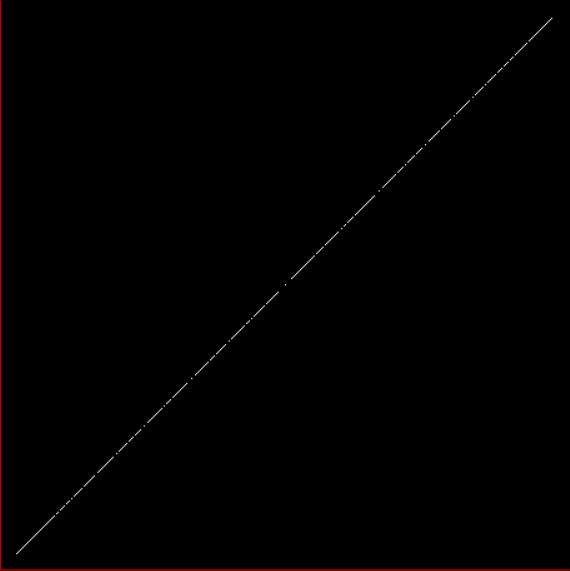
fract-L for x = 1/2, 1/3, 2/3…, y = 1/2, 1/3, 2/3…
If the fractions went to infinity, you’d get a solid line. As it is, you get some interesting splits in the 45° line. And when you plot the fractions like that, it’s easy to see that each point, (x,y), has a unique x and a unique y. But there are other ways to order the rational fractions. Try the same set ordered by the size of the decimal, not the denominator and numerator. In the previous set, 1/2 came before 1/7. Now 1/2 comes after 1/7, because 0.5 = 1/2 > 0.142857… = 1/7:
1/10, 1/9, 1/8, 1/7, 1/6, 1/5, 2/9, 1/4, 2/7, 3/10, 1/3, 3/8, 2/5, 3/7, 4/9, 1/2, 5/9, 4/7, 3/5, 5/8, 2/3, 7/10, 5/7, 3/4, 7/9, 4/5, 5/6, 6/7, 7/8, 8/9, 9/10
Now let’s plot x as the first set of fractions, ordered by size of denominator-and-numerator, and y as the second set of fractions, ordered by the size of the decimal. You’ll see that this kind of size scatters:
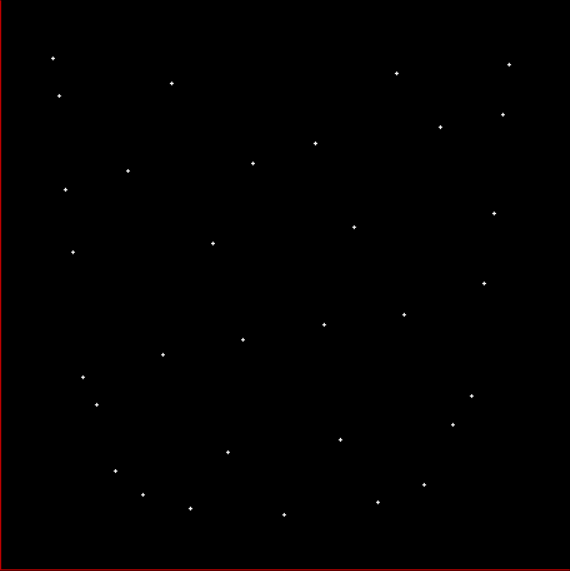
fract-L for x = 1/2, 1/3, 2/3, 1/4, 3/4, 1/5…, y = 1/10, 1/9, 1/8, 1/7, 1/6, 1/5, 2/9…
Now the points aren’t compressed into a 1-d line, but beginning to spread in 2-d space. The more fractions you use, the more the points spread. They remind me of papillae on a fractal tongue:
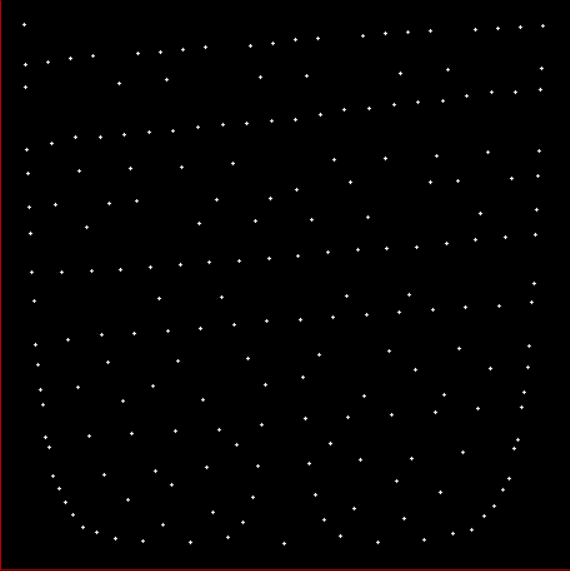
x = 1/2, 1/3, 2/3, 1/4, 3/4, 1/5… < 1/26, y = sizesort(1/2..1/26)
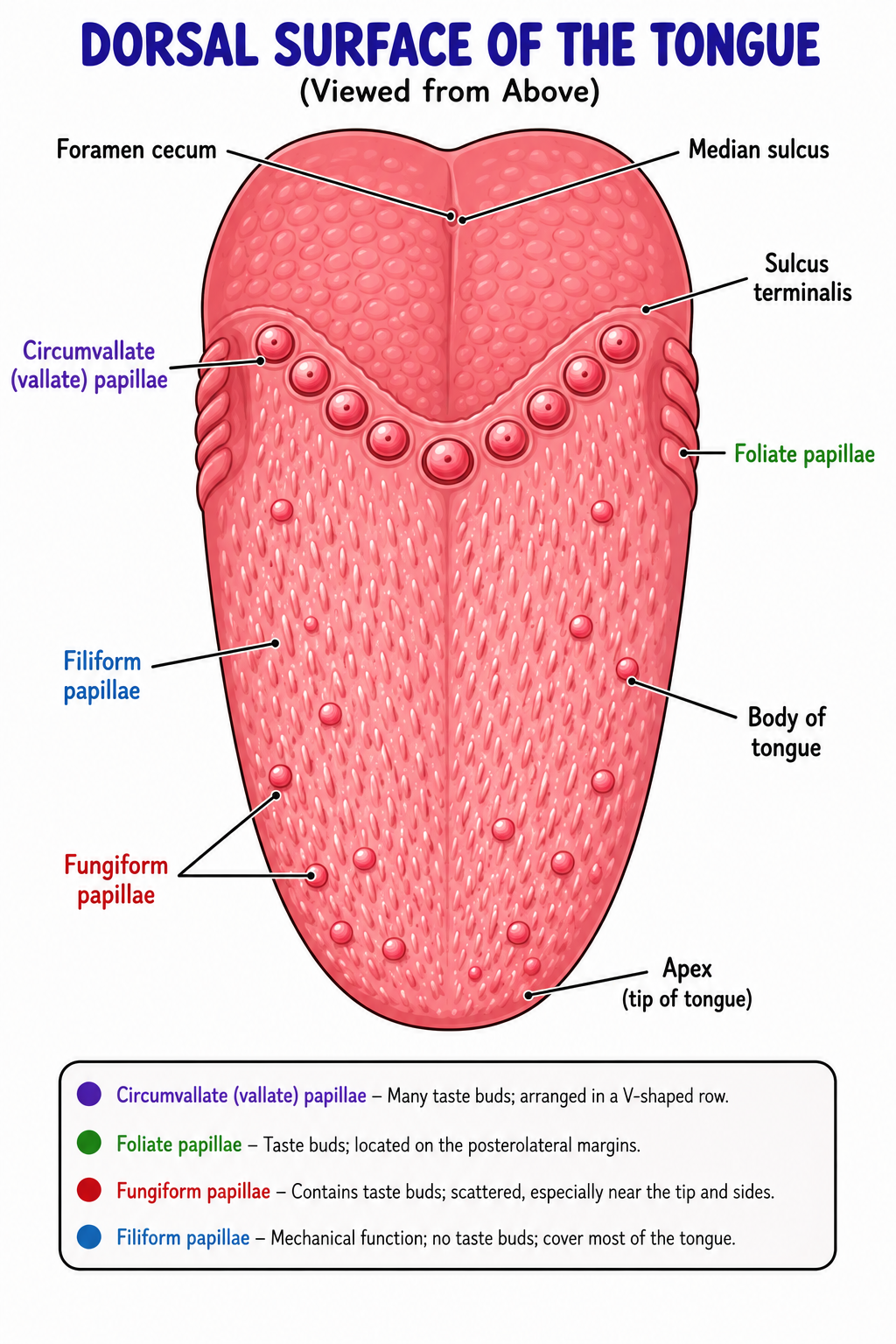
Papillae on a human tongue (image courtesy chatGPT)
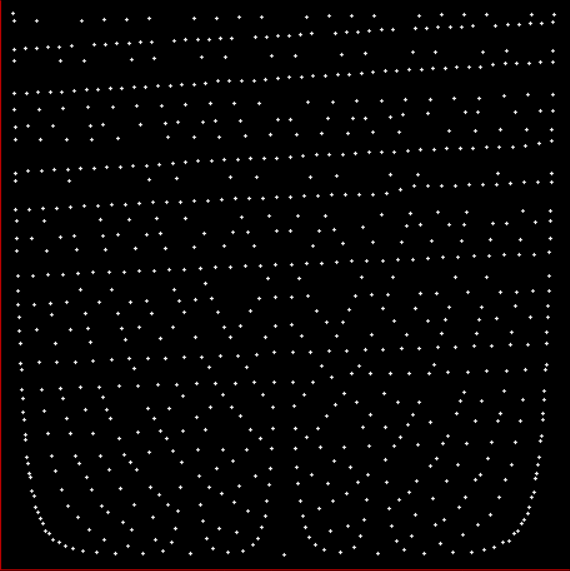
x = denumsort(1/2..1/51), y = sizesort(1/2..1/51)
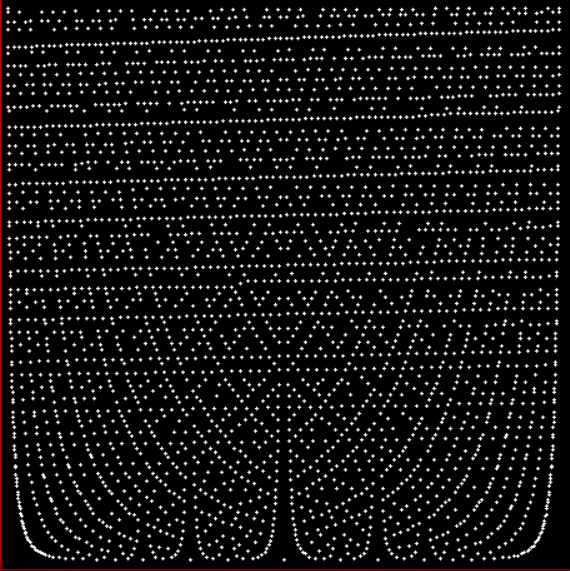
x = denumsort(1/2..101/), y = sizesort(1/2..1/101)
And the points seem to be occurring at the same x or y value. But that’s an artefact of a screen with limited pixels. On an impossible screen with infinite pixels, each (x,y) still has a unique x and unique y. Here are more fract-Ls with more fractions:
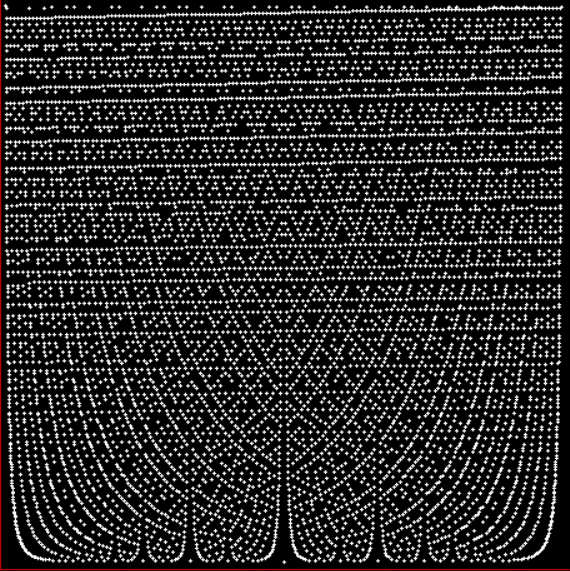
x = denumsort(1/2..1/151), y = sizesort(1/2..1/151)
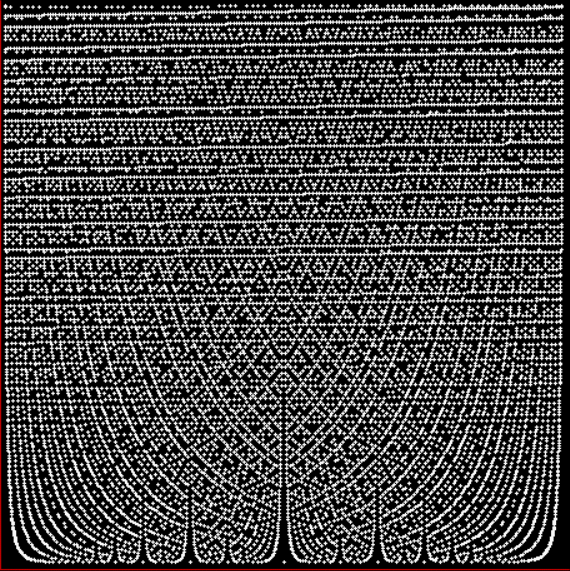
x = denumsort(1/2..1/201), y = sizesort(1/2..1/201)
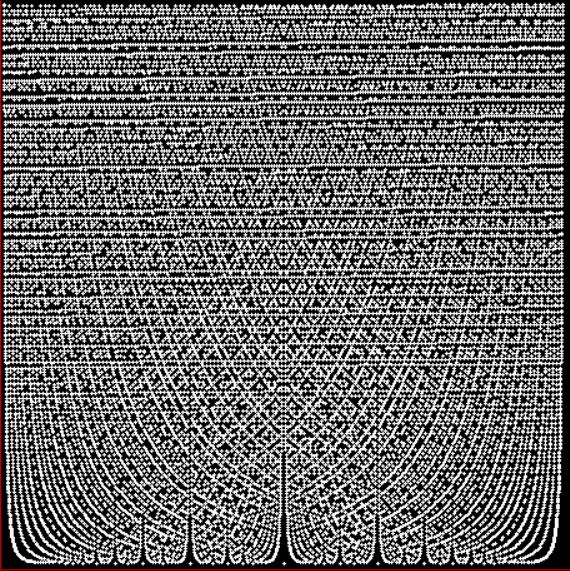
x = denumsort(1/2..1/251), y = sizesort(1/2..1/251)
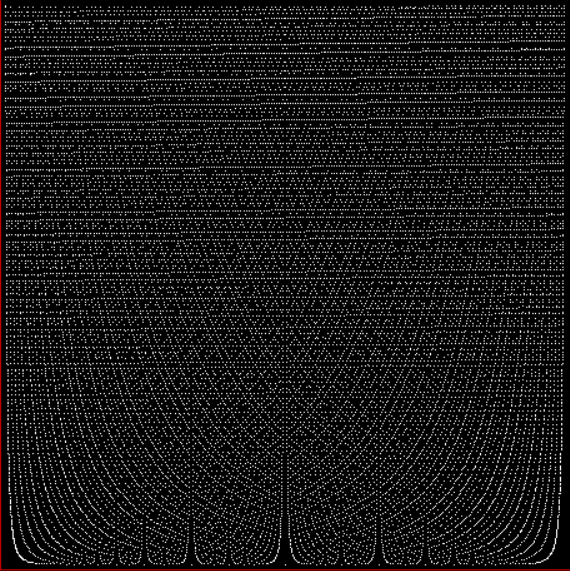
finer detail for x = denumsort(1/2..1/251), y = sizesort(1/2..1/251)
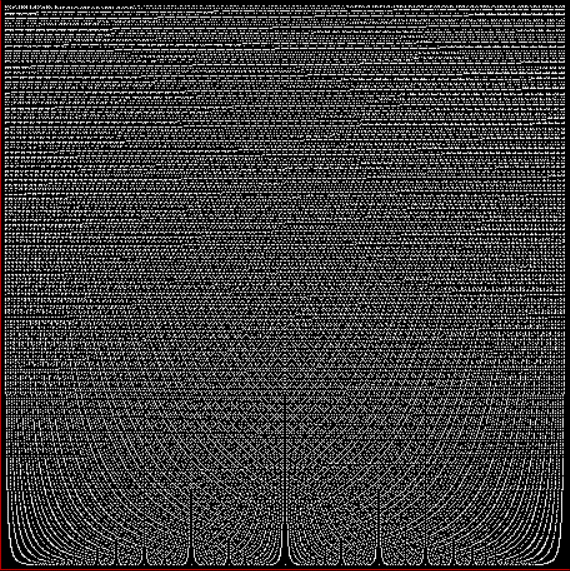
x = denumsort(1/2..37/406), y = sizesort(1/2..37/406)
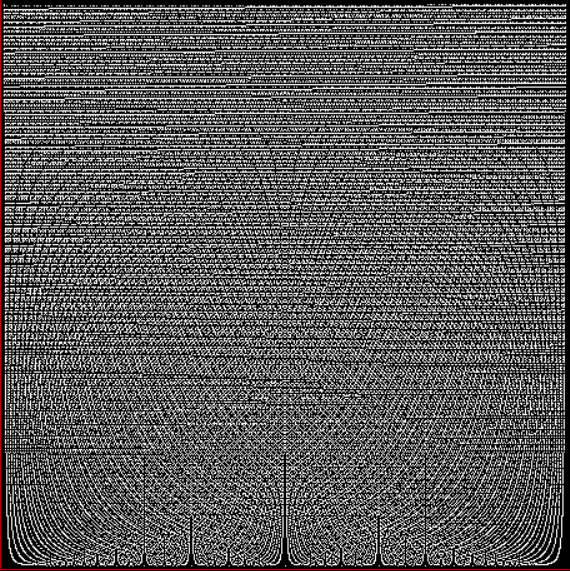
x = denumsort(1/2..1/501), y = sizesort(1/2..1/501)
Finally, to the closing bars of New Order, let’s view order in an animated gif:
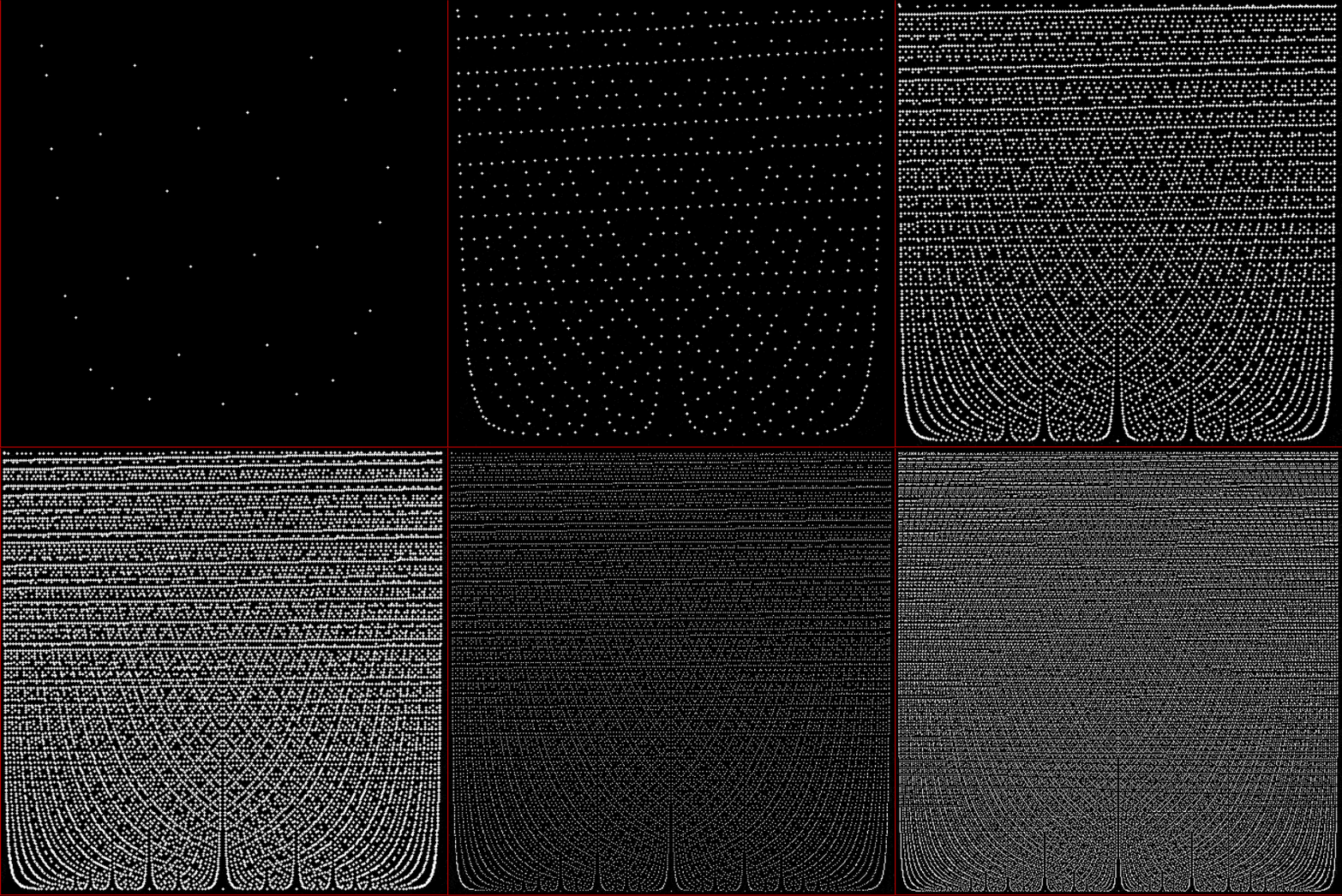
x = denumsort(a/b), y = sizesort(a/b) (animated at EZgif)
Post-Performative Post-Scriptum…
In fact, I wasn’t listening to New Order to view order. I’m not a fan of New Order, just a fan of assonance.

