Apostrophizing Andy

If you get it, you’ll laugh. If you don’t, you won’t:

Eee, I know what you mean. Shine’s gone off this government faster than gravy off chips, as we say up here in the North, where I authentically am. What t’party needs is a leader who’s reet proper connected with t’working man. In terms of names, we’ll see to that when dog’s in t’barn, as Northerners like me say up here in the North. — “Mandelson: Let’s chat about Keir…”, 29ix25

Well, I laughed anyway. That’s Robert Hutton in The Critic joking about the prime-ministerial ambitions of Andy Burnham, the mayor of Manchester. And I’m wondering about the “In terms of names…” I think it’s there for deliberate contrast. As I’ve endlessly adumbrated in terms of Overlord-of-theÜber-Feral, “in terms of” is an ugly, pretentious piece of bureaucratese that’s keyly characteristic of politicians, lawyers, academics in the humanities, and other core communities of windbags. In short, it’s highly bourgeois.

And I reckon that’s why Hutton put it into his mockery of Burnham, who’s pretending to be reet down-to-earth but can’t help letting his true nature coom through. Whatever his roots, he’s a bourgeois bureaucrat now. If I’m right, then Hutton recognizes the rebarbativity of “in terms of”. Good on ya, Bob. But bad on ya for getting the northern accent wrong. The apostrophe’s in the wrong place: “t’party” and “t’working man” should be “’t party” and “’t working man”, because that northern form of the definite article doesn’t represent thet’ but that’t (in Old English þæt was the neuter form of the definite article, while the masculine and feminine forms were and sēo). You can hear the truth in the glottal stop, which is sometimes all that’s left of the original “that”. In fact, that’s what “t’” is generally a bad transcription of — a glottal stop, “ʔ” in phonetic transcription. But in some dialects of northern English, the glottal stop disappears too, so there’s no definite article and English weirdly seems like Latin or Russian or some other language that doesn’t use definite articles.

You can see Mancunian English moving towards no-definite-article with “Shine’s gone off this government…” But the most natural way to read that line is with a glottal stop: “ʔShine’s gone off this government…” If Hutton meant it to be read like that, he’s implicitly recognizing that “t’” is a bad transcription. “T’shine’s gone off…” would sound like “Chine’s gone off…” But no Mancunian would say it like that. Something else that no Mancunian would say is that the Fat Slags are from Newcastle. But that’s a story for another day.


Peri-Performative Post-Scriptum

As is usual with sociology or biology, the story of the northern definite article is much more complicated than a short discussion can cover. And I can’t remember where I read about its true origins and can’t find anything online at the moment. But this supports what I’m saying:

The phenomenon of Definite Article Reduction (DAR) is the realization of the definite article in northern British English dialects in a range of vowel-less forms, usually written t’ in literature. The origin of DAR is assumed to be the assimilation of the initial fricative of the Middle English definite article þe to produce a te form, a sound change recorded for many dialects of Middle English. This article examines the validity of this hypothesis by analysing the distribution of fricative allomorphs in the modern dialects in comparison with the details of the Middle English change. The predicted distribution of fricative forms is not found at most localities, indicating that the development hypothesis is incorrect, but the available data are too scanty to suggest an alternative model. — “The origin of Definite Article Reduction in northern English dialects: evidence from dialect allomorphy, Mark J. Jones in English Language and Linguistics, November 2002

Mavericks in a Metropolis of Millions…

Trump has won again.

I can’t believe I’ve just written those words.

I don’t wanna believe I’ve just written those words.

But I hafta.

’Coz they’re true.

Toxically, traumatizingly, tear-tappingly true.

So how’m I gonna respond to the toxic truth of tyrannical Trump’s triumph?

Welp… how better than by publishing some fiercely unbowed words of anti-fascist resistance from one of the core counter-cultural components at one of the world’s leading anti-racist publishing houses?

Yes indeedy, this Papyrocentric Performativizer is positively pulsating with pride and passion to present an exclusive antifa extract from arguably the best interview in Titans of Transgression: Incendiary Interviews with Eleven Ultra-Icons of Über-Extremity (TransVisceral Books 2024), which has just seen its third edition.

Please raise your revolutionary fists for Jay Guinness, Artistic Director and Ipsissimic Aesthetician at Manchester-locused Savoy Books, long hailed as England’s most transgressive publishing company…

Readers’ Advisory: Interview extract contains strong language and uncompromising counter-cultural contrarianism. Proceed at your own risk.

[…]

Miriam Stimbers: Manchester was in the headlines for all the wrong reasons in 2017 [editor’s note: Miriam is referring to the murder of twenty-two people by the homophobic and misogynist Islamist suicide-bomber Salman Abedi at the Manchester Arena].

Jay Guinness: It was, yes. Sadly it was.

Miriam Stimbers: How did you react at Savoy?

Jay Guinness: We in the Savoy community were badly affected. Clearly, we’ve engaged fictionally, artistically, aesthetically with issues around fascism, hatred, intolerance throughout our professional lives, but to have those issues strike on your own doorstep, as it were, strike for real, well, it’s something you could never be prepared for.

Miriam Stimbers: So you think what he did was fascism?

Jay Guinness: I think it was echt fascism, fascism pur sang. Pun not intended. Let’s not beat about the bush. It was fascism.

Miriam Stimbers: Much has been made of the fact that the terrorist––

Jay Guinness: I don’t think “terrorist” is the mot juste. Not at all. For me, he’s just a criminal with a diseased mind. And I don’t mean that as a compliment!
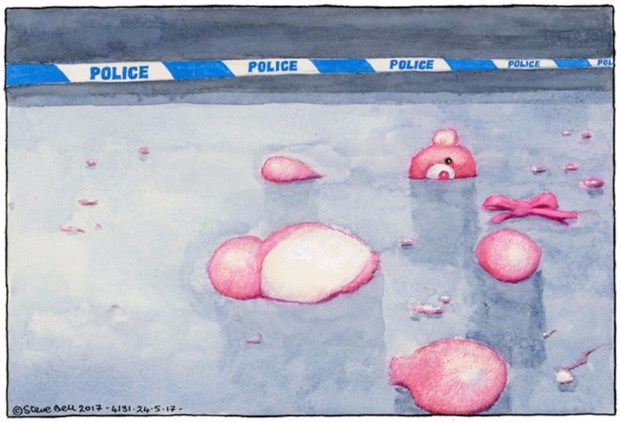
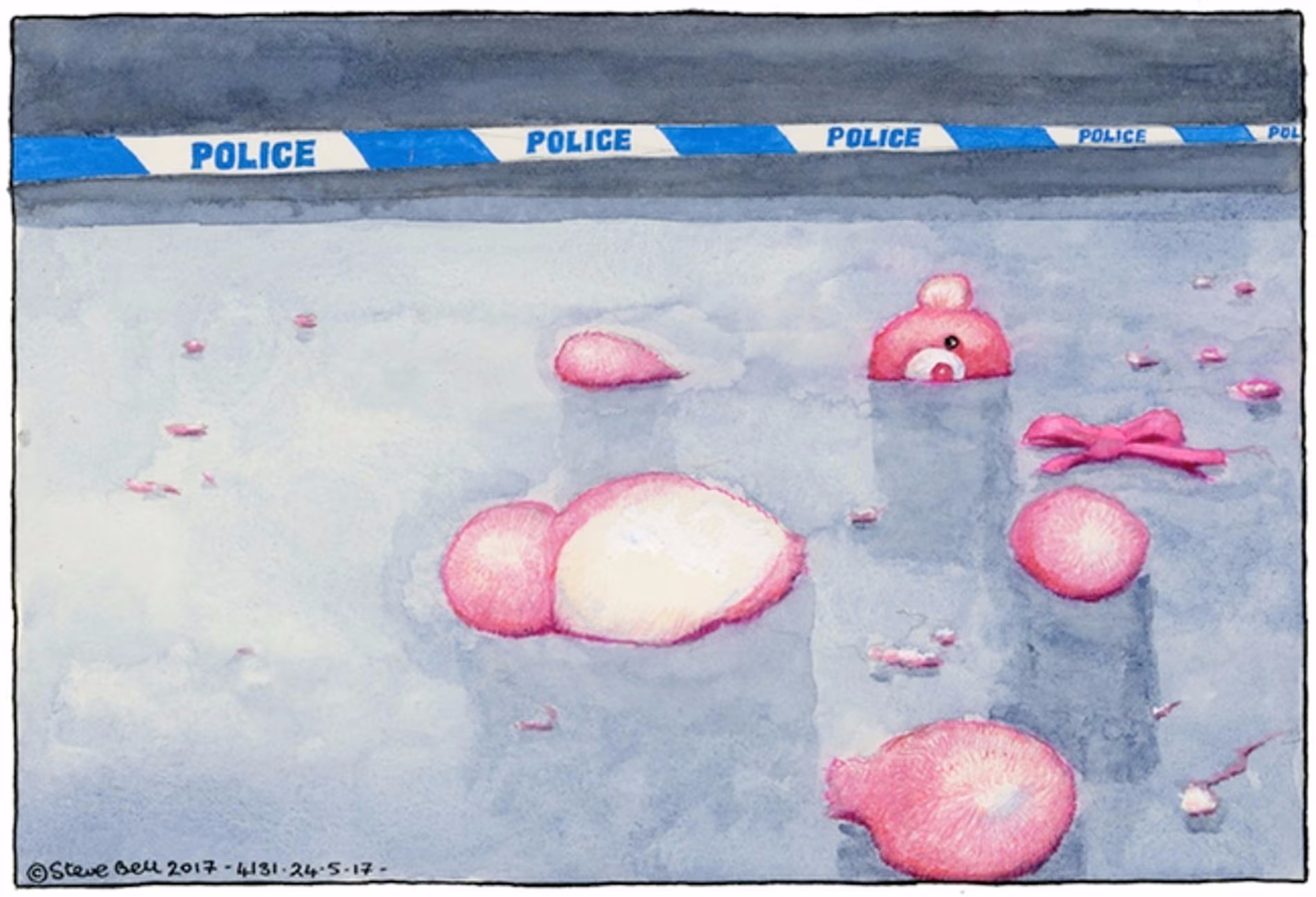
Steve Bell of The Guardian excoriates the Manchester Arena Bomber

Miriam Stimbers: Okay. Much has been made of the fact that the criminal was born and brought up in Manchester. Have you any thoughts on that?

Jay Guinness: You’re right, much has been made of it. But for me and my colleagues at Savoy what he did merely underlined the fact that Manchester is a state of mind far more than it is a physical and temporal Sitz im Leben. It’s about a locus of values, not about geography. I mean, I was born in Huddersfield myself, but I felt that I was Mancunian from the moment I first hung my hat here, because I subscribe to Mancunian values. People who were born here but don’t subscribe to those values aren’t part of the city. Not for me, not for the Savoy community, not ever. I think Dave [Britton] put it best when we were processing the news of what he’d done. Dave’s words have stayed with me: “He’s not a fucking Manc, he’s a fucking cunt. The fucker should be fucking strung up.”

Miriam Stimbers: Metaphorically speaking?

Jay Guinness: No, not metaphorically. Literally. We in the Savoy community are a pretty progressive bunch. We’re not instinctive supporters of the death penalty, to put it mildly. But if you took a vote at Savoy in terms of whether people who do things like that should be hanged, it would be a unanimous yes. No dissenters.

Miriam Stimbers: I’m taken aback. It seems a little extreme. A lot extreme, to be honest.

Jay Guinness: The Savoy community might be progressive, but we’re not bleeding-heart liberals. As Dave said, the fucker should be fucking strung up.

Miriam Stimbers: But what could you hope to achieve by it?

Jay Guinness: Well, for one thing it would be a deterrent to others. Just as importantly, it would ensure he doesn’t do it again.

Miriam Stimbers: But he won’t be doing it again. How could he?

Jay Guinness: Very easily. And he will do it again. We in the Savoy community are confident of that. Leopards don’t change their spots.

Miriam Stimbers: But how could he do it again? He’s dead.

Jay Guinness: I’m sorry, you’ve lost me. Who’s dead?

Miriam Stimbers: Salman Abedi, of course. The suicide-bomber at the Manchester Arena. Who else?
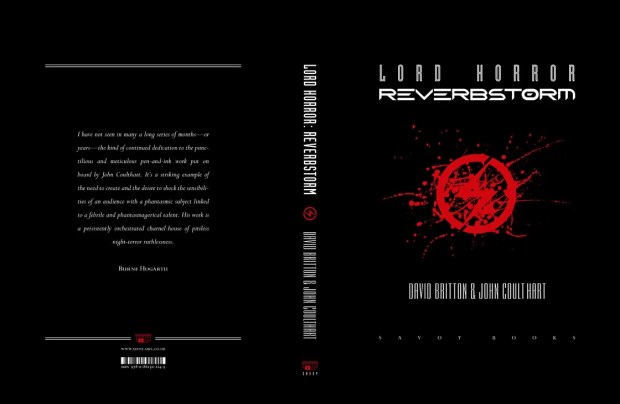
Much More Mucking Maverick Than You, Monkeyfunker!

Jay Guinness: Oh no, no, no, you’ve got entirely the wrong end of the stick. I wasn’t talking about that poor British-Muslim boy. He was quite possibly the biggest victim in that unfortunate business at the Arena.

Miriam Stimbers: Then who were you talking about?

Jay Guinness: That despicable creature Morrissey, of course. Those comments of his about immigration and Salman’s background were utterly unforgivable. Utterly. But no more than one would expect. As Dave went on to say: “That fucking crypto-fascist cunt’s just a fucking attention-seeker, always fucking has been, always fucking will be. String the fucker up!”

Miriam Stimbers: And you really think there’d be a majority at Savoy in favour of executing Morrissey?

Jay Guinness: I don’t think it, I know it. But it wouldn’t just be a majority, it would a unanimous vote, nem. con. What has Morrissey ever done but bring Manchester into disrepute with his dire music, his shitty fashion sense and his toxic racist agenda? As Michael Moorcock once said: “Fascism never sleeps and nor must the anti-fascist community.” In terms of saying it all, it does. Definitively.

[…]

Interview extract © Jay Guinness, Dr Miriam Stimbers, TransVisceral Books 2024


Jay Guinness is a Huddersfield-born artist and aesthetician, and the subject of Dr Joan Jay Jefferson’s incisive and exhaustive biography Art-Bandit: Interrogating the Outlaw Aesthetics of Über-Maverick Gay Atelierista Jay Guinness (University of Salford Press 2012). See reviews of Art-Bandit at: Pink News, The Guardian, London Review of Books, Quietus, and Huffington Post. Visit Jay’s website for news of his latest projects.

Miriam Stimbers is a Glasgow-born psychoanalyst, literary scholar and cultural commentatrix whose most recent book is the updated edition of Morbidly Miriam: The Mephitic Memoirs of Miriam B. Stimbers (TransVisceral Books 2023). See a review of Morbidly Miriam at Papyrocentric Performativity. Visit Miriam’s website for news of her latest projects.


Previously pre-posted on Papyrocentric Performativity…

Il Nano e il Necrofilo… – an earlier exclusive extract from Titans of Transgression

The Hurt Shocker – an even earlier exclusive extract from Titans of Transgression

Performativizing Papyrocentricity #73

Papyrocentric Performativity Presents…

Hod is G-dPlaymaker: My Autobiography, Glenn Hoddle with Jacob Steinberg (HarperCollins 2021)

The Wheel DealCyclogeography: Journeys of a London Bicycle Courier, Jon Day (Notting Hill Editions 2015)

Manc WancFrom Manchester with Love: The Life and Opinions of Tony Wilson, Paul Morley (Faber & Faber 2021)

Goyles, Goyles, Goyles…I, Gargoyle: Toxic True Tales of Fetid Freaks, Wild-Eyed Weirdos and Kore Kounter-Kultural Kooks Who Insidiously Identify as Human Gargoyles…, edited by David Kerekes and Norman Nekrophile (Visceral Visions, forthcoming)

Sneaky McCreadyThe Deceiver, Frederick Forsyth (1991)

Shake’s PeerShakespeare, Bill Bryson (William Collins 2017)

Winged WordsThe Last Enemy, Richard Hillary (1942)

The Cult of Ult1312: Among the Ultras: A Journey with the World’s Most Extreme Fans, James Montague (Ebury Press 2021)


Or Read a Review at Random: RaRaR

Maximal Moz

Morrissey in Conversation: The Essential Interviews, ed. Paul A. Woods (Plexus 2016)

It’s very Mozzean that one of the most Mozzean things in this book is marginal. That is, it’s not in the interviews or anything Moz himself says: it’s in the mini-bios of the “Contributors” section at the end of the book. For example, Dave McCullough interviewed Moz for the long-defunct Sounds in 1983. And I thought it was a joke when McCullough’s mini-bio ended with “His current whereabouts are unknown.”

But it happened again for Shaun Philips, who interviewed Moz, again for Sounds, in 1988: “His
current whereabouts are unknown.” And again for Elissa Van Poznak, who interviewed Moz for The Face in 1984: “Her current whereabouts are unknown.” And that sentence is the last in the book, apart from the acknowledgements. What happened to these three journalists? They had lives and careers, friends and family. Their writing was once regularly read by many thousands or even millions of people. And then read again in this book. But “Their current whereabouts are unknown.” They’ve dropped out of sight, even maybe out of life, and the editor of the book, Paul A. Woods, hasn’t been able to find out what happened to them. Not even in this ultra-connected internet age.

That’s very Mozzean. You could even wonder whether they’ve succumbed to a belated form of the Curse of Moz, or the career-failure that strikes bands after Morrissey praises them or takes them on tour as support. Or you could wonder whether, like Morrissey himself for so long, they were struggling with depression and an urge-to-self-annihilation even as they achieved professional success. You’d certainly expect the first publication of this book in 2007 to have flushed them out. But it didn’t. Nor did the second publication in 2011. But perhaps the third publication did in 2016.

I don’t know and I’d rather not know. I like the Mozzeanism of three missing journalists. And I liked this book too. A lot. Obviously a lot of other people did too, or it wouldn’t have been printed three times. But I suspect it won’t be re-printed again. Why not? Coz of Moz on Muz. Guardian-readers were not pleased by Morrissey’s comments on Muslims and Muslim immigration after the Manchester bombing in 2017 or by his support for Brexit and the “far-right” For Britain party. You can get T-shirts now that say “Shut Up, Morrissey!” and there have been a string of anathemas and excommunications issued at Moz from woke bastions like the Quietus (where bad English goes to die). Guardian-readers feel deeply betrayed by Morrissey, who once said all the right things about economics, animal rights, vegetarianism, and the evilness of the Conservative and Republican parties – as you can read here.

But you’ll also read here about disturbing early signs – or sounds – that Moz wasn’t prepared to buzz with the hive-mind on everything. After he began his solo career in 1988 he released songs with titles like “The National Front Disco” and “Bengali in Platforms”, the latter of which opined “Life is hard enough when you belong here.” But there was enough ambiguity and authorial distance in the songs for him to deny plausibly that he was being racist or sympathizing with racism. And he still had a whole heap of good-will from the Smiths, so he survived the first campaign to cancel him and came back as strong as ever.

Well, the good-will has disappeared now. Moz has burned all his bridges to the Guardian and I don’t think there’s any chance of this book being re-re-re-printed. Indeed, I bet a lot of former fans have thrown out their copies or even ritually burned them. It’s their loss, because Morrissey is one of the wittiest, most interesting, and most intelligent interviewees who ever lived. As the back cover says of an earlier edition of Morrissey: In Conversation:

It’s proof, lest we forget, that in terms of great copy, Morrissey has rarely been anything other than interview gold. – Q magazine

But that quote itself needs trimming of its Guardianist fat: “It’s proof, lest we forget, that Morrissey has rarely been anything other than interview gold.” Moz himself is rarely guilty of saying more than he needs to. He’s both articulate and acute. It’s hard to believe that he came from a big working-class Irish family in Manchester and spent years on the dole after being shunted into a bad school by failing his eleven-plus. If he’d passed that selective exam he would have gone to a better school and most probably on to university. But I think university would have been bad for him. He probably wouldn’t have had a career in music and he certainly wouldn’t have become the Morrissey that millions of people either love or loathe.

But he would have become someone who habitually said “in terms of” and “prior to”. Alas, he does sometimes say “in terms of” in later interviews here, but it’s a minor blemish and I read everything in the book. Except – speak of “in terms of” and the windbag appears – Will Self’s “The King of Bedsit Angst Grows Up” from 1995. As usual with Self, I began losing the will to live half-a-paragraph in and gave up. If it had been a proper interview rather than Self blotivating on themes Mozzean, I might have persevered. But it wasn’t, so I didn’t.

Most of the other pieces were proper interviews, but either way I always persevered. You can read how Moz’s ideas and allegiances changed. And you can also see how Moz himself changed, because there are some good photos too. I bet some of the interviewers now regret their association with Morrissey and their appearance in this book, but that adds to its appeal for me. Moz has bitten the hands that typed about him and they’ll never forgive him for it. But they were warned:

Are you a bad man?

Only inwardly. (“The Importance of Being Morrissey”, Jennifer Nine for Melody Maker, August 1997)

And here’s more from the man himself:

What else could you do [besides perform]?

Nothing. I’m entirely talentless… it was all a great big accident – I just came out of the wrong lift. (“Mr Smith: All Mouth and Trousers”, Dylan Jones for i-D magazine, October 1987)


What does your music do to your fans?

Well, they wear heavy overcoats and stare at broken lightbulbs. That’s the way it’s always been for me! (“Wilde Child”, Paul Morley for Blitz, April 1988)

“I often pass a mirror,” he confides, loving the attention he’s getting, “and I glance into it slightly, and I don’t really recognize myself at all. You can look into a mirror and wonder – where have I seen that person before? And then you remember. It was at a neighbour’s funeral, and it was the corpse.” (“Wilde Child”)


What was it like playing live again when you appeared in Wolverhampton in December [1988]?

It was nice. I did enjoy it. It was nice to be fondled.

Was it good to be back on stage again?

No, it was just nice to be fondled. (“Playboy of the Western World”, Eleanor Levy, Q magazine, January 1989)


My perfect audience are skinheads in nail varnish. And I’m not trying to be funny, that really is the perfect audience for me. But I am incapable of racism, and the people who say I am racist are basically just the people who can’t stand the sight of my physical frame. I don’t think we should flatter them with our attention. (“Morrissey Comes Out (For a Drink)”, Stuart Maconie for New Musical Express, May 1991)


I would rather eat my own testicles than reform the Smiths – and that’s saying something for a vegetarian. (“The Last Temptation of Morrissey”, Paul Morley for Uncut, May 2006)


My best friend is myself. I look after myself very, very well. I can rely on myself never to let myself down. I’m the last person I want to see at night and the first in the morning. I am endlessly fascinating – at eight o’clock at night, at midnight, I’m fascinated. It’s a lifelong relationship and divorce will never come into it. That’s why, as I say, I feel privileged. And that is an honest reply. (“The man with the thorn in his side”, Lynn Barber for The Observer, September 2002)


Favourite shop?

Rymans, the stationers. To me it’s like a sweetshop. I go in there for hours, smelling the envelopes. As I grew up I used to love stationery and pens and booklets and binders. I can get incredibly erotic about blotting paper. So for me, going into Rymans is the most extreme sexual experience one could ever have. (“Morrissey Answers Twenty Questions”, Smash Hits Collection, 1985)

Performativizing Papyrocentricity #65

Papyrocentric Performativity Presents:

Fratele Gets You NowhereO mie nouă sute optzeci şi patru, George Orwell, translated by Mihnea Gafiţa (Biblioteca Polirom 2002)

Whole Lotta ScottHighway to Hell: The Life and Times of AC/DC Legend Bon Scott, Clinton Walker (Pan Books 1996)

The Bella and the BoltonianA Forger’s Tale: Confessions of the Bolton Forger, Shaun Greenhalgh (Allen & Unwin 2017)

Clubbed to DeafThe Haçienda: How Not to Run a Club, Peter Hook (Simon & Schuster 2009)

Dizh Izh Vizh BizhVilest Visions: The Darkest, Despicablest, Disgustingest Decapitations vs The Nastiest, Noxiousest, Nauseatingest Necrophilia, Dr Samuel P. Salatta and Dr William K. Phipps (Visceral Visions 2018)


Or Read a Review at Random: RaRaR

Guns’n’Gladioli

Front cover of A Light That Never Goes Out by Tony FletcherA Light That Never Goes Out: The Enduring Saga of the Smiths, Tony Fletcher (Windmill Books 2013)

Coke, booze, earsplitting volume. Not a combination you associate with the Smiths. But it was there, as you’ll learn from this book. Towards the end, they were almost turning into Guns’n’Gladioli. Morrissey, of course, was the odd one out: he wasn’t battering his brain-cells with drink and drugs on their final American tour. But back home his Lichtmusik was also lout-music: the Smiths didn’t just appeal to bedsit miserabilists in rain-hammered humdrum towns. No, they appealed to some football hooligans too, including a Chelsea fan who didn’t mind being asked, “You still wanking off over that miserable northern poof?” as he travelled north by train to do battle with Manchester United and Manchester City, who also supplied hoolifans to the Smiths (pp. 509-10). So did football clubs in Glasgow and Edinburgh. The Smiths are easy to caricature, but the caricatures don’t capture their complexity.

Tony Fletcher does capture it: the band, their music, their fans, friends, producers, studio-engineers and record-labels. He’s definitely a Guardianista, but his prose is plodding rather than painful and he does a good job of putting the poof and his partners into context. The 1980s is one important part of that context. So are Irish Catholicism and Manchester. When you look at pictures of the Smiths, you can see two clear divisions. One of them separates the singer, guitarist and drummer from the bassist: the dark-haired, bushy-browed, strong-faced Morrissey, Johnny Marr and Andy Rourke clearly belong to one race and the light-haired, lesser-browed, milder-faced Mike Joyce to another. They’re Irish and he’s English: the British Isles are rich in language and rich in biology too. But Morrissey’s height and handsomeness also separate him from Marr, Rourke and Joyce, like his polysyllabic name. Both must be related to his intelligence, his creativity and his ability to turn himself into the Pope of Mope and become much more famous than any of the other three. Fletcher doesn’t talk about this biology – as I said, he’s a Guardianista – but it’s implicit in his descriptions of Irish settlement in Manchester and of Morrissey’s genius.

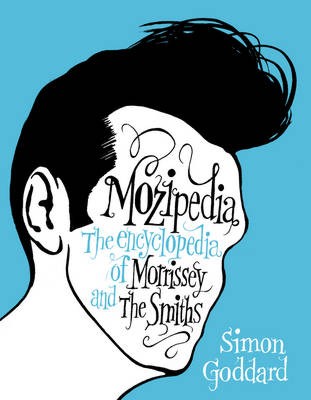
Is that too strong a word? Maybe. Morrissey is certainly the interesting and original one in this book and it ends with his story only just beginning. You can feel the tug of his later career throughout the book: it’s not discussed, but you know it’s there. But Fletcher isn’t concentrating on Morrissey and doesn’t seem very interested in Carry On and Brit-film in the 1960s, so he’s less good on what might be called the Smythos: the world created by Morrissey in his lyrics and interviews. Morrissey’s influences are better explained in Simon Goddard’s Mozipedia (2009), which isn’t just about the New York Dolls, the Cockney Rejects and vegetarianism. It has also entries for everyone from Hawtrey and Housman to Williams and Wilde by way of Sandy Shaw, Shelagh Delaney and Jobriath. No-one will ever devote an encyclopaedia to Marr like that: music doesn’t have as much meaning and metaphor in it. It has emotion and beauty instead and Fletcher is good at describing how Marr created a lot of both on albums like Meat Is Murder and Strangeways Here We Come.

Front cover of Mozipedia by Simon Goddard

Front cover of Mozipedia by Simon Goddard

I’ve never liked him much, though. I like what he did with the guitar and in the studio, but I don’t like what he did to his body and mind. Or what he put on his body: he didn’t have Mozza’s way with weeds either. In the photos, you can clearly see Morrissey’s narcissism and Marr’s weediness. It’s no surprise that Marr smoked a lot of marijuana, preferred working at night and didn’t eat properly. But he’s weedy in more ways than the physical: there’s also a photo of him with Billy Bragg, the committed socialist behind Red Wedge. This was a collective of musicians and bands who wanted to make the world a better place by fighting Fatcher, fascism and free speech with their fantastic music. Morrissey had his lefty opinions too, but he didn’t like collectives and he didn’t scorn just Margaret Thatcher and the Queen: Bob Geldof and Live Aid got the sharp side of his tongue too. Which is good. Mozza is worshipped by Guardianistas, but he’s not a Guardianista himself.

Or not wholly. The hive-mind hasn’t been able to hum him fully into line, unlike Marr and Bragg. As for Rourke and Joyce: their politics don’t matter and the most interesting thing one of them does in this book is get stung by a sting-ray (pp. 539-40). They were competent musicians, but they weren’t essential to the Smiths. Joyce is most important for causing trouble, not for strumming his bass: first there was the heroin addiction, then the 21st-century court-case in which he sued for more money and earnt Morrissey’s undying enmity. Fletcher barely mentions the court-case and ends the book in the 1980s, with the Smiths exhausted, antagonistic and unfulfilled. They never achieved their full potential and though few bands do, few bands have had more to offer than the Smiths. The Beatles were one and managed to offer it from the nearby northern city of Liverpool. They were Irish Catholic too. But, like the Smiths, they achieved success in England, not Ireland. That’s important and the younger band captured it in their name. “Smiths” is an Anglo-Saxon word with ancient roots and difficult phonetics. It seems simple, but it isn’t. Rather like light.

Hit and Smith

Front cover of Songs that Saved Your Life by Simon GoddardSongs that Saved Your Life: The Art of The Smiths 1982-87, Simon Goddard (Titan Books 2013)

I enjoyed Simon Goddard’s Mozipedia – The Encyclopedia of Morrissey and The Smiths a lot. And learnt a lot from it too. But I haven’t bothered finishing Simon Goddard’s Songs that Saved Your Life: The Art of The Smiths 1982-87 (an updated edition of The Smiths: Songs That Saved Your Life, 2002). There’s too much rock-writer rhetoric, too many mixed metaphors, too few pictures. None, in fact, apart from the band-photo on the front cover and the tickets on the back. Part of the problem is that The Smiths were only Act One in Mozza’s career. Johnny Marr played guitar well and wrote some beautiful tunes. But Morrissey was the interesting, eclectic and original one in The Smiths: the Mogpie didn’t need Marr a quarter as much as Marr needed the Mogpie. That’s part of why Mozipedia is better. Use this book as a supplement, because it’s got a lot of disc-o-detail and the appendices are good, covering The Smiths on record, in concert and on TV and radio. Goddard doesn’t have room to get rock-o-rhetorical there.

Vermilion Glands

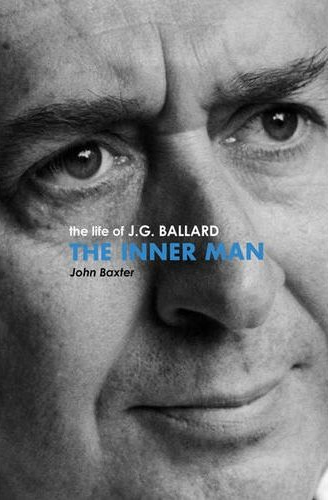
Front cover of The Inner Man The Life of J.G. Ballard by John BaxterReaders’ Advisory: Contains Self-abuse and reference to Mancas.

The Inner Man: The Life of J.G. Ballard, John Baxter (W&N 2011)

“B” is for Bataille, Burroughs, and Ballard. I’ve never read Bataille, I can’t stand Burroughs, I used to love Ballard. Nowadays I have strong doubts about him. Vermilion Sands, yes. Crash, no. Vermilion Sands is surreal, haunting, funny, endlessly inventive, and extravagantly intelligent. Crash, by contrast, is silly and sordid. The last time I tried to read it I quickly gave up. I couldn’t take it seriously any more. It’s a book for pretentious, wanna-be-intellectual adolescents of all ages who like Dark’n’Dangerous Sex’n’Violence. A book for Guardian-readers, in short – the sort of people who continually use and hear the phrase “in terms of”, who believe passionately in Equality, Justice, and the Fight against Hate, and who desperately, desperately, wished they’d been able to stimulate the largest erogenous zone in their bodies by voting for Barack Obama in 2008.

What is that erogenous zone? Well, though not all liberals are Guardianistas, all Guardianistas are liberals, so the largest erogenous zone in a Guardianista’s body is his-or-her narcissism. Guardianistas are also, alas, the sort of people who write biographies of J.G. Ballard. John Baxter is most definitely a committed component of the core community. As a big admirer of Mike Moorcock, Britain’s biggest bearded Burroughsian lit-twat, how could he not be? This is part of why I now have doubts about Ballard. I don’t like liking things that Guardianistas like and I don’t like the fact that Moorcock was mates (on and off) with Ballard. On the other hand, I do like the fact that Moorcock and the Guardian boosted Burroughs big-time back in the day and that the Guardian now bigs up Cormac McCarthy and his Dark’n’Dangerous Sex’n’Violence. Good, I think: they all deserve each other. Perhaps one day, in some drug-stoked, depravity-soaked über-orgy of trans-transgressive hyper-homoeroticism, they’ll all manage to climb up each other’s arseholes and disappear from history.

But Guardianistas don’t just like Burroughs and McCarthy: they like Ballard too. They write books about him. Fortunately, The Inner Man isn’t a good book. That would have been disturbing, believe me. The dedication is by far the best thing in it: “To the insane. I owe them everything.” And guess whose lines those are? After that, it’s mostly Baxter and mostly dull. When it’s not, you’ll usually have Ballard to thank:

Novels sent to him in hope of endorsement got short shrift. He enjoyed describing the satisfying thump of Salman Rushdie’s Midnight’s Children as it hit the bottom of the dustbin. (pg. 47) In September 1995, the Observer, for a piece about odd bequests, invited him to answer the question, “What would you leave to whom, and why?” Jim said, “I would leave Andrea Dworkin my testicles. She could have testicules flambés.” Anti-pornography campaigner Dworkin was a close friend of Mike and Linda Moorcock but a bête noire of Ballard’s. (pg. 308)

I think Ballard was right in his cod-bequest for Dworkin and bum’s-rush for Rushdie. And if Baxter had the same sense of humour and mischief, The Inner Man would have been a much better book. Okay, it’s not that bad, because I managed to finish it, but that was disappointing in its own way. I’d almost have preferred a boldly, flamboyantly pretentious Ballard bio full of solecisms and mixed metaphors to a plodding, mediocre one like this. I like sneering at and feeling sniffily superior to Guardianistas. And all I’ve got to go on here are occasional lines like these:

Like another diligent civil servant, he [Ballard] was Agent 00∞: licensed to chill… (pg. 3) But in surrealism, as in most things, Jim was drawn to the extremity, the dangerous edge, the abyss which, as H.G. Wells warned, will, if you stare into it long enough, stare back at you. (pg. 36)

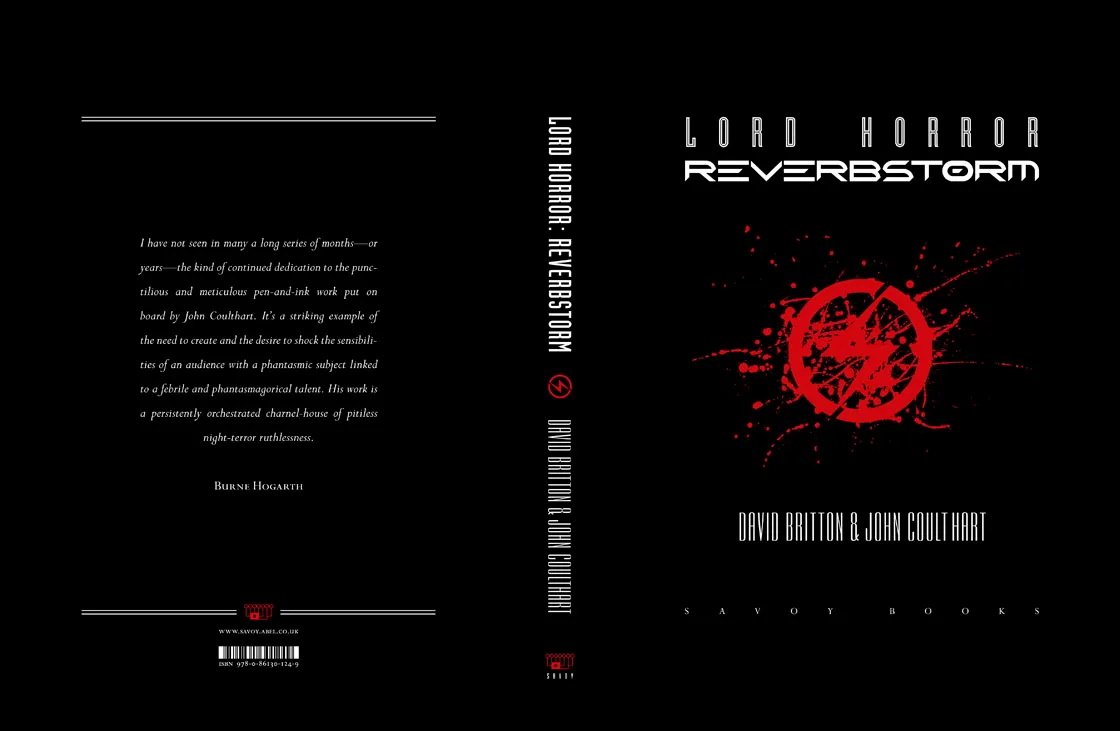
It’s puzzling that Baxter misattributes such a famous quote and that his editors didn’t spot the misattribution. It’s also puzzling that Baxter doesn’t seem to like Ballard much, to be very interested in Ballard’s life, or to be very enthusiastic about Ballard’s writing. Born in Shanghai, incarcerated (and half-starved) under the Japanese during the war, trained as a doctor: Ballard had an unusual early life for a writer and one can only admire Baxter’s ability to keep the interest out of it. Baxter devotes much more attention to Ballard’s time in advertising and life in suburbia. Yes, the contrast between this apparently staid existence and the wildness of Ballard’s veridically visceral visions is interesting, but it’s obviously related to his early experiences in China. Baxter has got those out of the way within the first 26 pages of a 377-page book. When he himself takes visionary flight, he doesn’t do so to Ballard’s advantage. Why did Ballard turn down the chance to be published in “a series of de luxe limited editions of fantasy classics” by Manchester’s most maverick messiahs, “the radical publishing enterprise of Savoy Books”? Baxter conducts an interview with his own imagination and reports back with this:

He may have felt that involvement with Savoy and [David] Britton – who had already served two prison terms under the Obscene Publications and Dangerous Dogs Acts – risked once again placing him in hazard, as had been the case with “Why I Want to Fuck Ronald Reagan”. (pg. 321)

Eh? Yes, he “may”, but simpler explanations are to hand. Either way, Baxter says the rejection meant that “a sense of grievance” now “permeated his relationship with” the messianic Mancas. Again: Eh? The grievance would have been one-sided, there was never much of a relationship, and although Savoy “put a lot of effort” into persuading Fenella Fielding to record extracts from one of Ballard’s books (no prizes for guessing which), they put in the effort without first asking Ballard if he was interested. When the recordings were made and they did ask, he “refused to cooperate”. It was now that grievance began to permeate the relationship.

Reading about this important episode in Ballard’s career, I felt another feeling begin to permeate me. A familiar feeling. Yes, “S” is for Savoy (B), Sontag (S), and Self (W). All three turn up in this biography, variously offering to publish Ballard, heaping praise on him, and having dinner with him. All three are part of the Guardianista demographic in one way or another: Self nails his colours firmly to the gasbag when he speaks of a “scintilla” of an “affectation” that forms an “armature” (pg. 341). All three add to my doubts about Ballard. If people like that like him, should I like him too, like? I think if Ballard had been born ten or twenty years later, the question wouldn’t arise. A younger Ballard would have been sucked fully into the macroverse of Guardianista subversion, radicalism, and counter-cultural twattishness and I’d never have liked him at all. As it was, he was too big to entirely fit. Crash got sucked and does suck. Vermilion Sands didn’t and doesn’t.

And this biography? Well, it could have been much worse. Yes, it’s dull but that may be partly because Ballard himself is such an interesting and memorable writer. As I’ve pointed out elsewhere, the danger in literary biographies is that the biographee is likely to be a better writer than the biographer. The implicit comparison will always be there and Ballard’s autobiography, Miracles of Life (2008), is likely to remain better, and briefer, than anything a biographer ever turns out. But Baxter tells you about things that Ballard doesn’t, possibly because they’re not true. Like the air of menace Ballard could project and his occasional violence towards his girlfriend Claire Walsh, who “appeared at parties with facial bruises, usually hidden between sunglasses” (pg. 187).

And “girlfriend” is the word: Baxter reports that Ballard “always” and “anachronistically” used it of Walsh (pg. 171), rather than (he implies) the smarmy Guardianista “partner”. Good for Ballard. But bad for Ballard in terms of engagement with issues around the bruises, if true. As George Orwell said:

If Shakespeare returned to the earth to-morrow, and if it were found that his favourite recreation was raping little girls in railway carriages, we should not tell him to go ahead with it on the ground that he might write another King Lear. (“Benefit of Clergy: Some Notes on Salvador Dalí”, 1944)

It would have been better that Ballard hadn’t punched his girlfriend, just as it would have been better that Caravaggio hadn’t been a murderer. But if they hadn’t been violent men, with more than a touch of psychosis, they might not have produced such interesting art. I don’t think Ballard is as significant a figure in European art as Caravaggio, and even if he is, he and his art won’t have as much time to be significant in. One way or another, Europe is now entering its final days. We are about to reap the whirlwinds so diligently sown for us by the Guardianistas and their continental cousins. And science is busy measuring mankind for its coffin. Ballard saw and wrote about parts of this future, but I now prefer his surreal side to his sinister and his dreams to his depravity. It’s bad, v. bad, that Will Self hails Ballard as “My single most important mentor and influence.” But Self (thank Bog) didn’t write this biography. He didn’t write Vermilion Sands either. He couldn’t. Ballard could and did. He could and did write other good stuff. I don’t love him any more, but, despite the Guardian and the Guardianistas, I will continue to read him. Lucky Jim, eh?


Post-Performative Post-Scriptum…

In terms of all Savoy-fans and other non-conformist mavericks, keyly committed core components of the counter-cultural community et al having read this review prior to departing in terms of departure… please can you stop using “in terms of” and “prior to” and stuff? You wouldn’t allow bloated flesh to adversely impact your body, so why do you allow bloated phrases to negatively trajectorize your English?

Ex-term-in-ate! — more on “in terms of”
Prior Analytics — more on “prior to”