
“SSV are not the Sisters. Their official full name is SSV-NSMABAAOTWMODAACOTIATW. Could this possibly stand for ‘Screw Shareholder Value — not so much a band as another opportunity to waste money on drugs and ammunition, courtesy of the idiots at Time Warner’? Surely not. That would require a comma.” — Andrew Eldritch.
Tag Archives: rock music
Performativizing Papyrocentricity #38
Papyrocentric Performativity Presents:
• Nature by Numbers – 30-Second Elements: The 50 Most Significant Elements, Each Explained in Half a Minute, ed. Eric Scerri (Icon 2013)
• Fresh Flesh – The Complete Illustrated Guide to Freshwater Fish & River Creatures, Daniel Gilpin and Dr Jenny Schmid-Araya (Hermes House 2011)
• The Reich Stoff – Rocket and Jet Aircraft of the Third Reich, Terry C. Treadwell (Spellmount 2011)
• Past Masters – Justice for All: The Truth about Metallica, Joel McIver (Omnibus Press, revised edition 2014)
• Ant on E – Burgess on Waugh
• M.O.R. of Babylon – Sleazy Listening: Frottage, Fladge and Frenzied Fornication in the Music of the Carpenters, Dr Miriam B. Stimbers (University of Nebraska Press 2015)
Or Read a Review at Random: RaRaR
Performativizing Papyrocentricity #36
Papyrocentric Performativity Presents:
• Tormenting the Tongue – Georgian Dictionary and Phrasebook, Nicholas Awde and Thea Khitarishvili (Hippocrene Books 2011)
• Roc and Rawl – Rise of the Super Furry Animals, Ric Rawlins (The Friday Project 2015)
Or Read a Review at Random: RaRaR
Performativizing Papyrocentricity #26
Papyrocentric Performativity Presents:
• World Wide Wings – The Big Book of Flight, Rowland White (Bantam Press 2013)
• Kite Write – The Kite-Making Handbook, compiled by Rossella Guerra and Giuseppe Ferlenga (David & Charles 2004)
• Gun Guide – Small Arms: 1914-45, Michael E. Haskew (Amber Books 2012)
• The Basis of the Beast – Killers: The Origins of Iron Maiden, 1975-1983, Neil Daniels (Soundcheck Books 2014)
Or Read a Review at Random: RaRaR
Performativizing Papyrocentricity #19
Papyrocentric Performativity Presents:
• Book in Black – Black Sabbath: Symptom of the Universe, Mick Wall (Orion Books 2013)
• Critical Math – A Mathematician Reads the Newspaper, John Allen Paulos (Penguin 1996)
• Rude Boys – Ruthless: The Global Rise of the Yardies, Geoff Small (Warner 1995)
• K-9 Konundrum – Dog, Peter Sotos (TransVisceral Books 2014)
• Ghosts in the Cathedral – The Neutrino Hunters: The Chase for the Ghost Particle and the Secrets of the Universe, Ray Jayawardhana (Oneworld 2013) (posted @ Overlord of the Über-Feral)
Or Read a Review at Random: RaRaR
Guns’n’Gladioli
 A Light That Never Goes Out: The Enduring Saga of the Smiths, Tony Fletcher (Windmill Books 2013)
Coke, booze, earsplitting volume. Not a combination you associate with the Smiths. But it was there, as you’ll learn from this book. Towards the end, they were almost turning into Guns’n’Gladioli. Morrissey, of course, was the odd one out: he wasn’t battering his brain-cells with drink and drugs on their final American tour. But back home his Lichtmusik was also lout-music: the Smiths didn’t just appeal to bedsit miserabilists in rain-hammered humdrum towns. No, they appealed to some football hooligans too, including a Chelsea fan who didn’t mind being asked, “You still wanking off over that miserable northern poof?” as he travelled north by train to do battle with Manchester United and Manchester City, who also supplied hoolifans to the Smiths (pp. 509-10). So did football clubs in Glasgow and Edinburgh. The Smiths are easy to caricature, but the caricatures don’t capture their complexity.
Tony Fletcher does capture it: the band, their music, their fans, friends, producers, studio-engineers and record-labels. He’s definitely a Guardianista, but his prose is plodding rather than painful and he does a good job of putting the poof and his partners into context. The 1980s is one important part of that context. So are Irish Catholicism and Manchester. When you look at pictures of the Smiths, you can see two clear divisions. One of them separates the singer, guitarist and drummer from the bassist: the dark-haired, bushy-browed, strong-faced Morrissey, Johnny Marr and Andy Rourke clearly belong to one race and the light-haired, lesser-browed, milder-faced Mike Joyce to another. They’re Irish and he’s English: the British Isles are rich in language and rich in biology too. But Morrissey’s height and handsomeness also separate him from Marr, Rourke and Joyce, like his polysyllabic name. Both must be related to his intelligence, his creativity and his ability to turn himself into the Pope of Mope and become much more famous than any of the other three. Fletcher doesn’t talk about this biology – as I said, he’s a Guardianista – but it’s implicit in his descriptions of Irish settlement in Manchester and of Morrissey’s genius.
Is that too strong a word? Maybe. Morrissey is certainly the interesting and original one in this book and it ends with his story only just beginning. You can feel the tug of his later career throughout the book: it’s not discussed, but you know it’s there. But Fletcher isn’t concentrating on Morrissey and doesn’t seem very interested in Carry On and Brit-film in the 1960s, so he’s less good on what might be called the Smythos: the world created by Morrissey in his lyrics and interviews. Morrissey’s influences are better explained in Simon Goddard’s Mozipedia (2009), which isn’t just about the New York Dolls, the Cockney Rejects and vegetarianism. It has also entries for everyone from Hawtrey and Housman to Williams and Wilde by way of Sandy Shaw, Shelagh Delaney and Jobriath. No-one will ever devote an encyclopaedia to Marr like that: music doesn’t have as much meaning and metaphor in it. It has emotion and beauty instead and Fletcher is good at describing how Marr created a lot of both on albums like Meat Is Murder and Strangeways Here We Come.
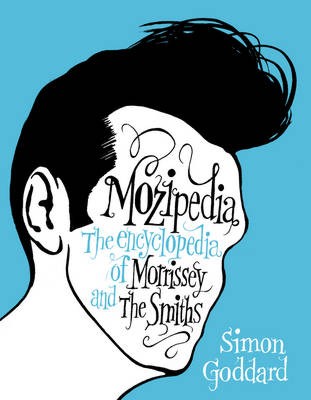
Front cover of Mozipedia by Simon Goddard
I’ve never liked him much, though. I like what he did with the guitar and in the studio, but I don’t like what he did to his body and mind. Or what he put on his body: he didn’t have Mozza’s way with weeds either. In the photos, you can clearly see Morrissey’s narcissism and Marr’s weediness. It’s no surprise that Marr smoked a lot of marijuana, preferred working at night and didn’t eat properly. But he’s weedy in more ways than the physical: there’s also a photo of him with Billy Bragg, the committed socialist behind Red Wedge. This was a collective of musicians and bands who wanted to make the world a better place by fighting Fatcher, fascism and free speech with their fantastic music. Morrissey had his lefty opinions too, but he didn’t like collectives and he didn’t scorn just Margaret Thatcher and the Queen: Bob Geldof and Live Aid got the sharp side of his tongue too. Which is good. Mozza is worshipped by Guardianistas, but he’s not a Guardianista himself.
Or not wholly. The hive-mind hasn’t been able to hum him fully into line, unlike Marr and Bragg. As for Rourke and Joyce: their politics don’t matter and the most interesting thing one of them does in this book is get stung by a sting-ray (pp. 539-40). They were competent musicians, but they weren’t essential to the Smiths. Joyce is most important for causing trouble, not for strumming his bass: first there was the heroin addiction, then the 21st-century court-case in which he sued for more money and earnt Morrissey’s undying enmity. Fletcher barely mentions the court-case and ends the book in the 1980s, with the Smiths exhausted, antagonistic and unfulfilled. They never achieved their full potential and though few bands do, few bands have had more to offer than the Smiths. The Beatles were one and managed to offer it from the nearby northern city of Liverpool. They were Irish Catholic too. But, like the Smiths, they achieved success in England, not Ireland. That’s important and the younger band captured it in their name. “Smiths” is an Anglo-Saxon word with ancient roots and difficult phonetics. It seems simple, but it isn’t. Rather like light.
He Say, He Sigh, He Sow #18
“Even so, firing a man for ordering a salad…”
“The salad was the last straw.” — Life lessons: Mark E Smith, The Independent, 13/xi/2011.
Performativizing Papyrocentricity #16
Papyrocentric Performativity Presents:
• Brit Grit – Granite and Grit: A Walker’s Guide to the Geology of British Mountains, Ronald Turnbull (Francis Lincoln 2011)
• Singh Summing Simpsons – The Simpsons and Their Mathematical Secrets, Simon Singh (Bloomsbury 2013)
• Go with the Quo – Status Quo: Still Doin’ It – The Official Updated Edition, compiled by Bob Young, edited by Francis Rossi and Rick Parfitt (Omnibus Press 2013)
• Breeding Bunnies – The Golden Ratio: The Story of Phi, the Extraordinary Number of Nature, Art and Beauty, Mario Livio (Headline Review 2003) (posted @ Overlord of the Über-Feral)
• Brit Bot Book – Reader’s Digest Field Guide to the Wild Flowers of Britain, J.R. Press et al, illustrated Leonora Box et al (1981) (@ O.o.t.Ü.-F.)
Or Read a Review at Random: RaRaR
More Musings on Music
• Black Mother Nirvana — from the potency of Purushmedh to the blast-beat barrage of Bodhisattva
• Groaning and Grieving — the ashen passion of Slough of Despond
• Pummelling Putridity — probing the purulence and putrefaction of Paraphistomiasis
Elsewhere other-posted:
• More Musings on Music
Performativizing Papyrocentricity #15
Papyrocentric Performativity Presents:
Brought to Book – A Book of English Essays, selected by W.E. Williams (Pelican 1942)
Glamourdämmerung – Treasures of Nirvana, Gillian G. Gaar (Carlton 2011)
Highway to Hell – The Road, Cormac McCarthy (2006)
Solids and Shadows – An Adventure in Multidimensional Space: The Art and Geometry of Polygons, Polyhedra, and Polytopes, Koji Miyazaki (Wiley-Interscience 1987) (posted @ Overlord of the Über-Feral)
Magna Mater Marina – The Illustrated World Encyclopedia of Marine Fish and Sea Creatures, Amy-Jane Beer and Derek Hall (Lorenz Books 2007) (@ O.o.t.Ü.-F.)
Or Read a Review at Random: RaRaR
 Overlord In Terms of Core Issues Around Maximal Engagement with Key Notions of the Über-Feral