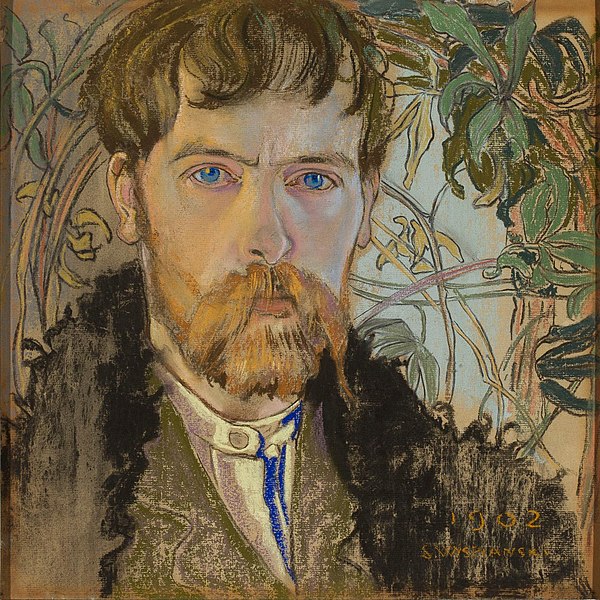
Eye See Blue

(Translated and edited by Simon Whitechapel)
In the black mirroring surface of the canal, these things: a sky very high and clear, the blue infinite interior of the skull of a god2 brooding beauty and pain into the world; the walls that line the canal, white marble, sharp-edged; the vivid mosaics of precious stone with which the walls are set: oval belladonnic eyes of emerald and obsidian in faces of sculpted mammoth ivory; the mouths of jade3-lipped bayadères leaking ruby threads of wine; the topaz fingers and wrists of rhodolite4-crowned lutanists; quartz-glistered sinews in the arms of capon5-plump eunuchs fanning the dances of turquoise6-skinned odalisques who prance and beck in frozen heated showers of opal-drop sweat.
But all, in the mirroring water, is grey.7
In the black mirroring surface of the canal, these things: a broad slab of basalt to which is bound a naked man8, white against the stone’s darkness, black-haired and bound with soft unbreakable bonds of purple silk; on his belly have been painted the red strokes and hooks and curls of the ideogram for death, like the roaring fist-talon and shank of a stooping hawk9 or the opening hungry maw of a leopard10, a splash of red tissues ringed and spiked and shaped by white barbs of teeth.
But all, in the mirroring water, is grey.
In the black mirroring surface of the canal, these things: five swans; their bright, forward-sweeping eyes are set in white, oval-skulled heads that are enwedged with yellow, black-rooted beaks; their white, smooth-feathered, twice-curved necks, slender as stems, are shivered on the ripples of the passage of bodies that are white seed-pods curling to smooth, hooked tails. Five swans, silent white swans. Their beaks are small and regular as the hardened gold heads of the ritual axes of the Temple of the Thanatocrator11, which sound tchlunk tchlunk tchlunk in the skulls of the sacrifices, opening slotted, red-welling ways for the prosempyreal passage of the soul.
But all, in the mirroring water, is grey.
In the black, mirroring surface of the canal, this: the white swans clustered on the white body of the sacrifice. Their necks dart and sway, sowing moist red blooms into the fertile milk of his skin. He strains against his bonds, but the necks fall, the heads hammer with steady, unconscious grace, opening the blooms to full flower. In the mirroring water they are beautiful, like strewn blossoms12 for the feet of the Thanatocrator, who dances his hatred into the waking dreams of the world. The sacrifice is dead and the swans are streaked and smirched and spotted with gore, like heavy white flowers in a garden of torture.
Their necks bend and sway, and their beaks open and close, but in the mirroring water their voices are silent, and how may we tell what they say?
NOTES
1. Trained swans were the favored form of execution under the insane and semi-legendary nymphomane Queen Sphalaghd (1-143 Anno Dominæ; 1137-1279 Anno Secundi Imperii), whose extravagances came nigh to ruining the kingdom before, after many hesitations on and retreats from the threshold, she converted fully to the austere and life-denying doctrines of the Thorn-God in the final lustrum of her nigromantically prolonged life.13 She was canonized by the Temple thirteen years after her death.
2. An obvious reference to the Thorn-God, and in another context the Yihhian (mhló)Kiùlthi might be translated “(of) the god”, but the use of the non-hieratic noun marker gives the flavor of the indefinite article in English and contributes to the sense of brooding anonymity in the story.
3. This is believed to be a satirical reference to Yokh-Tsiolphë’s own religion (see note 8 below), that of the Moon-Deity, whose abstemious priestesses wore strongly colored make-up while performing their ritual dances under the full moon.
4. From its use in other texts retrieved oneirically from the Temple, the hieroglyph appears to refer to some rose-colored semi-precious mineral, and I have chosen to translate the word as “rhodolite”: coronemus nos rosis antequam marcescant (“let us crown us with roses before they be withered”, Sapientia Solomonis 2:8) was a sentiment accepted in its widest possible sense at the week-long feasts held during the long years of Queen Sphalagdh’s dissipation.
5. Possibly a castrated form not of the domestic hen (Gallus domesticus) but of the peacock (Pavo cristatus).
6. Again a possible satirical reference to the priestesses of the Moon-Deity.
7. Mirrors in the Temple were only of dark minerals, principally basalt, haematite, and black coral (Gorgonia spp), for the priests taught that color was one of the snares of sensuality by which the world entrapped men’s souls. Accordingly, possession of a fully reflecting mirror was an excommunicable offence for members of the Thorn-God’s congregation.
8. The story is believed to refer to the execution of a nobleman called Yokh-Tsiolphë (Yugg-Siurphë in some texts), who had offended the Queen either by refusing to sacrifice his eldest son and daughter to the Thorn-God or (as most scholars now believe) by falling under suspicion of having composed an anonymous pasquinade against the Thorn-God which was briefly circulated at the royal court in 38 A.D./1174 A.S.I. The execution would have been one of the earliest signs of the Queen’s growing regard for the Thorn-God.
9. The Yihhian here is a little unclear and the reference is perhaps to the Osprey (Pandion haliætus), which was second only to the Great Grey Shrike (Lanius excubitor) in the ornithomancy of the Temple.
10. The Yihhian kiuthi literally means “spotted one” and can refer to several species of animal; “leopard” seems the most appropriate translation in this context.
11. Niédýthithlà (mhló)Nhriúlr, literally “deathly lord(’s)”, was a title of the Thorn-God, but the foreign derivation of the words in Yihhian means it is perhaps best translated into English as “thanatocrator”.
12. Blossoms of gorse (Ulex spp) and other spinose plants were thrown beneath the feet of dancing priests during rituals at the Temple, and many of the Temple’s hymns refer to osmomancy, or divination by the scents released from the crushed petals.
13. She is said to have been planning another round of the puerile and puellar sacrifices with which she purchased her unnatural youth at the time of her death, occasioned when she slipped on trampled petals in the Temple of the Thorn-God whilst approaching the altar for blessing and was impaled on the silver thorns topping a newly erected altar-rail. Some contemporary commentators hinted at numerological significance in her death, saying that the priests of the Thorn-God had persuaded her that by laying down her life at that age she would regain it at the beginning of the next cosmic cycle. It is possible, therefore, that the encephalotomy and cardiotomy of her ritual mummification were feigned.
Below is one of the best album-covers I’ve ever seen. It’s a triumph of subtlety and simplicity:

Burning Witch, Crippled Lucifer (1998)
The American blackened doom sludge-sters Burning Witch used Sorgen / Sorrow (1894-5), a painting by the Norwegian painter Theodor Kittelsen (1857-1914), to conjure an atmosphere of despair and darkness. Here is the original painting, skilfully combining snow, darkness and despair:

Theodor Kittelsen, Sorgen (1894-95)
But while the painting and album are good examples of less-is-more, the album is also an example of less-and-more. Part of its power comes from the contrast between the simplicity of the wandering figure and the complexity of the scripts used for the band’s name and album title:

Crippled Lucifer (detail)
Usually images are more detailed than writing. Here it’s the reverse. And while you can easily read the writing, despite its complexity, you can’t “read” the figure, despite its simplicity. Kittelsen’s skilful simplicity raised questions that can’t be answered. Is the figure male or female? Why is it sorrowful? Where is it going?
Well, you can say where it’s going in one sense: it’s walking from left-to-right. And that made me wonder whether the album could have become even starker in its contrasts. If you’re literate in Norwegian or English, you naturally read images from left-to-right, because that’s the direction of the Roman alphabet. On the album, you read the figure and the writing in the same direction. They contrast starkly in other ways, but they don’t contrast there. So let’s try making them contrast there too. Compare these two versions of the cover:
Crippled Lucifer (original cover)
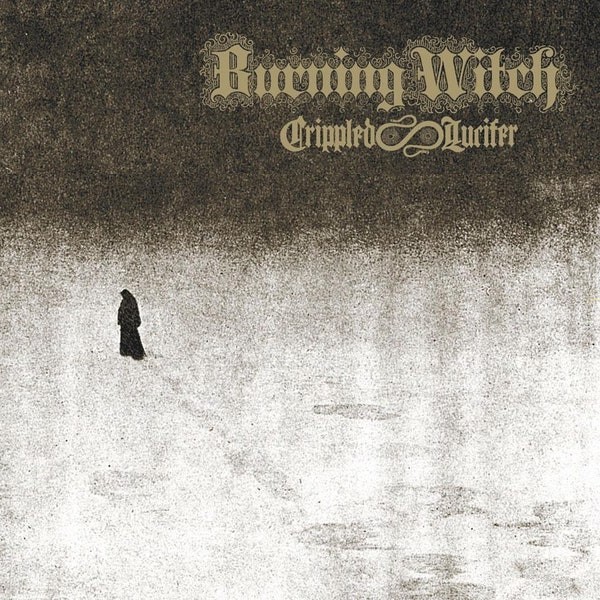
Crippled Lucifer (figure-and-snowscape mirrored)
I think there’s something emptier and more despairing in the mirrored figure, walking from right-to-left. On the original cover, the figure is in some sense walking into the future, despite the weight of sorrow it carries. As we read from left to right along a piece of writing, what’s to the left of our eye is the past, and what’s to the right is the future. The figure carries the same implication. And because the figure moving towards the highly-complex-but-perfectly-intelligible band-name-and-title, there’s almost an implication that its story will be told, even if it’s moving towards death or suicide.
When the image is mirrored, all that disappears. Moving from right-to-left, the figure seems to be walking into the past, not the future. It’s no longer near or moving towards the complexity-and-intelligibility of the band-name-and-title. It’s abandoning the world more strongly: there’s no hope, no future, no implication that its story will be told.
I think the same happens, though less strongly, when the original painting is contrasted with a mirrored version:
Sorrow (original)
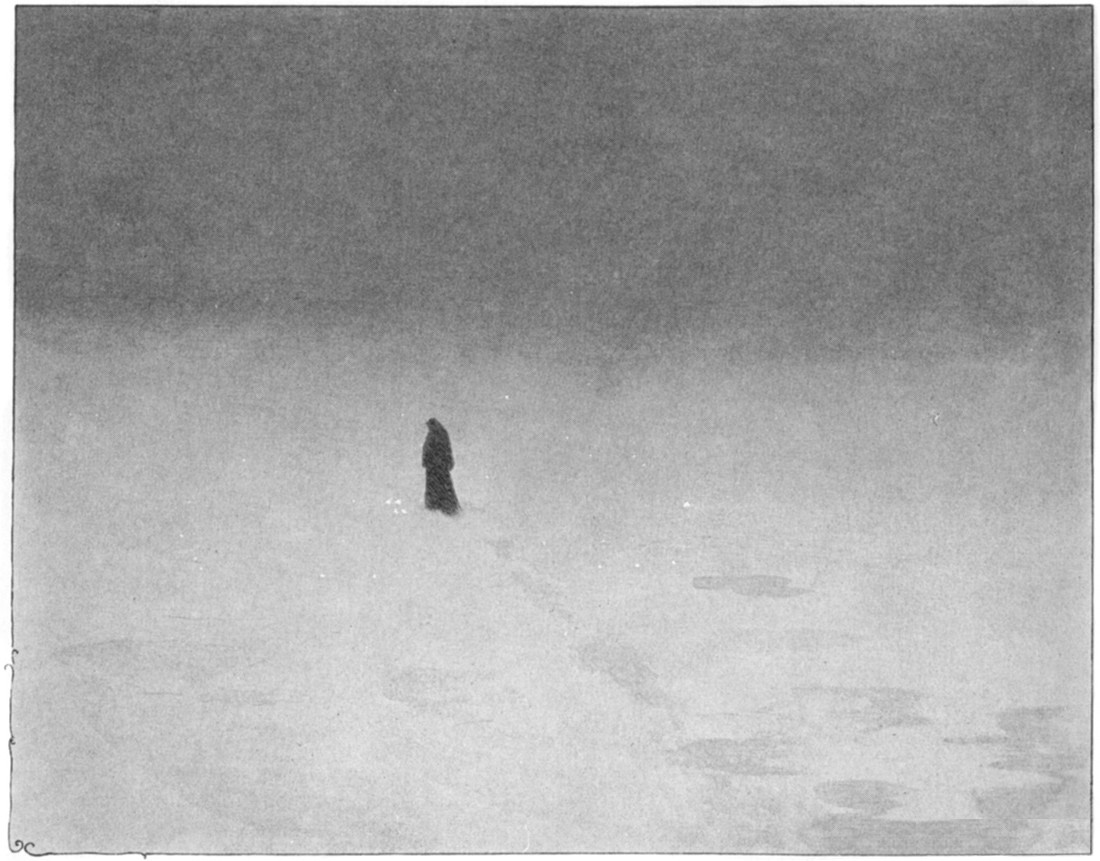
Sorrow (mirrored)
The contrast is less stark because, unlike the album-cover, there’s no complex patch of writing in the painting and the figure is moving away from what writing there is: the artist’s signature in the bottom left. In the original, the figure is abandoning identity and intelligibility by moving away from the signature. That’s why I’ve removed the signature in the mirrored version of the painting. It would be anomalous on the right, whether or not it was mirror-reversed, and it would be anomalous if it stayed on the left.
Finally, here’s a photo of two musicians in Sunn O))), the band into which Burning Witch eventually evolved:
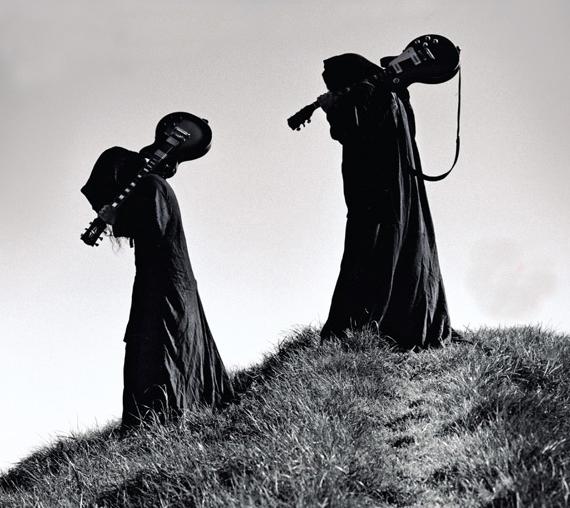
Sunn O))) in black robes
In the original, Stephen O’Malley and Greg Anderson are walking from right-to-left. Here’s a mirrored version for comparison:
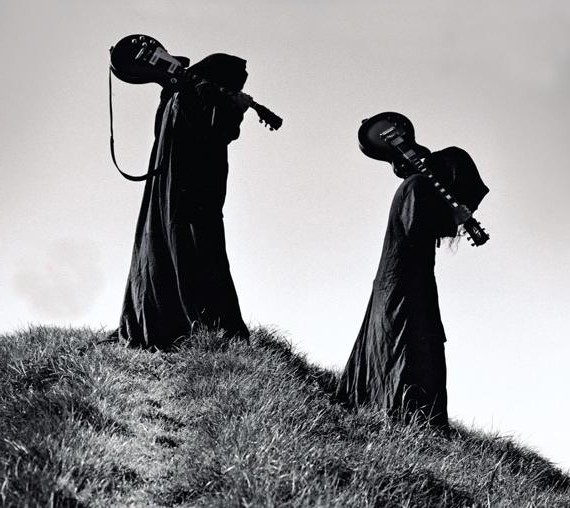
Sunn O))) photo (mirrored)
I think the original photo has more power, because the robed figures are walking against the grain, as it were — against the direction in which our Roman-alphabet-conditioned eyes read a photo.
“Ich habe unter meinen Papieren ein Blatt gefunden,” sagte Goethe, “wo ich die Baukunst eine erstarrte Musik nenne.” — Gespräche mit Goethe, Johann Peter Eckermann (1836)
• “I have found a sheet among my papers,” said Goethe, “where I call architecture a frozen music.” — Conversations with Goethe
N.B. The aphorism “Architecture is frozen music” has also sometimes been attributed to Friedrich von Schelling (1775-1854) and Ganopati Sthapat (1927-2011).
Peri-Performative Post-Scriptum
The toxic title of this paronomastic post is a key reference to core Beatles album Please Please Me (1963).
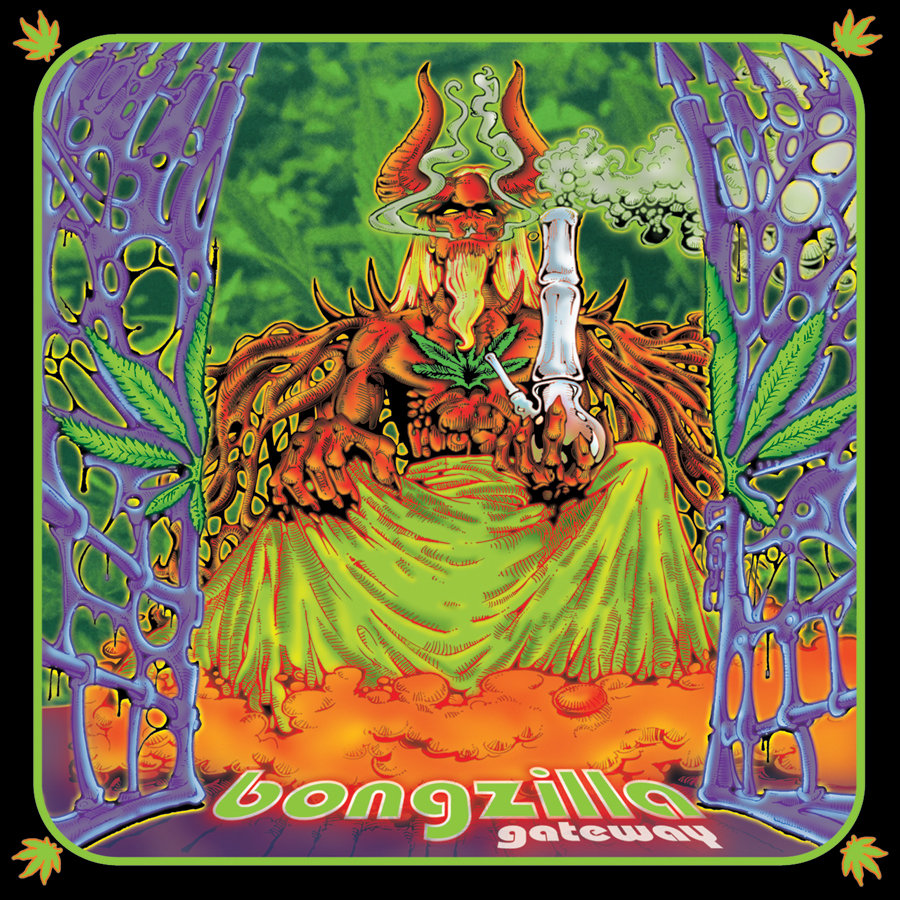
Although this blog stands strongly and sternly against the use of any drugs weaker than water (which is all of ’em), some interesting art has been inspired by those weaker drugs. The front cover of Bongzilla’s Gateway (2002) by Malleus Rock Art Lab is a good and skilful example. Please be aware, however, that smoking grass is more likely to induce psychosis than turn you into a golden goat-god. Especially coz artificially strengthened varieties of grass are not what Gaia intended. (dot dot dot)
Post-Performative Post-Scriptum
Yes, the horns on the album-cover are those of a bovid, not a caprid, but I like to think of the image being that of a goat-god rather than a bull-god.

Woodcut of a waterfall by Reynolds Stone (1909-79)
It’s the wrong kind of waterfall to go with this passage from Nietzsche, but that can’t be helped dot dot dot colon
Am Wasserfall. — Beim Anblick eines Wasserfalles meinen wir in den zahllosen Biegungen, Schlängelungen, Brechungen der Wellen Freiheit des Willens und Belieben zu sehen; aber Alles ist nothwendig, jede Bewegung mathematisch auszurechnen. So ist es auch bei den menschlichen Handlungen; man müsste jede einzelne Handlung vorher ausrechnen können, wenn man allwissend wäre, ebenso jeden Fortschritt der Erkenntniss, jeden Irrthum, jede Bosheit. Der Handelnde selbst steckt freilich in der Illusion der Willkür; wenn in einem Augenblick das Rad der Welt still stände und ein allwissender, rechnender Verstand da wäre, um diese Pausen zu benützen, so könnte er bis in die fernsten Zeiten die Zukunft jedes Wesens weitererzählen und jede Spur bezeichnen, auf der jenes Rad noch rollen wird. Die Täuschung des Handelnden über sich, die Annahme des freien Willens, gehört mit hinein in diesen auszurechnenden Mechanismus. — Friedrich Nietzsche, Menschliches, Allzumenschliches: Ein Buch für freie Geister (1878)
AT THE WATERFALL.—In looking at a waterfall we imagine that there is freedom of will and fancy in the countless turnings, twistings, and breakings of the waves ; but everything is compulsory, every movement can be mathematically calculated. So it is also with human actions ; one would have to be able to calculate every single action beforehand if one were all-knowing ; equally so all progress of knowledge, every error, all malice. The one who acts certainly labours under the illusion of voluntariness ; if the world’s wheel were to stand still for a moment and an all-knowing, calculating reason were there to make use of this pause, it could foretell the future of every creature to the remotest times, and mark out every track upon which that wheel would continue to roll. The delusion of the acting agent about himself, the supposition of a free will, belongs to this mechanism which still remains to be calculated. — Friedrich Nietzsche, Human, All-Too Human: A Book for Free Spirits (1908)
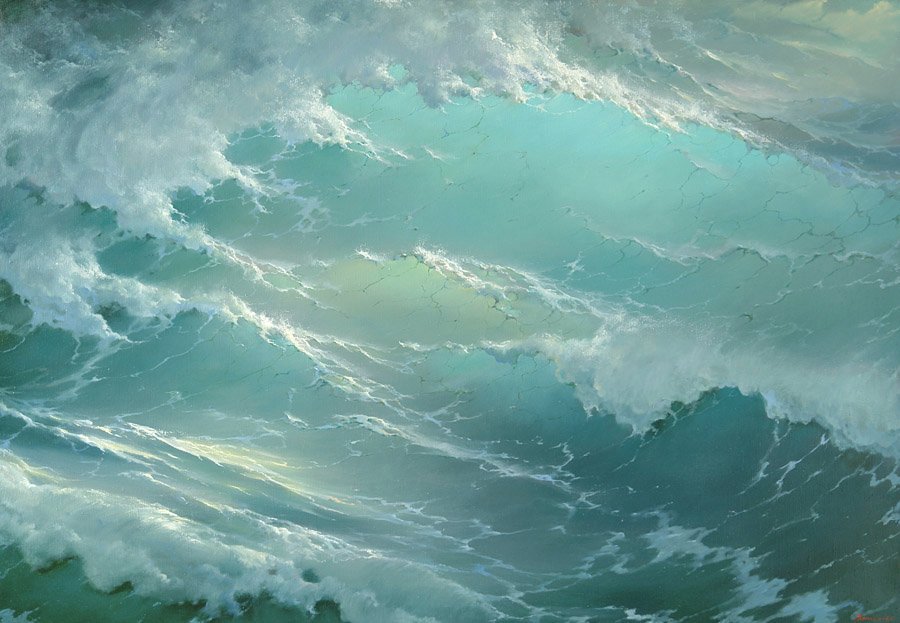
Study of waves, wave-crests and foam by the Armenian artist Ivan Aivazovsky (1817-1900)
Aivazovsky was a citizen of Imperial Russia whose name is Հովհաննես Այվազյան in Armenian and Иван Айвазовский in Russian.
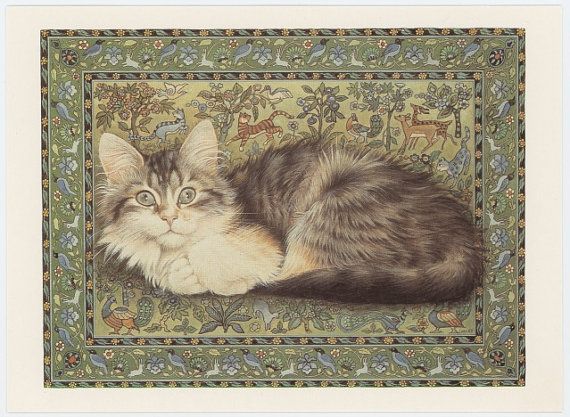
Cat-painting by Lesley Anne Ivory (born 1934)
Peri-Performative Post-Scriptum
The title of this incendiary intervention can be parsed as a nominative noun followed by a past (or even present) participle followed by a locative noun. Indeed, that is how it’s supposed to be parsed.
“Será tan breve que ya he terminado,” — Salvador Dalí, Con la frase “Ja soc aquí”, Dalí abrió una surrealista conferencia de Prensa, El País, 25×1980
Salvador Dalí […] once gave the world’s shortest speech – six seconds in duration. He said, “I will be so brief I have already finished,” and he sat down. — Edward O. Wilson
Previously pre-posted
• A Seriously Sizzling Series of Super-Saucy Salvadisms — more good quotes by Salvador Dalí

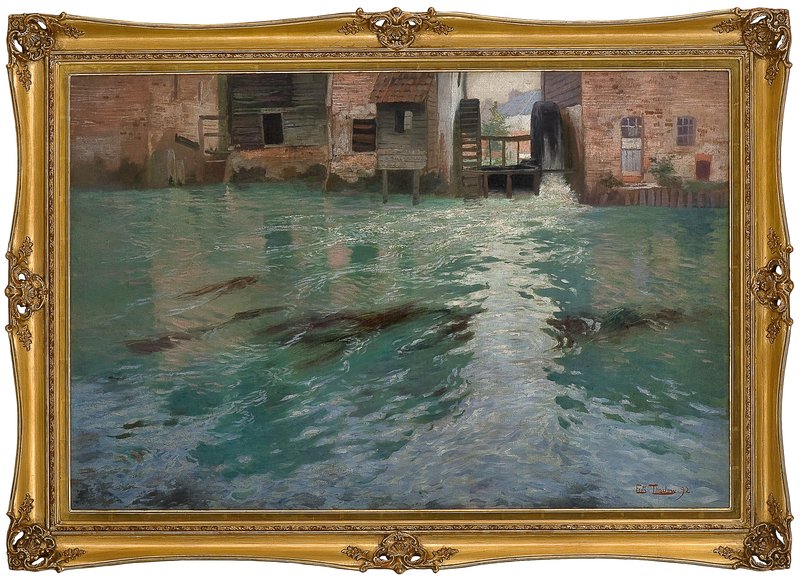
Water Mill (1892) by the Norwegian impressionist Frits Thaulow (1847-1906)
Thaulow painted this almost identical “Bak møllene, Montreuil-sur-Mer” (1892):
 Overlord In Terms of Core Issues Around Maximal Engagement with Key Notions of the Über-Feral