Terminal Breach

It’s said that, if you hear “in terms of” 23 times in 23 hours on the 23rd of the month, the ghost of William Burroughs will appear and offer you a heroin enema.

I don’t know whether this is true.


Elsewhere other-engageable:

William S. Burroughs
Alan Moore, C.B.E.
Michael Moorcock
Will Self
Stewart Home
Cormac McCarthy
Dr Joan Jay Jefferson
Serpent’s Tail
Titans of Trangression

Bestia Bestialissima

Auberon Waugh called himself a “practitioner of the vituperative arts”. Perhaps it was a Catholic thing. And unless you know Latin, you won’t understand. Or you won’t understand as much as you might. I don’t know Latin well, but I can appreciate some of the wonderful vituperation in a book of Latin exorcisms I’ve found scanned at Google Books. The title alone is good: Flagellum Daemonum: Exorcismos Terribiles, Potentissimos et Efficaces, which means (I think) The Flail of Demons: Exorcisms Terrible, Most Potent and Effective. Or is the title Fustis Daemonum: Adiurationes Formidabiles, Potentissimas et Efficaces, meaning The Cudgel of Demons: Adjurations Formidable, Most Potent and Effective?
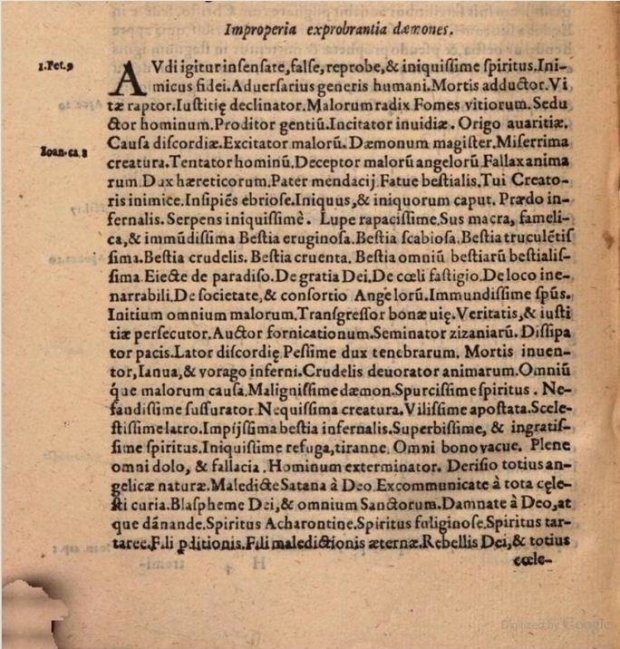
Vituperation from the Flagellum Daemonum (1644)

Vituperation from the Flagellum Daemonum (1644)


Either way, one of the exorcisms contains a good list of curses directed at the Devil. He’s called Bestia Omnium Bestiarum Bestialissima, meaning “Beast of All Beasts the Most Beastly”. Beside that, there are Dux Hæreticorum and Lupus Rapacissimus, “Duke of Heretics” and “Most Rapacious Wolf”. There’s an odd Sus Macra, Famelica, et Immundissima, which means something like “Scrawny, Famished and Most Filthy Hog”. Lovecraft would have liked Nefandissimus Susurrator, “Most Unspeakable Whisperer”, and Draco Iniquissimus, “Most Iniquitous Dragon”.

Pessimus Dux Tenebrarum is “Most Evil Duke of Darkness” and Janua et Vorago Inferni is “Door and Abyss of Hell”. Seminator Zizaniarum, meaning “Sower of Tares”, refers to Matthew xiii, 25: “But while men slept, his enemy came and sowed tares among the wheat, and went his way.” And those are only a few of the curses poured on the Devil’s head. I’ve turned the full list into plain text. As it says in the book that originally led me to the Flagellum Daemonum, “The following is a specimen of one of these vituperative addresses”:

Audi igitur insensate, false, reprobe, et iniquissime Spiritus. Inimice fidei. Adversarie generis humani. Mortis adductor. Vitæ raptor. Justitiæ declinator. Malorum radix. Fomes vitiorum. Seductor hominum. Proditor gentium. Incitator invidiæ. Origo aravitiæ. Causa discordiæ. Excitator malorum. Dæmonum magister. Miserrima Creature. Tentator Homininum. Deceptor malorum Angelorum. Fallax animarum. Dux Hæreticorum. Pater Mendacii. Fatue Bestialis. Tui creatoris Inimicus. Insipiens ebriose. Inique et iniquorum caput. Prædo infernalis. Serpens iniquissime. Lupe rapacissime. Sus macra, famelica, et immundissima. Bestia eruginosa. Bestia scabiosa. Bestia truculentissima. Bestia crudelis. Bestia cruenta. Bestia omnium Bestiarum Bestialissima. Ejecte de Paradise. De gratiâ Dei. De Cœli fastigio. De loco inerrabili. De Societate et consortia Angelorum. Immundissime Spiritus Initium omnium malorum. Trangressor bonæ vitæ. Veritatis et Justitiæ persecutor. Auctor fornicationum. Seminator zizaniarum. Dissipator pacis. Latro discordiæ. Pessime dux tenebrarum. Mortis inventor. Janua et vorago Inferni. Crudelis devorator animarum omniumque malorum causa. Malignissime Dæmon. Spurcissime Spiritus. Nefandissime susurrator. Nequissima Creatura. Vilissime apostata. Scelestissima latro. Impiissima bestia infernalis. Superbissime et ingratissime Spiritus. Iniquissime refuga. Tyranne, Omni bono vacue. Plene omni dolo et fallaciâ. Hominum exterminator. Derisio totius Angelicæ Naturæ. Maledicte Satana a Deo. Excommunicate a totâ cœlesti curiâ. Blaspheme Dei et omnium Sanctorum. Damnate a Deo atque Damnande. Spiritus Acherontine. Spiritus Tartaree. Fili Perditionis. Fili maledictionis æternæ. Rebellis Dei et totius cœlestis curiæ. Serpens crudelissime. Draco iniquissime. Creatura damnata, reprobata et maledicta a Deo in æternum ob superbiam nequitiam tuam.

The first line, Audi igitur insensate, false, reprobe, et iniquissime Spiritus means something like “Hear, then, Senseless, False, Reprobate and Most Iniquitous Spirit”. Then the Devil is called Inimicus Fidei, “Enemy of the Faith”, Adversarius Generis Humani, “Adversary of the Human Race”, Mortis Adductor, “Dragger to Death”, and Vitæ Raptor, “Snatcher of Life”. Then the vituperation really begins.

Bash the Pash

An heretical Guardianista keyly critiquizes a core component of Guardianese:

I recently considered nominating for a board position on a professional association to which I belong, so I had a look at the biographical statements of the incumbents. One claimed to be “passionate about helping individuals, businesses, and communities thrive”, another declared “a particular passion for thought leadership and executive profiling”, and another revealed “a passion for social inclusion”. Yet another claimed “a passion about creating valuable career development opportunities for the profession”. The best was the one that stated, without irony, “a passion for working on meaningful projects”.

In days gone by, job applicants listed hobbies. These days, it appears candidates are expected to declare, not merely interests or things they like doing, but things they are allegedly passionate about. — Being enthusiastic is no longer enough. Now we must all be passionate, Paul Begley, The Guardian, 13/vii/2016.


Elsewhere other-engageable:

Ex-term-in-ate!
Reds under the Thread
Titus Graun — Heresy, Homotextuality, Hive-Mind
Oh My Guardian

Don’t Do Dot…

It’s a mistake to think that Guardianese, the optimal dialect of keyly committed core components of the counter-cultural community, mandates optionizing on a permanent basis for the pretentious and polysyllabic. Yes, Guardianistas are addicted to phrases like “in terms of” and “prior to”, but they also like urgently throbbing monosyllables like “key”, “core” and “spike”.

These are unnatural words, taken from headlines, not from normal English. They reveal an important truth: simplicity can be pretentious too. The two aspects of Guardianese come together in phrases like “key indicator” and “core metric”. I would say that “vital sign” and “important statistic” are better and more natural English, but you can’t tell that by counting syllables.

And sometimes Guardianese doesn’t use any syllables at all…  Guardianistas also like the stylistic trick of trailing dots. I find it cheap and irritating, so I’m glad that one of my favourite writers thought the same long ago. In his essay “Stories I Have Tried to Write”, M.R. James (1862-1936) said this:

In parenthesis, many common objects may be made the vehicles of retribution, and where retribution is not called for, of malice. Be careful how you handle the packet you pick up in the carriage-drive, particularly if it contains nail parings and hair. Do not, in any case, bring it into the house. It may not be alone… (Dots are believed by many writers of our day to be a good substitute for effective writing. They are certainly an easy one. Let us have a few more……) (“Stories I Have Tried To Write”, 1929)

In short: Don’t do dot…


Elsewhere other-engageable:


Ex-term-in-ate!
Titus Graun
Reds under the Thread

Terminal Teraticity…

Americotrop-ism: n. literally, a tendency or habit of moving towards America; hence, a tendency or habit of adopting American culture, vocabulary and usage when one is not oneself American. | -ist, -ic(al) [Americ(a) + -o- + tropism, on the analogy of phototropism, chemotropism, geotropism, etc]

• “The Guardian-reading community displays a marked Americotropism.”

Term-in-ator!

V. disappointed by China Miéville on BBC Radio 4’s Book Club (Sunday 1st November). It took him eight minutes to say “in terms of”.

Metricizing Michael…

All right-thinking folk are agreed that the Peckham-based author and visionary Michael Moorcock is a core colossus of the counter-culture. As the Guardian put it in 2007, he’s “the incendiary keystone of the visionary vortex that crystallized around New Worlds magazine in the 1960s, sparking a transgressive tornado that has sculpted paradigm-defying narratives of mutant sexuality, psychology and politics on an almost daily basis for over fifty years.”

But how often have keyly committed components of the Moorcock-fan community wished they had some objective mode of metricizing the coreness of the colossusness of his counter-culturality?

Well, the wait is over dot dot dot

site:http://www.multiverse.org/ “in terms of”

About 4,910 results (0.56 seconds)

• in terms of sci-fi recommendations, I gotta go — Moorcock’s
• They’re really rebellious in terms of gender, in terms of sex, in terms of politics, the portrayal of society and race, and I really want that to be …
• In terms of games I am rediscovering Zelda: Majora’s Mask with updated graphics and sound.
• … and to describe such elements in terms of Good and Evil seems (as I hope I demonstrate) a rather useless way of looking at our problems.
• We’ve reached a point, in this new century, that can be identified as both technologically and sociologically, futuristic, even in terms of the very recent past and …
• I’m wondering about stillborn-siblings in terms of esoterica: are they the next sibling born after the stillbirth, making a short appearance (i.e. is …
• I can say I’ve had one good experience with a press release distribution service, in terms of acquiring reviews.
• In terms of chronology, however, it would have to fit in somewhere between the novels The Fortress of the Pearl and The Sailor on the Seas of [Fate]


Elsewhere other-posted:

Ex-term-in-ate!

Terminal Logorrhoea

An SJW with a PhD writes:

It’s probably about time to collect all the issues and discussion of the 2015 Hugo Awards into one big post that is, at least in terms of what I have to say, a definitive take on it…. Three days after unveiling his slate of nominees, Torgersen wrote an essay explaining the necessity of the slate in terms of the “unreliability” of contemporary science fiction… The easiest mistake to make when trying to understand fascists is to think that they are best described in terms of a philosophy…. As a PhD in English with no small amount of training in postmodernism[,] I feel some qualification to speak here… and he does explain his beliefs in part in terms of a religious experience… Let us view it this way, since, in terms of the Hugos, we now have no other choice…. That covers the actual response in terms of the Hugos…. Your beliefs are horrible. You’re horrible. You’re a nasty, cruel little bully, and I do not like you…. in terms of brilliant, Hugo-worthy stuff that spits in the face of everything Theodore Beale loves… Norman Spinrad’s 1972 novel The Iron Dream, which imagines an alternate history where Hitler became a hack sci-fi writer in America, is probably the most notable in terms of just how much it anticipates this mess… afrofuturism, an artistic movement that uses the imaginative possibilities of science fiction to try to conceive of the African Diaspora not in terms of its tragic past but in terms of the generative potential of the future…. As a song, “Electric Lady” is an anthem in praise of Cindi Mayweather, long on braggadocio, but framed in terms of Monáe’s carefully worked out vision of black female sexuality… — Guided by the Beauty of Their Weapons: An Analysis of Theodore Beale and his Supporters, Philip Sandifer, 21/iv/2015.


Elsewhere other-posted:

Ex-term-in-ate!

Spike U Like?

Keeping out of the Hive Mind is an endless struggle. The Hive evolves, constantly throwing out toxic tentacles of glottic grotesqueness to enwrap and entwine the unwary mind. However, “in terms of” is an old and familiar tentacle. It’s easy to spot and avoid. New tentacles can be trickier, particularly when they come in cosy colloquial guise, like this:

Perrine’s brother is one of 36 people killed in Baltimore so far this month, already the highest homicide count for May since 1999. But while homicides are spiking, arrests have plunged more than 50 percent compared to last year. […]

Baltimore was seeing a slight rise in homicides this year even before Gray’s death April 19. But the 36 homicides so far in May is a major spike, after 22 in April, 15 in March, 13 in February and 23 in January.

Non-fatal shootings are spiking as well. So far in May there have been 91 — 58 of them in the Western District. […] Rawlings-Blake said her office is “examining” the relationship between the homicide spike and the dwindling arrest rate. – Baltimore residents fearful amid rash of homicides, The Washington Times, 28/5/2015.

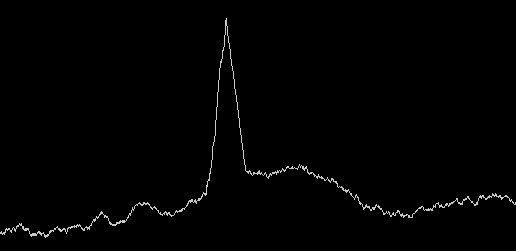
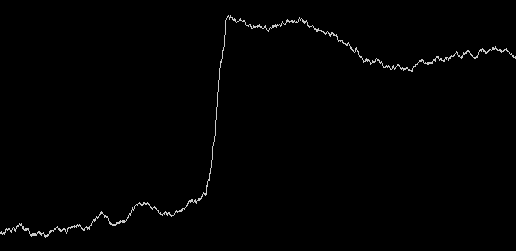
“Spike” is a metaphor drawn from the behaviour of a line on a graph. When a variable rises sharply, reaches a brief maximum, and then falls sharply, it looks like an inverted V. A spike, in other words:

A spike

A spike

Not a spike

Not a spike


A sharp rise cannot be a spike on its own. It has to be followed immediately or almost immediately by a sharp fall. The rise and fall have to be more or less balanced. That’s why it’s nonsensical to say “homicides are spiking”. The rise in murders might level off and establish a new average. Or the murder rate might return slowly to the old level. You can’t announce a spike while a variable is still rising, so every time “spike” is used as a verb or a noun in the article quoted above, it’s being used incorrectly.

But the same article supplies a word that is correct:

At a news conference Wednesday, Rawlings-Blake said there were “a lot of reasons why we’re having a surge in violence.”

A surge can be identified while it is happening. Violence in Baltimore is surging or rocketing or shooting up or rising sharply. It is not “spiking”. But why is this simple metaphor being misused? I think it’s because “spike” conveys a sense of urgency and excitement. It gives journalists and other members of the hive-mind a buzz. They like the connotation, so they forget about the denotation.

Performativizing Papyrocentricity #37

Papyrocentric Performativity Presents:

Maths and Marmosets – The Great Mathematical Problems: Marvels and Mysteries of Mathematics, Ian Stewart (Profile Books 2013)

Be Ear Now – Sonic Wonderland: A Scientific Odyssey of Sound, Trevor Cox (Vintage 2015)

Exquisite Bulgarity – The Future of Architecture in 100 Buildings, Mark Kushner (Simon & Schuster 2015)

Stellar StoryDiscovering the Universe: The Story of Astronomy, Paul Murdin (Andre Deutsch 2014)

Terms of EndrearmentShe Literally Exploded: The Daily Telegraph Infuriating Phrasebook, Christopher Howse and Richard Preston (Constable 2007)


Or Read a Review at Random: RaRaR