• «Планета есть колыбель разума, но нельзя вечно жить в колыбели.» — Константин Эдуардович Циолковский (1911)
• “Planet is the cradle of mind, but one cannot live in the cradle forever.” — Konstantin Tsiolkovsky

• «Планета есть колыбель разума, но нельзя вечно жить в колыбели.» — Константин Эдуардович Циолковский (1911)
• “Planet is the cradle of mind, but one cannot live in the cradle forever.” — Konstantin Tsiolkovsky
“H.P. Lovecraft were really underrated in terms of the sixties bands from the West Coast.” — Psychic Hi-Fi: Genesis Breyer P-Orridge’s Favourite Albums, The Quietus, 23i2014.
Previously pre-posted:
• He Say, He Sigh, He Sow #23 — an earlier engagement by Genesis P. Orridge in terms of issues around “in terms of” (dot dot dot)
• Ex-term-in-ate!
Morrissey’s stag night, like sim. Descriptive of a public house peopled entirely by broken men of indeterminate age staring silently at their half-empty pint glasses. […]
mortal adj. Refreshed (qv) within an inch of one’s life.
mortal combat n. Fighting between intoxicated fellows. Or occasionally, in the case of certain self-sufficient Harold Ramps (qv), between a single intoxicated fellow. — from Roger’s Profanisaurus: Das Krapital, The Revolutionary Dictionary of Bad Language (Viz 2010)
I thought I knew how depraved and despicable core serial-slayer Ted Bundy was when I began The Only Living Witness (1983) for the first time earlier this month.
I was wrong.
Keyly, corely wrong.
As I discovered when I reached this putrefactively performative passage:
I wanted to know how Lynda Healy had been taken from her bedroom. “I guess you would have had to dress her?” I ventured.
Ted ignored my use of “you”.
“In that kind of situation,” he replied mechanically, “a person who was alert enough to be able to dress would not be afraid in terms of struggling or crying out. So it would be unlikely that any attempt was made to clothe the girl.” — from chapter 5 of The Only Living Witness, Stephen G. Michaud and Hugh Aynesworth (revised edition 1989)
It’s always possible to go lower and get worse, it seems. Bundy trained as a lawyer. That’s bad. Bundy used “in terms of”. That’s worse. (dot dot dot)
Ted should of course have said: “afraid to struggle…” or “afraid about struggling…”
Elsewhere other-engageable:
• Ex-term-in-ate!
• All Posts interrogating issues around “in terms of”
• Don’t Do Dot… (also interrogates issues around “core” and “spike”)…
• Heresy, Homotextuality, Hive-Mind…
Album primo-avrilesque, meaning April-Foolish Album, is a collection of visual jokes published by the French humourist Alphonse Allais (1854-1905) on 1st April 1897. Note that some of the captions can’t be translated fully into English, because they use French idioms that refer to color.
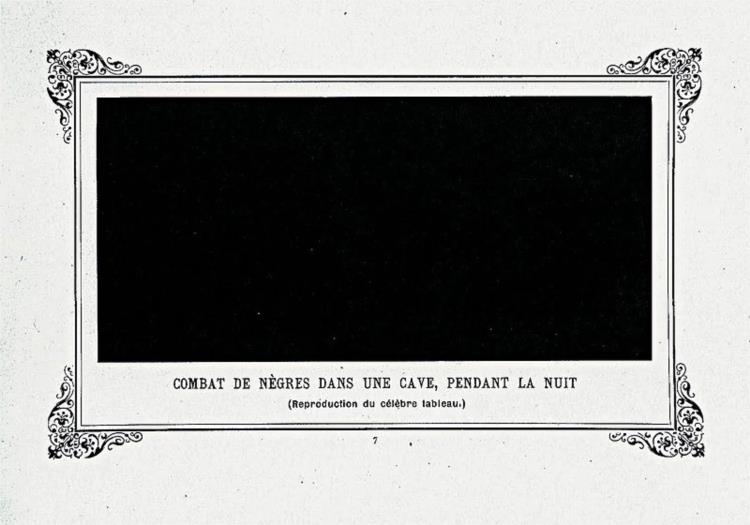
Combat de nègres dans une cave, pendant la nuit
Negroes fighting in a cellar at night

Stupeur de jeunes recrues apercevant pour la première fois ton azur, O Méditerranée!
Astonishment of young naval recruits seeing for the first time your blue, O Mediterranean!
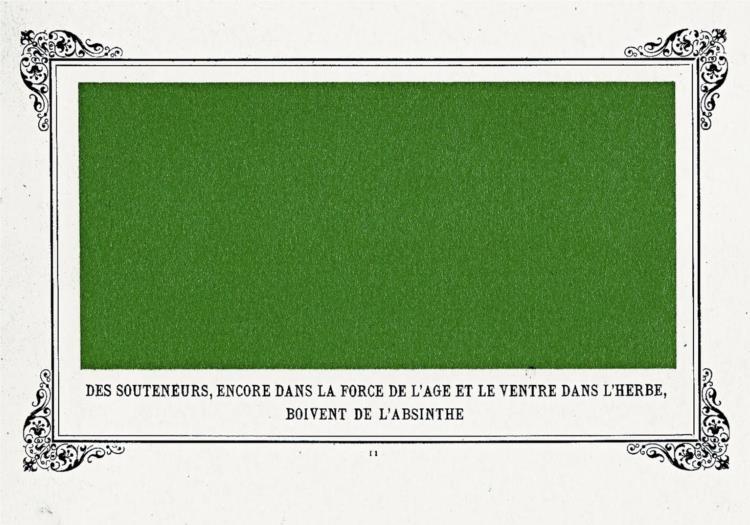
Des souteneurs, encore dans la force de l’âge et le ventre dans l’herbe, boivant de l’absinthe
Pimps, still in the prime of life and with bellies to the grass, drinking absinthe
(Pimps were then known as dos verts or “green-backs”)
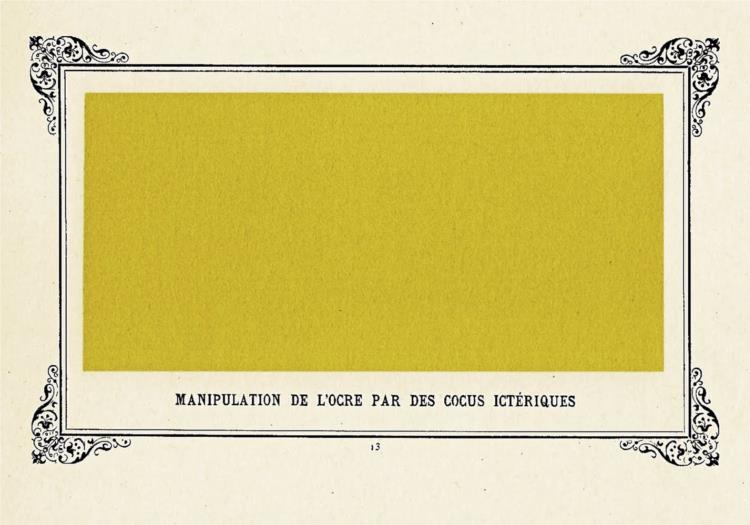
Manipulation de l’ocre par des cocus ictériques
Handling of ochre by jaundiced cuckolds
(According to one page I’ve found, coucou is the name given to some yellow wild-flowers, and cuckolds can be yellow with jealousy)
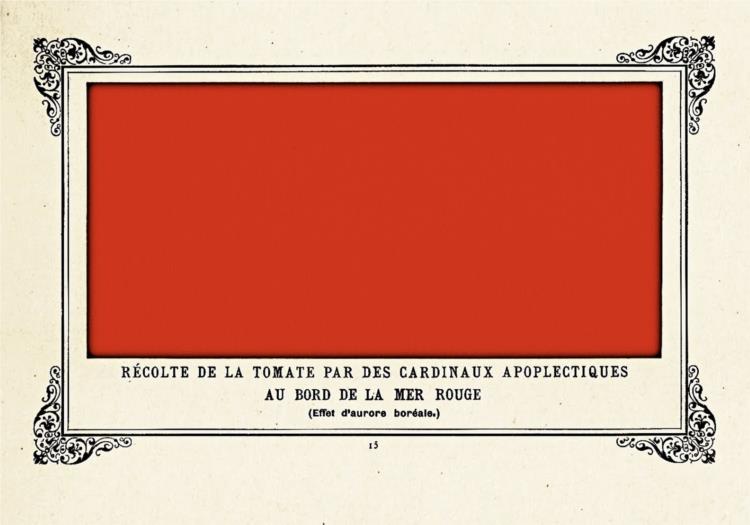
Récolte de la tomate par des cardinaux apoplectiques au bord de la mer Rouge (Effet d’aurore boréale)
Harvesting of tomatoes by apoplectic cardinals on the shore of the Red Sea (effect of the Aurora Borealis)

Ronde de pochards dans le brouillard
Dance of drunks in the fog
(Slang for “drunk” in French is gris, which also means “gray”)
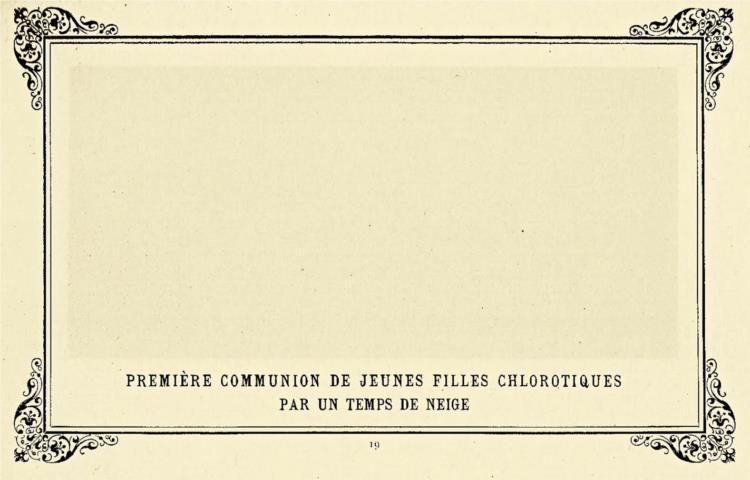
Première communion de jeunes filles chlorotiques par un temps de neige
First communion of anaemic young girls in snowy weather
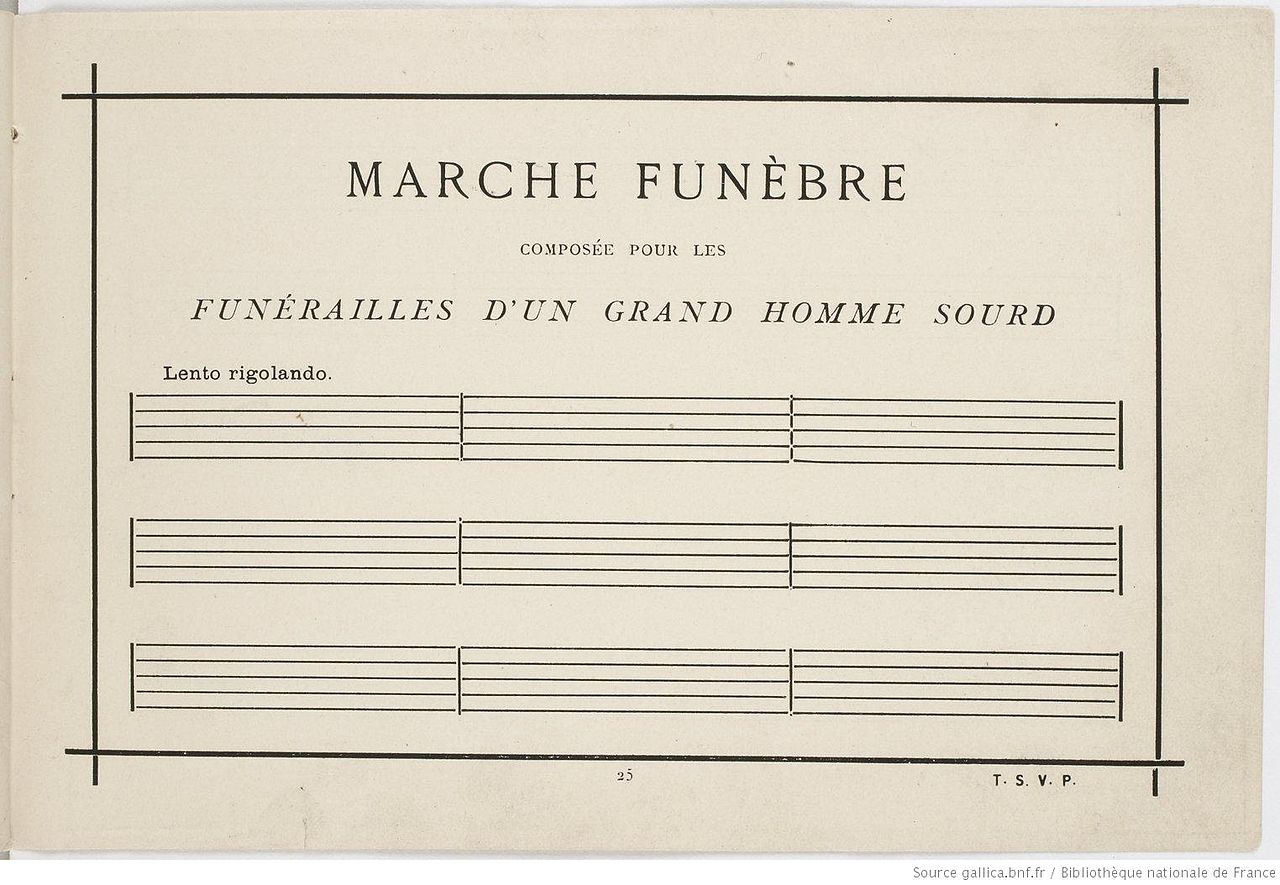
Marche funèbre, composée pour les funérailles d’un grand homme sourd
Funeral March, composed for the obsequies of a great deaf man
I’ve said it before and I’ll say it again: I wish someone would translate Lord of the Rings (1954-5) into English. By that I mean (of course) that I wish someone would translate LOTR into good English. I’ve looked at Tolkien’s bad English in “Noise Annoys” and “Science and Sorcery”. Here’s another example:
Pippin declared that Frodo was looking twice the hobbit that he had been.
“Very odd,” said Frodo, tightening his belt, “considering that there is actually a good deal less of me. I hope the thinning process will not go on indefinitely, or I shall become a wraith.”
“Do not speak of such things!” said Strider quickly, and with surprising earnestness. – The Fellowship of the Ring (1954), Chapter 11, “A Knife in the Dark”
Strider should have added: “Or in such a way!” In the second paragraph, Frodo suddenly talks like a Guardian-reader. Why on earth did Tolkien use “thinning process”, “indefinitely” and “actually” amid otherwise good, simple English? Thinning is obviously a “process”, so there’s no need to say it is, and “indefinitely” and “actually” are badly out of a place in a fantasy novel, let alone in dialogue there. “Considering” is less bad, but it should go too. I would improve the paragraph like this:
“Very odd,” said Frodo, tightening his belt, “seeing that there is now a good deal less of me. I hope the thinning will not go on much longer, or I shall become a wraith.”
Now there’s nothing incongruous: the only un-English word is “very”, but that doesn’t seem un-English on the tongue or to the eye. The Guardianese is gone, but it should never have been there in the first place. Tolkien should not have written like that in Lord of the Rings. And not just as a professional scholar of language: simply as a literate Englishman. H.W. Fowler’s Modern English Usage (1926) had been in print for twenty-eight years when The Fellowship of the Ring was first published. It’s hard to believe that Tolkien wasn’t familiar with it.
If he wasn’t, that’s a great pity. If he was, the bad prose in LOTR becomes even more inexplicable and unforgiveable. Alas for what might have been! Imagine if, per impossibile, Tolkien’s masterwork had been edited by the second-greatest Catholic writer of the twentieth-century, namely, Evelyn Waugh.
When bad prose appears in something by Waugh, it’s deliberate:
I had a fine haul – eleven paintings and fifty odd drawings – and when eventually I exhibited them in London, the art critics, many of whom hitherto had been patronizing in tone as my success invited, acclaimed a new and richer note in my work.
Mr. Ryder [the most respected of them wrote] rises like a fresh young trout to the hypodermic injection of a new culture and discloses a powerful facet in the vista of his potentialities … By focusing the frankly traditional battery of his elegance and erudition on the maelstrom of barbarism, Mr. Ryder has at last found himself. – Brideshead Revisited (1945), Book II, “A Twitch Upon the Thread”, ch. 1
Waugh was deliberately mocking the mixed-metaphor-strewn prose and pretensions of modern critics. Waugh paid great attention to language and compared writing to carpentry. It was a craft and good craftsmen do not work carelessly or use bad materials. Nothing in Brideshead is careless or casual, as we can see when the narrator, Charles Ryder, first meets the “devilish” æsthete Anthony Blanche, who has “studied Black Art at Cefalù” with Aleister Crowley and is “a byword of iniquity from Cherwell Edge to Somerville”. Blanche has a stutter and Waugh uses the stutter to underline his iniquity. Or so I would claim. Here is Blanche engaging in some papyrocentric performativity:
After luncheon he stood on the balcony with a megaphone which had appeared surprisingly among the bric-à-brac of Sebastian’s room, and in languishing, sobbing tones recited passages from The Waste Land to the sweatered and muffled throng that was on its way to the river.
“’I, Tiresias, have foresuffered all,’” he sobbed to them from the Venetian arches –
“Enacted on this same d-divan or b-bed,
I who have sat by Thebes below the wall
And walked among the l-l-lowest of the dead….”And then, stepping lightly into the room, “How I have surprised them! All b-boatmen are Grace Darlings to me.” Brideshead Revisited, Book I, “Et in Arcadia Ego”, ch. 1
Talking about the Greek sage Tiresias, who experienced life as both a man and a woman, Anthony Blanche, a man whose surname is the feminine form of the French adjective blanc, meaning “white”, stumbles over the initial consonants of three words: “divan”, “bed” and “lowest”. Is it a coincidence that the same consonants, in the same order, appear in the Greek diabolos, meaning “devil”?
I don’t think so. If Blanche had stuttered on “surprised” too, I would be even more certain. But the –s isn’t essential. After all, it was lost as diabolos journeyed from Greek to Latin, from Latin to French, and from French to English, where it appears as “Devil”. And what does Charles Ryder later call Anthony Blanche after Blanche has spent an evening tête-à-tête trying to turn Ryder against Ryder’s great friend Sebastian Flyte? You can find out here, as Ryder discusses the evening with Sebastian:
“I just wanted to find out how much truth there was in what Anthony said last night.”
“I shouldn’t think a word. That’s his great charm.”
“You may think it charming. I think it’s devilish. Do you know he spent the whole of yesterday evening trying to turn me against you, and almost succeeded?”
“Did he? How silly. Aloysius wouldn’t approve of that at all, would you, you pompous old bear?” – Brideshead Revisited, Book I, “Et in Arcadia Ego”, ch. 2
Blanche is “devilish” and his reputation for “iniquity” is well-deserved. That’s why I think the three words over which Blanche stutters were carefully chosen by Waugh from The Waste Land. Waugh was a logophile and that is exactly the kind of linguistic game that logophiles like to play.
I don’t know about you, but this is exactly what I like to see in the opening paragraph of an essay engaging issues around William S. Burroughs and the cult of rock’n’roll dot dot dot…
Naked Lunch is inseparable from its author William S. Burroughs, which tends to happen with certain major works. The book may be the only Burroughs title many literature buffs can name. In terms of name recognition, Naked Lunch is a bit like Miles Davis’ Kind of Blue, which also arrived in 1959. Radical for its time, Kind of Blue now sounds quaint, though it is undeniably a masterwork. — William S. Burroughs and the Cult of Rock ’n’ Roll, Casey Rae
Did you spot it? Didja?
Previously pre-posted:
• The Hum of Heresy…
• The Conqueror Term…
• Bill Self…
Ὁ γαρ ἡδονής και ἀλγηδόνος ἧλος, ὃς πρὸς το σώμα τήν ψυχην προσηλοῖ, μέγιστον κακὸν ἔχειν ἔοικε, τὸ τα αἰσθητά ποιεῖν ἐναργέστερα τῶν νοητῶν, καὶ καταβιάζεσθαι καὶ πάθει μᾶλλον ἢ λόγῳ κρίνειν τήν διάνοιαν.
• ΠΡΟΒΛΗΜΑ Β’. Πώς Πλάτων ἔλεγε τον θεὸν άεὶ γεωμετρεῖν.
Nam voluptatis et doloris ille clavus, quo animus corpori affigitur, id videtur maximum habere malum, quod sensilia facit intelligibilibus evidentiora, vimque facit intellectui, ut affectionem magis quam rationem in judicando sequatur.
• QUÆSTIO II: Qua ratione Plato dixerit, Deum semper geometriam tractare.
For the nail of pain and pleasure, which fastens the soul to the body, seems to do us the greatest mischief, by making sensible things more powerful over us than intelligible, and by forcing the understanding to determine them rather by passion than by reason.
• Plutarch’s Symposiacs, QUESTION II: What is Plato’s Meaning, When He Says that God Always Plays the Geometer?
“When it comes to Harry Potter, JK Rowling just can’t leave it alone. This is not necessarily a bad thing – fans have got to see Harry and friends all grown-up in the Cursed Child plays – but she’s also managed to muddy the waters by her constant rejigging of the original narrative furniture.” — Fantastic Beasts isn’t racist, but JK Rowling should stop tweaking the source material, Hannah Flint, The Guardian, 28ix2018.
• Oh My Guardian #7 — the previous entry in this award-winning series
• Reds under the Thread more on mixed metaphors… in terms of The Guardian…
• All posts interrogating issues around the Guardian-reading community and its affiliates
Mull (island) Arg. Malaios c. 150. Pre-Celtic island name. (The Oxford Dictionary of British Place Names)
Elsewhere other-engageable:
• Place of Glades — a review of The Oxford Dictionary of British Place Names, A.D. Mills (1991)
 Overlord In Terms of Core Issues Around Maximal Engagement with Key Notions of the Über-Feral