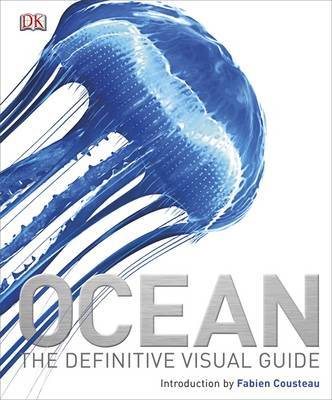
 Ocean: The Definitive Visual Guide, introduction by Fabien Cousteau (Dorling Kindersley 2014)
A big book for a big subject: the sea. But “guide” isn’t the mot juste. “Encyclopaedia” is better, because the book covers all aspects of oceanography and marine life, drawing on physics, chemistry and biology to describe everything inorganic from waves and icebergs to whirlpools and underwater volcanoes, everything organic from a beautiful flower like beach morning-glory, Ipomoea imperati, to a grotesque fish like the Pacific blackdragon, Idiacanthus antrostomus. The flower is on the shore, the fish is in the abyss, but both of them descend from a single ancestor.
And that ancestor may have evolved in the sea. It certainly moved there before it gave rise to flowers and fish. This big subject is also a very important one: the sea is central to the evolution and continued existence of life on earth. Only the sun matters as much, but some marine life could potentially survive the disappearance of the sun:
Hydrothermal vents are similar to hot springs on land. Located near ocean ridges and rifts, at an average depth of 2,100m (7,000ft), they spew out mineral-rich, superheated seawater. Some have tall chimneys, formed from dissolved minerals that precipitate when the hot vent water meets cold, deep-ocean water. The mix of heat and chemicals supports animal communities around the vents – the first life known to exist entirely without the energy of sunlight. (pg. 188, “The Open Ocean and Ocean Floor”)
The deep ocean is a fascinating and little-known place: much nearer than the other side of the earth, but much harder to get to. Like climbing mountains, plumbing the abyss is difficult and dangerous. It’s interesting that both endeavours have been dominated by a particular group of human being: both the highest and lowest points on the planet were first reached by white males. Fabien Cousteau, who introduces this book, continues the tradition. He’s the grandson of Jacques Cousteau (1910-97), who popularized diving and marine biology for millions of people. Jacques saw huge advances in marine technology and science and his son and grandson have seen more. But the discoveries are still coming: as Fabien points out, it’s estimated that “over 90 per cent of the world’s biodiversity resides in its oceans”.
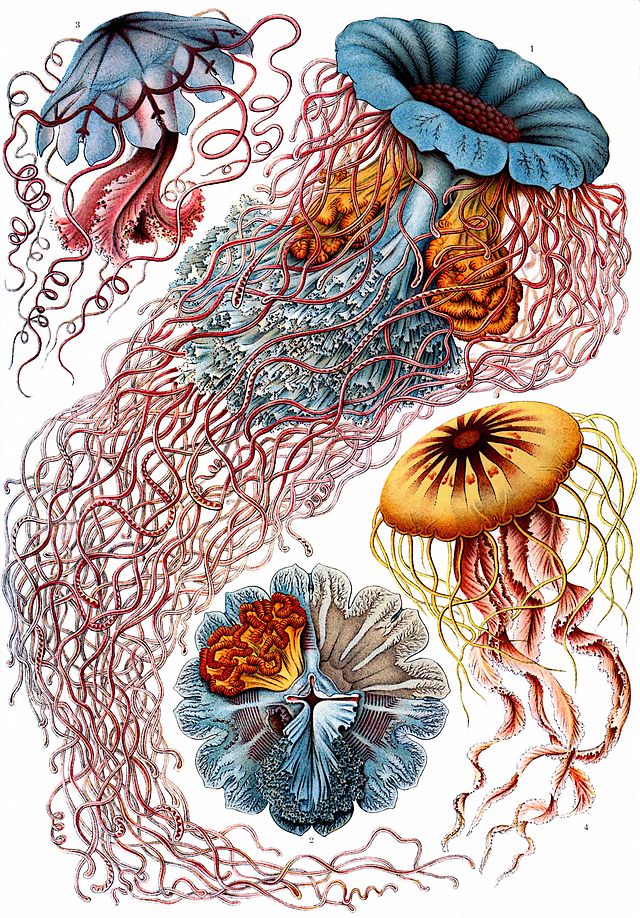
Discomedusae by Ernst Haeckel
Some of that biodiversity left the water for the land and evolved new forms. Some of those new forms went back to the water, like the ceteceans and sea-snakes. Like human beings, they’re descended from fish, the most varied of all vertebrate groups. But some marine life never left its cradle. Where else can you find the beauty and strangeness of groups like the jellyfish? Radial symmetry is a marine speciality and when H.P. Lovecraft was inventing his aliens, he looked to under-space as much as outer:
But to give it a name at this stage was mere folly. It looked like a radiate, but was clearly something more. It was partly vegetable, but had three-fourths of the essentials of animal structure. That it was marine in origin, its symmetrical contour and certain other attributes clearly indicated; yet one could not be exact as to the limit of its later adaptations. The wings, after all, held a persistent suggestion of the aerial. How it could have undergone its tremendously complex evolution on a new-born earth in time to leave prints in Archaean rocks was so far beyond conception as to make Lake whimsically recall the primal myths about Great Old Ones who filtered down from the stars and concocted earth life as a joke or mistake; and the wild tales of cosmic hill things from outside told by a folklorist colleague in Miskatonic’s English department. (At the Mountains of Madness, 1931)
Lovecraft would have enjoyed Ocean as much as Jacques Cousteau. It closes with a detailed “Atlas of the Oceans”, with maps of the ocean floor all around the world. Before that, you can learn how the Corryvreckan whirlpool nearly killed George Orwell in 1947, where to find manganese nodules, why so many deep-sea creatures are red and what the narwhale’s horn really is. You can also feast your eyes on photography that records everything from microscopic plankton to swirling hurricanes hundreds of kilometres across. Big subject, big book. Beautiful subject and beautiful book too.