Reverssum

Here’s a simple sequence. What’s the next number?

1, 2, 4, 8, 16, 68, 100, ?

The rule I’m using is this: Reverse the number, then add the sum of the digits. So 1 doubles till it becomes 16. Then 16 becomes 61 + 6 + 1 = 68. Then 68 becomes 86 + 8 + 6 = 100. Then 100 becomes 001 + 1 = 2. And the sequence falls into a loop.

Reversing the number means that small numbers can get big and big numbers can get small, but the second tendency is stronger for the first few seeds:

• 1 → 2 → 4 → 8 → 16 → 68 → 100 → 2
• 2 → 4 → 8 → 16 → 68 → 100 → 2
• 3 → 6 → 12 → 24 → 48 → 96 → 84 → 60 → 12
• 4 → 8 → 16 → 68 → 100 → 2 → 4
• 5 → 10 → 2 → 4 → 8 → 16 → 68 → 100 → 2
• 6 → 12 → 24 → 48 → 96 → 84 → 60 → 12
• 7 → 14 → 46 → 74 → 58 → 98 → 106 → 608 → 820 → 38 → 94 → 62 → 34 → 50 → 10 → 2 → 4 → 8 → 16 → 68 → 100 → 2
• 8 → 16 → 68 → 100 → 2 → 4 → 8
• 9 → 18 → 90 → 18
• 10 → 2 → 4 → 8 → 16 → 68 → 100 → 2

An 11-seed is a little more interesting:

11 → 13 → 35 → 61 → 23 → 37 → 83 → 49 → 107 → 709 → 923 → 343 → 353 → 364 → 476 → 691 → 212 → 217 → 722 → 238 → 845 → 565 → 581 → 199 → 1010 → 103 → 305 → 511 → 122 → 226 → 632 → 247 → 755 → 574 → 491 → 208 → 812 → 229 → 935 → 556 → 671 → 190 → 101 → 103 (11 leads to an 18-loop from 103 at step 26; total steps = 44)

Now try some higher bases:

• 1 → 2 → 4 → 8 → 15 → 57 → 86 → 80 → 15 (base=11)
• 1 → 2 → 4 → 8 → 14 → 46 → 72 → 34 → 4A → B6 → 84 → 58 → 96 → 80 → 14 (base=12)
• 1 → 2 → 4 → 8 → 13 → 35 → 5B → C8 → A6 → 80 → 13 (base=13)
• 1 → 2 → 4 → 8 → 12 → 24 → 48 → 92 → 36 → 6C → DA → C8 → A4 → 5A → B6 → 80 → 12 (base=14)
• 1 → 2 → 4 → 8 → 11 → 13 → 35 → 5B → C6 → 80 → 11 (base=15)
• 1 → 2 → 4 → 8 → 10 → 2 (base=16)

Does the 1-seed always create a short sequence? No, it gets pretty long in base-19 and base-20:

• 1 → 2 → 4 → 8 → [16] → 1D → DF → [17]3 → 4[18] → 107 → 709 → 914 → 424 → 42E → E35 → 54[17] → [17]5C → C7D → D96 → 6B3 → 3C7 → 7D6 → 6EE → E[16]2 → 2[18]8 → 90B → B1A → A2E → E3[17] → [17]5A → A7B → B90 → AC→ DD → F1 → 2C → C[16] → [18]2 → 40 → 8 (base=19)
• 1 → 2 → 4 → 8 → [16] → 1C → CE → F[18] → 108 → 80A → A16 → 627 → 731 → 13[18] → [18]43 → 363 → 36F → F77 → 794 → 4A7 → 7B5 → 5CA → ADC → CF5 → 5[17]4 → 4[18]B → B[19][17] → [18]1[18] → [18]3F → F5E → E79 → 994 → 4AB → BB9 → 9D2 → 2ED → DFB → B[17]C → C[19]B → C1E → E2[19] → [19]49 → 96B → B7F → F94 → 4B3 → 3C2 → 2D0 → D[17] → [19]3 → 51 → 1B → BD → EF → [17]3 → 4[17] → [18]5 → 71 → 1F → F[17] → [19]7 → 95 → 63 → 3F → [16]1 → 2D → D[17] (base=20)

Then it settles down again:

• 1 → 2 → 4 → 8 → [16] → 1B → BD → EE → [16]0 → 1B (base=21)
• 1 → 2 → 4 → 8 → [16] → 1A → AC → DA → BE → FE → [16]0 → 1A (base=22)
• 1 → 2 → 4 → 8 → [16] → 19 → 9B → C6 → 77 → 7[21] → [22]C → EA → BF → [16]E → [16]0 → 19 (base=23)

Base-33 is also short:

1 → 2 → 4 → 8 → [16] → [32] → 1[31] → [32]0 → 1[31] (base=33)

And so is base-35:

1 → 2 → 4 → 8 → [16] → [32] → 1[29] → [29][31] → [33][19] → [21]F → [16][22] → [23][19] → [20][30] → [32]0 → 1[29] (base=35)

So what about base-34?

1 → 2 → 4 → 8 → [16] → [32] → 1[30] → [30][32] → 10[24] → [24]0[26] → [26]26 → 63[26] → [26]47 → 75[29] → [29]6E → E8A → A9C → CA7 → 7B7 → 7B[32] → [32]C[23] → [23]E[31] → [31][16][23] → [23][18][33] → [33][20][29] → [29][23]D → D[25][26] → [26][27]9 → 9[29][20] → [20][30][33] → [33][33]1 → 21[32] → [32]23 → 341 → 14B → B4[17] → [17]59 → 96E → E74 → 485 → 58[21] → [21]95 → 5A[22] → [22]B8 → 8C[29] → [29]D[23] → [23]F[26] → [26][17][19] → [19][19][20] → [20][21]9 → 9[23]2 → 2[24]9 → 9[25]3 → 3[26]C → C[27]A → A[28][27] → [27][30]7 → 7[32][23] → [24]01 → 11F → F1[18] → [18]2F → F3[19] → [19]4[18] → [18]5[26] → [26]6[33] → [33]8[23] → [23]A[29] → [29]C[17] → [17]E[19] → [19]F[33] → [33][17][18] → [18][19][33] → [33][21][20] → [20][24]5 → 5[26]1 → 1[27]3 → 3[27][32] → [32][28][31] → [31][31][21] → [22]0C → C1[22] → [22]2D → D3[25] → [25]4[20] → [20]66 → 67[18] → [18]83 → 39D → D9[28] → [28]A[29] → [29]C[27] → [27]E[29] → [29][16][29] → [29][19]1 → 1[21]A → A[21][33] → [33][23]6 → 6[25][27] → [27][26][30] → [30][29]8 → 8[31][29] → [29][33]8 → 91[31] → [31]2[16] → [16]4C → C5E → E69 → 979 → 980 → 8[26] → [27]8 → 9[28] → [29]C → E2 → 2[30] → [31]0 → 1[28] → [28][30] → [32][18] → [20]E → F[20] → [21][16] → [17][24] → [25][24] → [26]6 → 7[24] → [25]4 → 5[20] → [20][30] → [32]2 → 3[32] → [33]4 → 62 → 2E → E[18] → [19]C → D[16] → [17]8 → 98 → 8[26] (1 leads to a 30-loop from 8[26] / 298 in base-34 at step 111; total steps = 141)

An alternative rule is to add the digit-sum first and then reverse the result. Now 8 becomes 8 + 8 = 16 and 16 becomes 61. Then 61 becomes 61 + 6 + 1 = 68 and 68 becomes 86. Then 86 becomes 86 + 8 + 6 = 100 and 100 becomes 001 = 1:

• 1 → 2 → 4 → 8 → 61 → 86 → 1
• 2 → 4 → 8 → 61 → 86 → 1 → 2
• 3 → 6 → 21 → 42 → 84 → 69 → 48 → 6
• 4 → 8 → 61 → 86 → 1 → 2 → 4
• 5 → 1 → 2 → 4 → 8 → 62 → 7 → 48 → 6 → 27 → 63 → 27
• 6 → 21 → 42 → 84 → 69 → 48 → 6
• 7 → 41 → 64 → 47 → 85 → 89 → 601 → 806 → 28 → 83 → 49 → 26 → 43 → 5 → 6 → 27 → 63 → 27
• 8 → 61 → 86 → 1 → 2 → 4 → 8
• 9 → 81 → 9
• 10 → 11 → 31 → 53 → 16 → 32 → 73 → 38 → 94 → 701 → 907 → 329 → 343 → 353 → 463 → 674 → 196 → 212 → 712 → 227 → 832 → 548 → 565 → 185 → 991 → 101 → 301 → 503 → 115 → 221 → 622 → 236 → 742 → 557 → 475 → 194→ 802 → 218 → 922 → 539 → 655 → 176 → 91 → 102 → 501 → 705 → 717 → 237 → 942 → 759 → 87 → 208 → 812 → 328 → 143 → 151 → 851 → 568 → 785 → 508 → 125 → 331 → 833 → 748 → 767 → 787 → 908 → 529 → 545 → 955 → 479 → 994 → 6102 → 1116 → 5211 → 225 → 432 → 144 → 351 → 63 → 27 → 63
Words at War

Front cover of Poetry of the First World War edited by Tim KendallPoetry of the First World War: An Anthology, ed. Tim Kendall (Oxford University Press 2013)

J.R.R. Tolkien and C.S. Lewis are famous names today, but both might have died young in the First World War. If so, they would now be long forgotten. Generally speaking, novelists, essayists and scholars take time to mature and need time to create. Poets are different: they can create something of permanent value in a few minutes. This helps explain why nearly half the men chosen for this book did not reach their thirties:

• Rupert Brooke (1887-1915)
• Julian Grenfell (1888-1915)
• Charles Sorley (1895-1915)
• Patrick Shaw Stewart (1888-1917)
• Arthur Graeme West (1891-1917)
• Isaac Rosenberg (1890-1918)
• Wilfred Owen (1893-1918)

And none of them left substantial bodies of work. Indeed, “except for some schoolboy verse”, Patrick Shaw Stewart is known for only one poem, which “was found written on the back flyleaf of his copy of A.E. Housman’s A Shropshire Lad after his death” (pg. 116). It begins like this:

I saw a man this morning
  Who did not wish to die:
I ask and cannot answer,
  If otherwise wish I.

(From I saw a man this morning)

Housman is here too, with Epitaph on an Army of Mercenaries, which Kipling, also here, is said to have called “the finest poem of the First World War” (pg. 14). I don’t agree and I would prefer less Kipling and no Thomas Hardy. That would have left space for something I wish had been included: translations from French and German. The First World War was fought by speakers of Europe’s three major languages and this book makes me realize that I know nothing about war poetry in French and German.

It would be interesting to compare it with the poetry in English. Were traditional forms mingling with modernism in the same way? I assume so. Wilfred Owen looked back to Keats and the assonance of Anglo-Saxon verse:

Our brains ache, in the merciless iced winds that knive us…
Wearied we keep awake because the night is silent…
Low, drooping flares confuse our memory of the salient…
Worried by silence, sentries whisper, curious, nervous,
  But nothing happens. (Exposure)

David Jones (1895-1974) looked forward:

   You can hear the silence of it:
You can hear the rat of no-man’s-land
rut-out intricacies,
weasel-out his patient workings,
scrut, scrut, sscrut,
harrow-out earthly, trowel his cunning paw;
redeem the time of our uncharity, to sap his own amphibi-
ous paradise.
   You can hear his carrying-parties rustle our corruptions
through the night-weeds – contest the choicest morsels in his
tiny conduits, bead-eyed feast on us; by a rule of his nature,
at night-feast on the broken of us. (In Parenthesis)

But is there Gerard Manley Hopkins in that? And in fact In Parenthesis was begun “in 1927 or 1928” and published in 1937. T.S. Eliot called it “a work of genius” (pg. 200). I’d prefer to disagree, but I can’t: you can feel the power in the extract given here. Isaac Rosenberg had a briefer life and left briefer work, but was someone else who could work magic with words:

A worm fed on the heart of Corinth,
Babylon and Rome.
Not Paris raped tall Helen,
But this incestuous worm
Who lured her vivid beauty
To his amorphous sleep.
England! famous as Helen
Is thy betrothal sung.
To him the shadowless,
More amorous than Solomon.

A beautiful poem about an ugly thing: death. A mysterious poem too. And a sardonic one. Rosenberg says much with little and I think he was a much better poet than the more famous Siegfried Sassoon and Robert Graves. They survived the war and wrote more during it, which helps explain their greater fame. But the flawed poetry of Graves was sometimes appropriate to its ugly theme:

To-day I found in Mametz Wood
A certain cure for lust of blood:

Where, propped against a shattered trunk,
  In a great mess of things unclean,
Sat a dead Boche; he scowled and stunk
  With clothes and face a sodden green,
Big-bellied, spectacled, crop-haired,
Dribbling black blood from nose and beard.

A poem like that is a cure for romanticism, but that’s part of what makes Wilfred Owen a better and more interesting poet than Graves. Owen’s romanticism wasn’t cured: there’s conflict in his poems about conflict:

I saw his round mouth’s crimson deepen as it fell,
  Like a sun, in his last deep hour;
Watched the magnificent recession of farewell,
  Clouding, half gleam, half glower,
And a last splendour burn the heavens of his cheek.
  And in his eyes
The cold stars lighting, very old and bleak,
  In different skies.

But how good is Owen’s work? He was a Kurt Cobain of his day: good-looking, tormented and dying young. You can’t escape the knowledge of early death when you read the poetry of one or listen to the music of other. That interferes with objective appraisal. But the flaws in Owen’s poetry add to its power, increasing the sense of someone writing against time and struggling for greatness in a bad place. The First World War destroyed a lot of poets and perhaps helped destroy poetry too, raising questions about tradition that some answered with nihilism. As Owen asks in Futility:

Was it for this the clay grew tall?
—O what made fatuous sun-beams toil
To break earth’s sleep at all?

Some of the poets here were happy to go to war, but it wasn’t the Homeric adventure anticipated by Patrick Shaw Stewart. He learnt that high explosive is impersonal, bullets kill at great distance and machines don’t need rest. Poetry of the First World War is about a confrontation: between flesh and metal, brains and machinery. It’s an interesting anthology that deserves much more time than I have devoted to it. The notes aren’t intrusive, the biographies are brief but illuminating, and although Tim Kendall is a Professor of English Literature he has let his profession down by writing clear prose and eschewing jargon. He’s also included some “Music-Hall and Trench Songs” and they speak for the ordinary and sometimes illiterate soldier. The First World War may be the most important war in European history and this is a good introduction to some of the words it inspired.

Bill Self

I would be disturbed and dismayed if Will Self ever wrote an essay on Evelyn Waugh or Clark Ashton Smith. In fact, I hope he has never even heard of CAS. But I’m happy to see Self writing in the Guardian on William Burroughs. It’s a perfect setting for a perfect pairing. And Self, like Christopher Hitchens, raises a very interesting question. What is his mother-tongue? Quechua? Tagalog? Sumerian? Whatever it is, it’s not even remotely related to English.


William Burroughs — the original Junkie — Will Self, The Guardian, 1/ii/2014.

Entitled Junkie: Confessions of an Unredeemed Drug Addict and authored pseudonymously by “William Lee” (Burroughs’ mother’s maiden name – he didn’t look too far for a nom de plume) …

[Self missed his chance there: nom de guerre would have been much better.]

The two-books-in-one format was not uncommon in 1950s America …

Despite its subhead, Wyn did think the book had a redemptive capability …

Both Junkie and Narcotic Agent have covers of beautiful garishness, featuring 1950s damsels in distress. On the cover of Junkie a craggy-browed man is grabbing a blond lovely from behind; one of his arms is around her neck, while the other grasps her hand, within which is a paper package. The table beside them has been knocked in the fray, propelling a spoon, a hypodermic, and even a gas ring, into inner space.

This cover illustration is, in fact, just that: an illustration of a scene described by Burroughs in the book. “When my wife saw I was getting the habit again, she did something she had never done before. I was cooking up a shot two days after I’d connected with Old Ike. My wife grabbed the spoon and threw the junk on the floor. I slapped her twice across the face and she threw herself on the bed, sobbing …” That this uncredited and now forgotten hack artist should have chosen one of the few episodes featuring the protagonist’s wife to use for the cover illustration represents one of those nastily serendipitous ironies that Burroughs himself almost always chose to view as evidence of the magical universe. …

… if you turn to his glossary of junk lingo and jive talk – you will see how many arcane drug terms have metastasised into the vigorous language. …

Burroughs viewed the postwar era as a Götterdämmerung and a convulsive re-evaluation of values. …

An open homosexual and a drug addict, his quintessentially Midwestern libertarianism led him to eschew any command economy of ethics …

For Burroughs, the re-evaluation was both discount and markup …

… and perhaps it was this that made him such a great avatar of the emergent counterculture. …

Janus-faced, and like some terminally cadaverous butler, Burroughs ushers in the new society of kicks for insight as well as kicks’ sake. …

Let’s return to that cover illustration with its portrayal of “William Lee” as Rock Hudson and his common-law wife, Joan Vollmer, as Kim Novak.

When I say Burroughs himself must have regarded the illustration – if he thought of it at all – as evidence of the magical universe he conceived of as underpinning and interpenetrating our own …

Much has been written and even more conjectured about the killing. Burroughs himself described it as “the accidental shooting death”; and although he jumped bail, he was only convicted – in absentia by the Mexican court – of homicide. …

When Burroughs was off heroin he was a bad, blackout drunk (for evidence you need look no further than his own confirmation in Junky). …

By the time Burroughs was living in Tangier in the late 1950s, his sense of being little more than a cipher, or a fictional construct, had become so plangent …

Burroughs was the perfect incarnation of late 20th-century western angst precisely because he was an addict. Self-deluding, vain, narcissistic, self-obsessed, and yet curiously perceptive about the sickness of the world if not his own malaise, Burroughs both offered up and was compelled to provide his psyche as a form of Petri dish, within which were cultured the obsessive and compulsive viruses of modernity. …

In a thin-as-a-rake’s progress …

… a deceptively thin, Pandora’s portfolio of an idea …

It is Burroughs’ own denial of the nature of his addiction that makes this book capable of being read as a fiendish parable of modern alienation. …

For, in describing addiction as “a way of life”, Burroughs makes of the hypodermic a microscope, through which he can examine the soul of man under late 20th-century capitalism.

William Burroughs – the original Junkie, The Guardian, 1/ii/2014.


The big disappointment is that he didn’t use in terms of.

Performativizing Papyrocentricity #19

Papyrocentric Performativity Presents:

• Book in Black – Black Sabbath: Symptom of the Universe, Mick Wall (Orion Books 2013)

• Critical Math – A Mathematician Reads the Newspaper, John Allen Paulos (Penguin 1996)

• Rude Boys – Ruthless: The Global Rise of the Yardies, Geoff Small (Warner 1995)

• K-9 Konundrum – Dog, Peter Sotos (TransVisceral Books 2014)

• Ghosts in the Cathedral – The Neutrino Hunters: The Chase for the Ghost Particle and the Secrets of the Universe, Ray Jayawardhana (Oneworld 2013) (posted @ Overlord of the Über-Feral)


Or Read a Review at Random: RaRaR

Block and Goal

123456789. How many ways are there to insert + and – between the numbers and create a formula for 100? With pen and ink it takes a long time to answer. With programming, the answer will flash up in an instant:

01. 1 + 2 + 3 - 4 + 5 + 6 + 78 + 9 = 100
02. 1 + 2 + 34 - 5 + 67 - 8 + 9 = 100
03. 1 + 23 - 4 + 5 + 6 + 78 - 9 = 100
04. 1 + 23 - 4 + 56 + 7 + 8 + 9 = 100
05. 12 - 3 - 4 + 5 - 6 + 7 + 89 = 100
06. 12 + 3 + 4 + 5 - 6 - 7 + 89 = 100
07. 12 + 3 - 4 + 5 + 67 + 8 + 9 = 100
08. 123 - 4 - 5 - 6 - 7 + 8 - 9 = 100
09. 123 + 4 - 5 + 67 - 89 = 100
10. 123 + 45 - 67 + 8 - 9 = 100
11. 123 - 45 - 67 + 89 = 100

And the beauty of programming is that you can easily generalize the problem to other bases. In base b, how many ways are there to insert + and – in the block [12345…b-1] to create a formula for b^2? When b = 10, the answer is 11. When b = 11, it’s 42. Here are two of those formulae in base-11:

123 - 45 + 6 + 7 - 8 + 9 + A = 100[b=11]
146 - 49 + 6 + 7 - 8 + 9 + 10 = 121

123 + 45 + 6 + 7 - 89 + A = 100[b=11]
146 + 49 + 6 + 7 - 97 + 10 = 121

When b = 12, it’s 51. Here are two of the formulae:

123 + 4 + 5 + 67 - 8 - 9A + B = 100[b=12]
171 + 4 + 5 + 79 - 8 - 118 + 11 = 144

123 + 4 + 56 + 7 - 89 - A + B = 100[b=12]
171 + 4 + 66 + 7 - 105 - 10 + 11 = 144

So that’s 11 formulae in base-10, 42 in base-11 and 51 in base-12. So what about base-13? The answer may be surprising: in base-13, there are no +/- formulae for 13^2 = 169 using the numbers 1 to 12. Nor are there any formulae in base-9 for 9^2 = 81 using the numbers 1 to 8. If you reverse the block, 987654321, the same thing happens. Base-10 has 15 formulae, base-11 has 54 and base-12 has 42. Here are some examples:

9 - 8 + 7 + 65 - 4 + 32 - 1 = 100
98 - 76 + 54 + 3 + 21 = 100

A9 + 87 - 65 + 4 - 3 - 21 = 100[b=11]
119 + 95 - 71 + 4 - 3 - 23 = 121

BA - 98 + 76 - 5 - 4 + 32 - 1 = 100[b=12]
142 - 116 + 90 - 5 - 4 + 38 - 1 = 144

But base-9 and base-13 again have no formulae. What’s going on? Is it a coincidence that 9 and 13 are each one more than a multiple of 4? No. Base-17 also has no formulae for b^2 = 13^2 = 169. Here is the list of formulae for bases-7 thru 17:

1, 2, 0, 11, 42, 51, 0, 292, 1344, 1571, 0 (block = 12345...)
3, 2, 0, 15, 54, 42, 0, 317, 1430, 1499, 0 (block = ...54321)

To understand what’s going on, consider any sequence of consecutive integers starting at 1. The number of odd integers in the sequence must always be greater than or equal to the number of even integers:

1, 2 (1 odd : 1 even)
1, 2, 3 (2 odds : 1 even)
1, 2, 3, 4 (2 : 2)
1, 2, 3, 4, 5 (3 : 2)
1, 2, 3, 4, 5, 6 (3 : 3)
1, 2, 3, 4, 5, 6, 7 (4 : 3)
1, 2, 3, 4, 5, 6, 7, 8 (4 : 4)

The odd numbers in a sequence determine the parity of the sum, that is, whether it is odd or even. For example:

1 + 2 = 3 (1 odd number)
1 + 2 + 3 = 6 (2 odd numbers)
1 + 2 + 3 + 4 = 10 (2 odd numbers)
1 + 2 + 3 + 4 + 5 = 15 (3 odd numbers)
1 + 2 + 3 + 4 + 5 + 6 = 21 (3 odd numbers)
1 + 2 + 3 + 4 + 5 + 6 + 7 = 28 (4 odd numbers)

If there is an even number of odd numbers, the sum will be even; if there is an odd number, the sum will be odd. Consider sequences that end in a multiple of 4:

1, 2, 3, 4 → 2 odds : 2 evens
1, 2, 3, 4, 5, 6, 7, 8 → 4 : 4
1, 2, 3, 4, 5, 6, 7, 8, 9, 10, 11, 12 → 6 : 6

Such sequences always contain an even number of odd numbers. Now, consider these formulae in base-10:

1. 12 + 3 + 4 + 56 + 7 + 8 + 9 = 99
2. 123 - 45 - 67 + 89 = 100
3. 123 + 4 + 56 + 7 - 89 = 101

They can be re-written like this:

1. 1×10^1 + 2×10^0 + 3×10^0 + 4×10^0 + 5×10^1 + 6×10^0 + 7×10^0 + 8×10^0 + 9×10^0 = 99

2. 1×10^2 + 2×10^1 + 3×10^0 – 4×10^1 – 5×10^0 – 6×10^1 – 7×10^0 + 8×10^1 + 9×10^0 = 100

3. 1×10^2 + 2×10^1 + 3×10^0 + 4×10^0 + 5×10^1 + 6×10^1 + 7×10^0 – 8×10^1 – 9×10^0 = 101

In general, the base-10 formulae will take this form:

1×10^a +/- 2×10^b +/- 3×10^c +/– 4×10^d +/– 5×10^e +/– 6×10^f +/– 7×10^g +/– 8×10^h +/– 9×10^i = 100

It’s important to note that the exponent of 10, or the power to which it is raised, determines whether an odd number remains odd or becomes even. For example, 3×10^0 = 3×1 = 3, whereas 3×10^1 = 3×10 = 30 and 3×10^2 = 3×100 = 300. Therefore the number of odd numbers in a base-10 formula can vary and so can the parity of the sum. Now consider base-9. When you’re trying to find a block-formula for 9^2 = 81, the formula will have to take this form:

1×9^a +/- 2×9^b +/- 3×9^c +/- 4×9^d +/- 5×9^e +/- 6×9^f +/- 7×9^g +/- 8×9^h = 81

But no such formula exists for 81 (with standard exponents). It’s now possible to see why this is so. Unlike base-10, the odd numbers in the formula will remain odd what the power of 9. For example, 3×9^0 = 3×1 = 3, 3×9^1 = 3×9 = 27 and 3×9^2 = 3×81 = 243. Therefore base-9 formulae will always contain four odd numbers and will always produce an even number. Odd numbers in base-2 always end in 1, even numbers always end in 0. Therefore, to determine the parity of a sum of integers, convert the integers to base-2, discard all but the final digit of each integer, then sum the 1s. In a base-9 formula, these are the four possible results:

1 + 1 + 1 + 1 = 4
1 + 1 + 1 - 1 = 2
1 + 1 - 1 - 1 = 0
1 - 1 - 1 - 1 = -2

The sum represents the parity of the answer, which is always even. Similar reasoning applies to base-13, base-17 and all other base-[b=4n+1].

Persist List

Multiplicative persistence is a complex term but a simple concept. Take a number, multiply its digits, repeat. Sooner or later the result is a single digit:

25 → 2 x 5 = 10 → 1 x 0 = 0 (mp=2)
39 → 3 x 9 = 27 → 2 x 7 = 14 → 1 x 4 = 4 (mp=3)

So 25 has a multiplicative persistence of 2 and 39 a multiplicative persistence of 3. Each is the smallest number with that m.p. in base-10. Further records are set by these numbers:

77 → 49 → 36 → 18 → 8 (mp=4)
679 → 378 → 168 → 48 → 32 → 6 (mp=5)
6788 → 2688 → 768 → 336 → 54 → 20 → 0 (mp=6)
68889 → 27648 → 2688 → 768 → 336 → 54 → 20 → 0 (mp=7)
2677889 → 338688 → 27648 → 2688 → 768 → 336 → 54 → 20 → 0 (mp=8)
26888999 → 4478976 → 338688 → 27648 → 2688 → 768 → 336 → 54 → 20 → 0 (mp=9)
3778888999 → 438939648 → 4478976 → 338688 → 27648 → 2688 → 768 → 336 → 54 → 20 → 0 (mp=10)

Now here’s base-9:

25[b=9] → 11 → 1 (mp=2)
38[b=9] → 26 → 13 → 3 (mp=3)
57[b=9] → 38 → 26 → 13 → 3 (mp=4)
477[b=9] → 237 → 46 → 26 → 13 → 3 (mp=5)
45788[b=9] → 13255 → 176 → 46 → 26 → 13 → 3 (mp=6)
2577777[b=9] → 275484 → 13255 → 176 → 46 → 26 → 13 → 3 (mp=7)

And base-11:

26[b=11] → 11 → 1 (mp=2)
3A[b=11] → 28 → 15 → 5 (mp=3)
69[b=11] → 4A → 37 → 1A → A (=10b=10) (mp=4)
269[b=11] → 99 → 74 → 26 → 11 → 1 (mp=5)
3579[b=11] → 78A → 46A → 1A9 → 82 → 15 → 5 (mp=6)
26778[b=11] → 3597 → 78A → 46A → 1A9 → 82 → 15 → 5 (mp=7)
47788A[b=11] → 86277 → 3597 → 78A → 46A → 1A9 → 82 → 15 → 5 (mp=8)
67899AAA[b=11] → 143A9869 → 299596 → 2A954 → 2783 → 286 → 88 → 59 → 41 → 4 (mp=9)
77777889999[b=11] → 2AA174996A → 143A9869 → 299596 → 2A954 → 2783 → 286 → 88 → 59 → 41 → 4 (mp=10)

I was also interested in the narcissism of multiplicative persistence. That is, are any numbers equal to the sum of the numbers created while calculating their multiplicative persistence? Yes:

86 = (8 x 6 = 48) + (4 x 8 = 32) + (3 x 2 = 6)

I haven’t found any more in base-10 (apart from the trivial 0 to 9) and can’t prove that this is the only one. Base-9 offers this:

78[b=9] = 62 + 13 + 3

I can’t find any at all in base-11, but here are base-12 and base-27:

57[b=12] = 2B + 1A + A
A8[b=12] = 68 + 40 + 0

4[23][b=27] = 3B + 16 + 6
7[24][b=27] = 66 + 19 + 9
A[18][b=27] = 6[18] + 40 + 0
[26][24][b=27] = [23]3 + 2F + 13 + 3
[26][23][26][b=27] = [21]8[23] + 583 + 4C + 1[21] + [21]

But the richest base I’ve found so far is base-108, with fourteen narcissistic multiplicative-persistence sums:

4[92][b=108] = 3[44] + 1[24] + [24]
5[63][b=108] = 2[99] + 1[90] + [90]
7[96][b=108] = 6[24] + 1[36] + [36]
A[72][b=108] = 6[72] + 40 + 0
[19][81][b=108] = E[27] + 3[54] + 1[54] + [54]
[26][96][b=108] = [23]C + 2[60] + 1C + C
[35][81][b=108] = [26][27] + 6[54] + 30 + 0
[37][55][b=108] = [18][91] + F[18] + 2[54] + 10 + 0
[73][60][b=108] = [40][60] + [22][24] + 4[96] + 3[60] + 1[72] + [72]
[107][66][b=108] = [65][42] + [25][30] + 6[102] + 5[72] + 3[36] + 10 + 0
[71][84][b=108] = [55][24] + C[24] + 2[72] + 1[36] + [36]
[107][99][b=108] = [98]9 + 8[18] + 1[36] + [36]
5[92][96][b=108] = 3[84][96] + 280 + 0
8[107][100][b=108] = 7[36][64] + 1[41][36] + D[72] + 8[72] + 5[36] + 1[72] + [72]


Update (10/ii/14): The best now is base-180 with eighteen multiplicative-persistence sums.

5[105][b=180] = 2[165] + 1[150] + [150]
7[118][b=180] = 4[106] + 2[64] + [128]
7[160][b=180] = 6[40] + 1[60] + [60]
8[108][b=180] = 4[144] + 3[36] + [108]
A[120][b=180] = 6[120] + 40 + 0 (s=5)
[19][135][b=180] = E[45] + 3[90] + 1[90] + [90]
[21][108][b=180] = C[108] + 7[36] + 1[72] + [72]
[26][160][b=180] = [23][20] + 2[100] + 1[20] + [20]
[31][98][b=180] = [16][158] + E8 + [112]
[35][135][b=180] = [26][45] + 6[90] + 30 + 0 (s=10)
[44][96][b=180] = [23][84] + A[132] + 7[60] + 2[60] + [120]
[71][140][b=180] = [55][40] + C[40] + 2[120] + 1[60] + [60]
[73][100][b=180] = [40][100] + [22][40] + 4[160] + 3[100] + 1[120] + [120]
[107][110][b=180] = [65][70] + [25][50] + 6[170] + 5[120] + 3[60] + 10 + 0
[107][165][b=180] = [98]F + 8[30] + 1[60] + [60] (s=15)
[172][132][b=180] = [126][24] + [16][144] + C[144] + 9[108] + 5[72] + 20 + 0
5[173][145][b=180] = 3[156][145] + 2[17]0 + 0
E[170][120][b=180] = 8[146][120] + 4[58][120] + [154][120] + [102][120] + [68]0 + 0

Ghosts in the Cathedral

Front cover of The Neutrino Hunters by Ray JayawardhanaThe Neutrino Hunters: The Chase for the Ghost Particle and the Secrets of the Universe, Ray Jayawardhana (Oneworld 2013)

An easy read on a difficult topic: Ray Jayawardhana takes some complicated ideas and makes them a pleasure to absorb. Humans have only recently discovered neutrinos, but neutrinos have always known us from the inside:

…about a hundred trillion neutrinos produced in the nuclear furnace at the Sun’s core pass through your body every second of the day and night, yet they do no harm and leave no trace. During your entire lifetime, perhaps one neutrino will interact with an atom in your body. Neutrinos travel right through the Earth unhindered, like bullets cutting through a fog. (ch. 1, “The Hunt Heats Up”, pg. 9)

In a way, “ghost particle” is a misnomer: to neutrinos, we are the ghosts, because they pass through all solid matter almost as though it’s not there:

Neutrinos are elementary particles, just like electrons that buzz around atomic nuclei or quarks that combine to make protons and neutrons. They are fundamental building blocks of matter, but they don’t remain trapped inside atoms. Also unlike their subatomic cousins, neutrinos carry no electric charge, have a tiny mass and hardly ever interact with other particles. A typical neutrino can travel through a light-year’s worth of lead without interacting with any atoms. (ch. 1, pg. 7)

That’s a lot of lead, but a little of neutrino. With a different ratio – a lot less matter and a lot more neutrino – it’s possible to detect them on earth. Because so many are passing through the earth at any moment, a large piece of matter watched for long enough will eventually catch a ghost. So neutrino-hunters sink optical sensors into the transparent ice of the Antarctic and fill huge tanks with carbon tetrachloride or water. Then they wait:

Every once in a while, a solar neutrino would collide with an electron in the water and propel it forward, like a billiard ball that’s hit head-on. The fast-moving electron would create an electromagnetic “wake”, or cone of light, along its path. The resulting pale blue radiation is called “Cherenkov radiation”, after the Russian physicist Pavel Cherenkov, who investigated the phenomenon. Phototubes lining the inside walls of the tank would register each light flash and reveal an electron’s interaction with a neutrino. The Kamiokande provided two extra bits of information to researchers: from the direction of the light cone scientists would infer the direction of the incoming neutrino and from its intensity they could determine the neutrino’s energy. (ch. 4, “Sun Underground”, pg. 95)

That’s a description of a neutrino-hunt in “3,000 tons of pure water” in a mine “150 miles west of Tokyo”: big brains around the world are obsessed with the “little neutral one”. That’s what “neutrino” means in Italian, because the particle was named by the physicist Enrico Fermi (1901-54) after the original proposal, “neutron”, was taken over by another, and much bigger, particle with no electric charge. Fermi was one of the greatest physicists of all time and oversaw the first “controlled nuclear chain reaction” at the University of Chicago in 1942. That is, he helped build the first nuclear reactor. Like the sun, reactors are rich sources of neutrinos and because neutrinos pass easily through any form of shielding, a reactor can’t be hidden from a neutrino-detector. Nor can a supernova: one of the most interesting sections of the book discusses the way exploding stars flood the universe with a lot of light and a lot more neutrinos:

Alex Friedland of the Los Alamos National Laboratory explained that a supernova is in essence a “neutrino bomb”, since the explosion releases a truly staggering number – some 10^58, or ten billion trillion trillion trillion trillion – of these particles. … In fact, the energy emitted in the form of neutrinos within a few seconds is several hundred times what the Sun emits in the form of photons over its entire lifetime of nearly 10 billion years. What’s more, during the supernova explosion, 99 percent of the precursor star’s gravitational binding energy goes into the neutrinos of all flavors, while barely half a percent appears as visible light. (ch. 6, “Exploding Star”, pg. 125)

That light is remarkably bright, but it can be blocked by interstellar dust. The neutrinos can’t, so they’re a way to detect supernovae that are otherwise invisible. However, Supernova 1987A was highly visible: a lot of photons were captured by a lot of telescopes when it flared in the Large Magellanic Cloud. Nearly four hours before that, a few neutrino-detectors had captured far fewer neutrinos:

Detecting a grand total of two dozen particles may not sound like much to crow about. But the significance of these two dozen neutrino events is underlined by the fact that they have been the subject of hundreds of scientific papers over the years. Supernova 1987A was the first time that we had observed neutrinos coming from an astronomical source other than the Sun. (ch. 6, pg. 124)

The timing of the two dozen was very important: it came before the visible explosion and “meant that astrophysicists like Bahcall and his colleagues were right about what happened during a supernova explosion” (pg. 123). That’s John Bahcall (1931-2005), an American who wanted to be a rabbi but ended up a physicist after taking a science course during his philosophy degree at Berkeley. He had predicted how many solar neutrinos his colleague Raymond Davis (1914-2006) should detect interacting with atoms in a giant tank of “dry-cleaning fluid”, as carbon tetrachloride is also known. But Davis found “only a third as many as Bahcall’s model calculation predicted” (ch. 4, pg. 90). Was Davis missing some? Was Bahcall’s model wrong? The answer would take decades to arrive, as Davis refined his apparatus and Bahcall re-checked his calculations. This book is about several kinds of interaction: between neutrinos and atoms, between theory and experiment, between mathematics and matter. Neutrinos were predicted with maths before they were detected in matter. The Austrian physicist Wolfgang Pauli (1900-58) produced the prediction; Davis and others did the detecting.

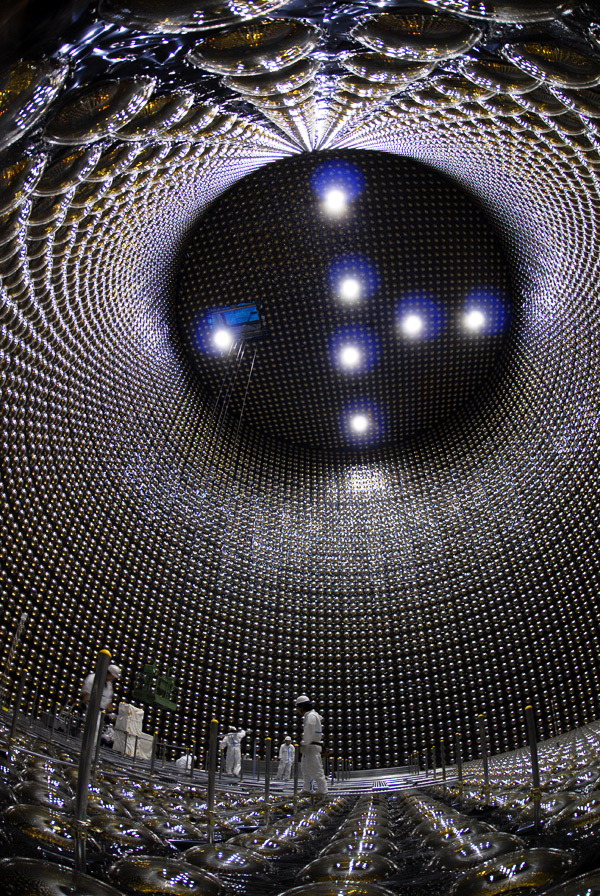
The Super-Kamiokande neutrino-cathedral

The Super-Kamiokande neutrino-cathedral (click for larger image)

Pauli was famously witty; another big brain in the book, the Englishman Paul Dirac (1902-84), was famously taciturn. Big brains are often strange ones too. That’s part of why they’re attracted to the very strange world of atomic physics. Jayawardhana also discusses the Italian physicist Ettore Majorana (1906-?1938), who disappeared at the age of thirty-two, and his colleague Bruno Pontecorvo (1913-93), who defected to the Soviet Union. Neutrinos are fascinating and so are the humans who have hunted for them. So is the history that surrounded them. Quantum physics was convulsing science at the same time as communism and Nazism were convulsing Europe. As the Danish physicist Niels Bohr (1885-1962) said: “Anyone who is not shocked by quantum theory has not understood it.” Modern physicists have been called a new priesthood, devoted to lofty and remote ideas incomprehensible and irrelevant to ordinary people. But ordinary people fund the devices the priests build to pursue their ideas with. And some of the neutrino-detectors pictured here are as huge and awe-inspiring as cathedrals. Some might say they’re as futile as cathedrals too. But if understanding the universe isn’t enough in itself, there may be practical uses for neutrinos on the way. At present, we have to communicate over the earth’s surface; a beam of neutrinos can travel right through the earth.

The universe is also a dangerous place: some scientists theorized that the neutrino deficit in Ray Davis’s experiments meant the sun was about to go nova. It wasn’t, but neutrinos may help the human race spot other dangers and exploit new opportunities. We still know only a fraction of what’s out there and the ghost particle is a messenger from the heart not only of supernovae and the sun, but also of the earth itself. There’s radioactivity deep in the earth, so there are neutrinos streaming upward. As methods of detecting them get better, we’ll understand the interior of the earth better. But Jayawardhana doesn’t discuss another possibility: that we might even discover advanced life down there, living under huge pressures at very high temperatures, as Arthur C. Clarke suggested in his short-story “The Fires Within” (1949).

Clarke also suggested that life could exist inside the sun. There’s presently no way of testing his ideas, but neutrinos may carry even more secrets than standard science has guessed. Either way, I think Clarke would have enjoyed this book and perhaps Jayawardhana, who’s of Sri Lankan origin, was influenced by him. Jayawardhana’s writing certainly reminds me of Clarke’s writing. It’s clear, enthusiastic and a pleasure to read, wearing its learning lightly and carrying you easily over vast stretches of space and time. The Neutrino Hunters is an excellent introduction to the hunters, the hunted and the history, with a good glossary and index too.


Previously pre-posted (please peruse):

• Think Ink – Review of 50 Quantum Physics Ideas You Really Need to Know

World Wide Watchmen

I prefer to self-issue books in a library. It’s quicker and more convenient. And you feel okay about borrowing books suggestive of sordid and socially unacceptable tastes. For example, who would want to hand a copy of Watch You Bleed to a live librarian?

Well, I wouldn’t mind. I find it amusing to be mistaken for a Guns’n’Roses fan, just as I find it amusing to be mistaken for a Guardian-reader. But there are limits, so I’m grateful for self-issue when I borrow, say, a biography of Martin Amis or that book about The Simpsons. The trouble is, nowadays we have to be more dubious about self-issue than we used to be. It’s all on computer and it isn’t just librarians who might be scanning the record of books you borrow. No, you also have to ask yourself: What will the NSA, GCHQ and MOSSAD think?

With this in mind, I’d like to put it clearly on record: I got that book out last year for research purposes only. Nothing more. I am not – repeat not – a fan of Iron Maiden. The same applies to that other book this year. I got it out for research purposes only, I swear. Inter alia, I had a hypothesis to confirm. I am not – repeat not – a fan of his.

Front cover of Iron Maiden: On Board Flight 666

And was the hypothesis confirmed? Yes, thanks for asking, it was.


As for Big Numbers, Moore asserted: “It is the most advanced comic work I’ve ever done in terms of the storytelling.” — Magic Words: The Extraordinary Life of Alan Moore, Lance Parkin, pg. 266 (Aurum 2013)


Elsewhere other-posted:

• Ex-term-in-ate!

She Say, She Sigh, She Sow

“Those who view mathematical science, not merely as a vast body of abstract and immutable truths, whose intrinsic beauty, symmetry and logical completeness, when regarded in their connection together as a whole, entitle them to a prominent place in the interest of all profound and logical minds, but as possessing a yet deeper interest for the human race, when it is remembered that this science constitutes the language through which alone we can adequately express the great facts of the natural world, and those unceasing changes of mutual relationship which, visibly or invisibly, consciously or unconsciously to our immediate physical perceptions, are interminably going on in the agencies of the creation we live amidst: those who thus think on mathematical truth as the instrument through which the weak mind of man can most effectively read his Creator’s works, will regard with especial interest all that can tend to facilitate the translation of its principles into explicit practical forms.” — Ada Lovelace (née Byron) (1815-52).