Toxic Turntable #9

Currently listening…

• Talbot Rich, Intangible EP (1983)
• Pimkka, Neptunienne (1976)
• Theoxiphos, Autochthulhu (1997)
• ζ Draconis, გველეშაპის ვარსკვლავი (1993)
• Sindroma-83, Cera Vera (1987)
• Zazara Xokh, Chemicated (1995)
• The Hems, Deinotherium (2003)
• Jethro Tull, The Broadsword and the Beast (1982)
• Veilchen, Seismophil (1996)


Previously pre-posted:

Toxic Turntable #1#2#3#4#5#6#7#8

Eyeway to Ell

Two new reviews of Jesús Ignacio Aldapuerta’s The Eyes:

Δεν είχα άλλο βιβλίο στα ελληνικά να διαβάσω, αγγλικά βαριόμουν λίγο, οπότε διάβασα αυτό το ανοσιούργημα. Κάποιες ελάχιστες ιστορίες ήταν εντάξει, σκληρές, αλλά τις άντεξα μια χαρά (καλό είναι αυτό τώρα;), αλλά κάποιες ήταν εντελώς εμετικές (π.χ. Αποδεικτικά στοιχεία), και με το ζόρι τις τελείωσα. Όπως και να το κάνουμε το βιβλίο είναι εμετικό, νοσηρό, άρρωστο, πείτε ό,τι άλλο θέλετε. Φυσικά η γραφή είναι πολύ καλή. Αν δεν ήταν τόσο άρρωστος ο συγγραφέας (από αυτά που διάβασα στον πρόλογο, δεν τον ήξερα και από πριν τον τυπά), σίγουρα θα μπορούσε να γράψει κάποια καλογραμμένα μυθιστορήματα τρόμου (έστω και σκληρά). Αλλά φευ… — Review

Translation: I had another book to read in Greek, English a little bored, so I read this outrage. Some few stories were okay, tough, but withstood fine (good is it now?), But some were completely emetic (eg Evidence), and by force of finished. Whatever you do book is emetic, unhealthy, sick, say whatever else you want. Of course the writing is very good. If it was not so sick the author (from what I read in the preface, I did not know from before standards) certainly could write a well written horror novels (even hard). But alas …


Αν το πάρει κανείς κυριολεκτικά είναι πραγματικά… απαίσιο! Αυτό βέβαια είναι, κατά την γνώμη μου, η επιφανειακή κριτική.

Λογοτεχνικά, ο μυστηριώδης αυτός συγγραφέας είχε να δώσει πράγματα καθώς τόσο οι περιγραφές όσο και οι εικόνες που δημιουργεί είναι δείγμα λογοτεχνικής δεξιοτεχνίας. Φυσικά, κανείς δε προσπερνά το άρρωστο του νοήματος.

Αξίζει κάποιος να το διαβάσει (αν διαθέτει γερό στομάχι) και θα διαπιστώσετε πως λογοτεχνικά είναι καλύτερο από την “Φιλοσοφία στο Μπουντουάρ” του μαρκήσιου και προσεγγίζει την “Ιστορία του Ματιού” του Ζ.Μπατάιγ. Αυστηρά για ενήλικο και ώρμο κοινό! — Review

Translation: If you get literally is really … horrible! This of course is, in my opinion, the superficial criticism.

Literature, the mysterious writer he had to give things as well as descriptions and images created are literary virtuosity sample. Of course, no one overtakes the sick of meaning.

It is worth to read (if you have a strong stomach) and you will see that literature is better than the “Philosophy in the Boudoir” Marquis and approaches the “Story of the Eye” of Z.Mpataig. Strictly for adult and ormo public!


Jesús say:

M… P… U….. G… G….. E… R…. | M….. P… A… T….. A… I….. G…. | M… P…. U… R… R… O….. U… G… H… S….. | …(…. | M… P… U….. T… | M… P….. A… L… L….. A… R… D… | M… P….. R… I… L….. L… | …)…

Toxic Turntable #8

Currently listening…

• Axis Telemachi, Urbi et Orbi (1976)
• The Minimals, 1+0 (1992)
• Bolshaya Zona, Slon (1978)
• A Tall Ship, To the Sea Again (1964)
• Instep, Den Chof (1994)
• Iugulator, Fazgo (2002)
• Status Quo, Just Supposin’ (1980)
• Fimver, Reaping Folk (and Sowing) (2004)


Previously pre-posted:

Toxic Turntable #1#2#3#4#5#6#7

Which Switch

Why didn’t George Orwell sort his relatives out? I don’t mean his family: I mean his pronouns. In The King’s English (1906), the Fowler brothers say this:

The few limitations on ‘that’ and ‘who’ about which every one is agreed all point to ‘that’ as the defining relative, ‘who’ or ‘which’ as the non-defining.

Here are some examples:

• The cat that sat on the mat ate a rat. (Defining)
• The cat, which is three, never sits on mats. (Non-defining)
• The cat that you see on the mat eats rats. (D)
• The cat, which you saw yesterday on a mat, eats rats. (N-D)
(The third example can also be written without an explicit relative: “The cat you see on the mat eats rats.”)


But Orwell doesn’t follow these simple rules consistently in Nineteen Eighty-Four (1949). In the opening chapter of the book, you can find many defining relatives using “which”:

• …one of those pictures which are so contrived that the eyes follow you about when you move
• …a list of figures which had something to do with the production of pig-iron
• …an oblong metal plaque like a dulled mirror which formed part of the surface of the right-hand wall
• …the blue overalls which were the uniform of the party

But you can also find defining relatives using “that”:

• …his skin roughened by coarse soap and blunt razor blades and the cold of the winter that had just ended
• …there seemed to be no colour in anything, except the posters that were plastered everywhere
• You had to live – did live, from habit that became instinct – in the assumption that every sound you made was overheard (note implicit relative after “sound”)

Here Orwell uses “that” and “which” as defining relatives in the same sentence:

• Any sound that Winston made, above the level of a very low whisper, would be picked up by it, moreover, so long as he remained within the field of vision which the metal plaque commanded, he could be seen as well as heard.

I can’t see any clear reason for the alternation, but it would be interesting to analyse the sentences more carefully and see if it’s possible to discover what conditions his use now of “which”, now of “that”. When I looked at the same phenomenon in the work of Evelyn Waugh, I found that “that” seemed to occur more often when the noun was governed by a preposition. That may also apply to Orwell.

Now let’s move from a particular writer to something more general. It’s possible to use a modification of the rules given above. If the noun and its defining relative are separated by several other words, I sometimes prefer “which” to “that”. Here’s an example from Orwell:

• He had a trick of resettling his spectacles on his nose which was curiously disarming…

The noun is “trick”, not “his nose”, so “which” doesn’t seem so bad to me, because it helps to disassociate the relative from the nouns that separate it from its antecedent. In its non-defining form “which” has what might be called a disjunctive role, and the disjunctive association is still there when it’s used as a defining relative. That’s why “which” doesn’t seem right as a defining relative when its antecedent stands directly before it.

But the possessive of “his nose” also helps to dissociate the relative, so I would also be happy to use “that” in this particular case. In the other examples, “that” is the clear winner (except perhaps in “an oblong metal plaque like a dulled mirror which formed part…”).

Do many foreign learners of English feel the same way about “that”? I doubt it. It must often be difficult to separate the three meanings of “that”: the demonstrative pronoun, the defining relative, and the coordinator. Not many foreign speakers of English would understand this sentence easily:

• It’s confusing that that “that” that’s a relative pronoun is written in exactly the same way as that “that” that’s not.

If English had a governing academy, we might spell the three thats differently: that, thæt and thatt, for example. And if I had my way, we wouldn’t use a digraph for the dentals. That is, the opening sentence of Nineteen Eighty-Four would look like this:

• It was a bright cold day in April, and ðe clocks were striking Þirteen.

Performativizing Papyrocentricity #50

Papyrocentric Performativity Presents:

Life LocomotesRestless Creatures: The Story of Life in Ten Movements, Matt Wilkinson (Icon 2016)

Heart of the MotherJourney to the Centre of the Earth: A Scientific Exploration into the Heart of Our Planet, David Whitehouse (Weidenfeld & Nicolson 2015)

LepidopterobibliophiliaBritish Butterflies: A History in Books, David Dunbar (The British Library 2012)

Minimal Manual – Georgisch Wörterbuch, Michael Jelden (Buske 2016)


Or Read a Review at Random: RaRaR

For Revver and Fevver

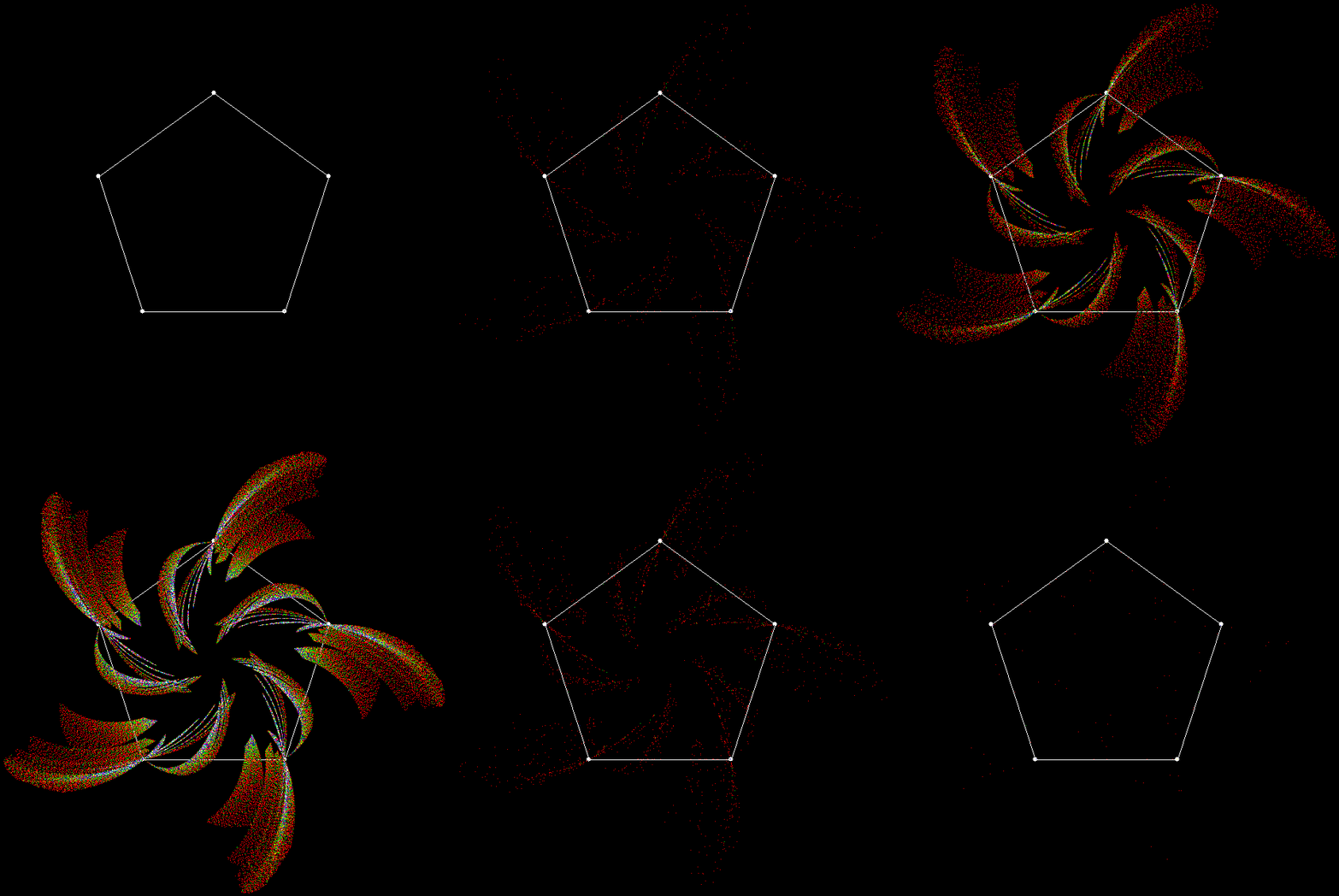
This shape reminds me of the feathers on an exotic bird:

feathers

(click or open in new window for full size)


feathers_anim

(animated version)


The shape is created by reversing the digits of a number, so you could say it involves revvers and fevvers. I discovered it when I was looking at the Halton sequence. It’s a sequence of fractions created according to a simple but interesting rule. The rule works like this: take n in base b, reverse it, and divide reverse(n) by the first power of b that is greater than n.

For example, suppose n = 6 and b = 2. In base 2, 6 = 110 and reverse(110) = 011 = 11 = 3. The first power of 2 that is greater than 6 is 2^3 or 8. Therefore, halton(6) in base 2 equals 3/8. Here is the same procedure applied to n = 1..20:

1: halton(1) = 1/10[2] → 1/2
2: halton(10) = 01/100[2] → 1/4
3: halton(11) = 11/100[2] → 3/4
4: halton(100) = 001/1000[2] → 1/8
5: halton(101) = 101/1000[2] → 5/8
6: halton(110) = 011/1000 → 3/8
7: halton(111) = 111/1000 → 7/8
8: halton(1000) = 0001/10000 → 1/16
9: halton(1001) = 1001/10000 → 9/16
10: halton(1010) = 0101/10000 → 5/16
11: halton(1011) = 1101/10000 → 13/16
12: halton(1100) = 0011/10000 → 3/16
13: halton(1101) = 1011/10000 → 11/16
14: halton(1110) = 0111/10000 → 7/16
15: halton(1111) = 1111/10000 → 15/16
16: halton(10000) = 00001/100000 → 1/32
17: halton(10001) = 10001/100000 → 17/32
18: halton(10010) = 01001/100000 → 9/32
19: halton(10011) = 11001/100000 → 25/32
20: halton(10100) = 00101/100000 → 5/32…

Note that the sequence always produces reduced fractions, i.e. fractions in their lowest possible terms. Once 1/2 has appeared, there is no 2/4, 4/8, 8/16…; once 3/4 has appeared, there is no 6/8, 12/16, 24/32…; and so on. If the fractions are represented as points in the interval [0,1], they look like this:

line1_1_2

point = 1/2


line2_1_4

point = 1/4


line3_3_4

point = 3/4


line4_1_8

point = 1/8


line5_5_8

point = 5/8


line6_3_8

point = 3/8


line7_7_8

point = 7/8


line_b2_anim

(animated line for base = 2, n = 1..63)


It’s apparent that Halton points in base 2 will evenly fill the interval [0,1]. Now compare a Halton sequence in base 3:

1: halton(1) = 1/10[3] → 1/3
2: halton(2) = 2/10[3] → 2/3
3: halton(10) = 01/100[3] → 1/9
4: halton(11) = 11/100[3] → 4/9
5: halton(12) = 21/100[3] → 7/9
6: halton(20) = 02/100 → 2/9
7: halton(21) = 12/100 → 5/9
8: halton(22) = 22/100 → 8/9
9: halton(100) = 001/1000 → 1/27
10: halton(101) = 101/1000 → 10/27
11: halton(102) = 201/1000 → 19/27
12: halton(110) = 011/1000 → 4/27
13: halton(111) = 111/1000 → 13/27
14: halton(112) = 211/1000 → 22/27
15: halton(120) = 021/1000 → 7/27
16: halton(121) = 121/1000 → 16/27
17: halton(122) = 221/1000 → 25/27
18: halton(200) = 002/1000 → 2/27
19: halton(201) = 102/1000 → 11/27
20: halton(202) = 202/1000 → 20/27
21: halton(210) = 012/1000 → 5/27
22: halton(211) = 112/1000 → 14/27
23: halton(212) = 212/1000 → 23/27
24: halton(220) = 022/1000 → 8/27
25: halton(221) = 122/1000 → 17/27
26: halton(222) = 222/1000 → 26/27
27: halton(1000) = 0001/10000 → 1/81
28: halton(1001) = 1001/10000 → 28/81
29: halton(1002) = 2001/10000 → 55/81
30: halton(1010) = 0101/10000 → 10/81

And here is an animated gif representing the Halton sequence in base 3 as points in the interval [0,1]:

line_b3_anim


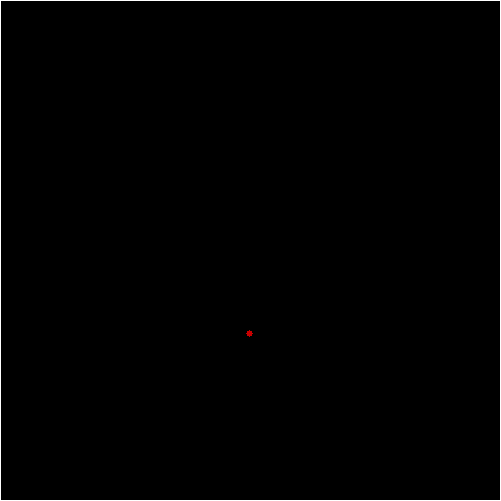
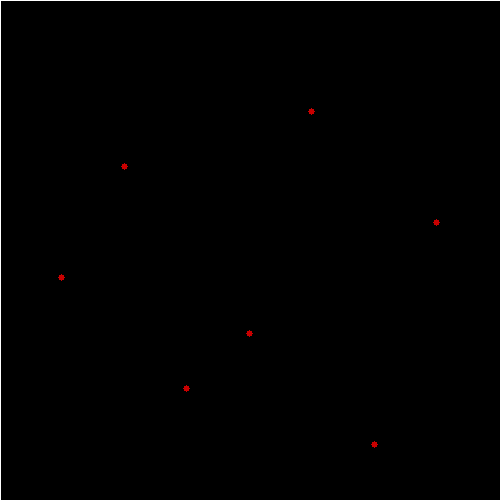
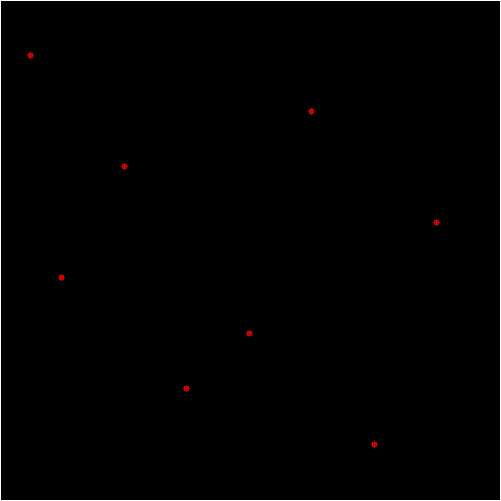
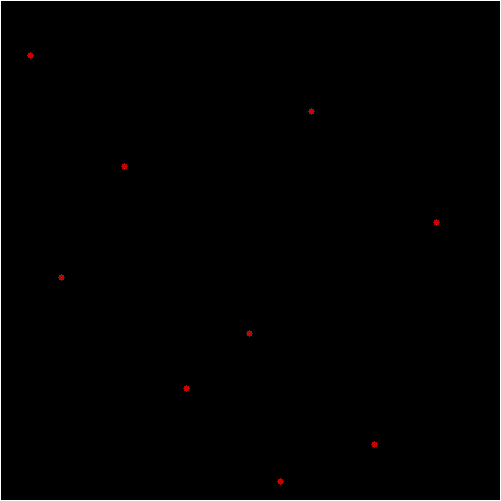
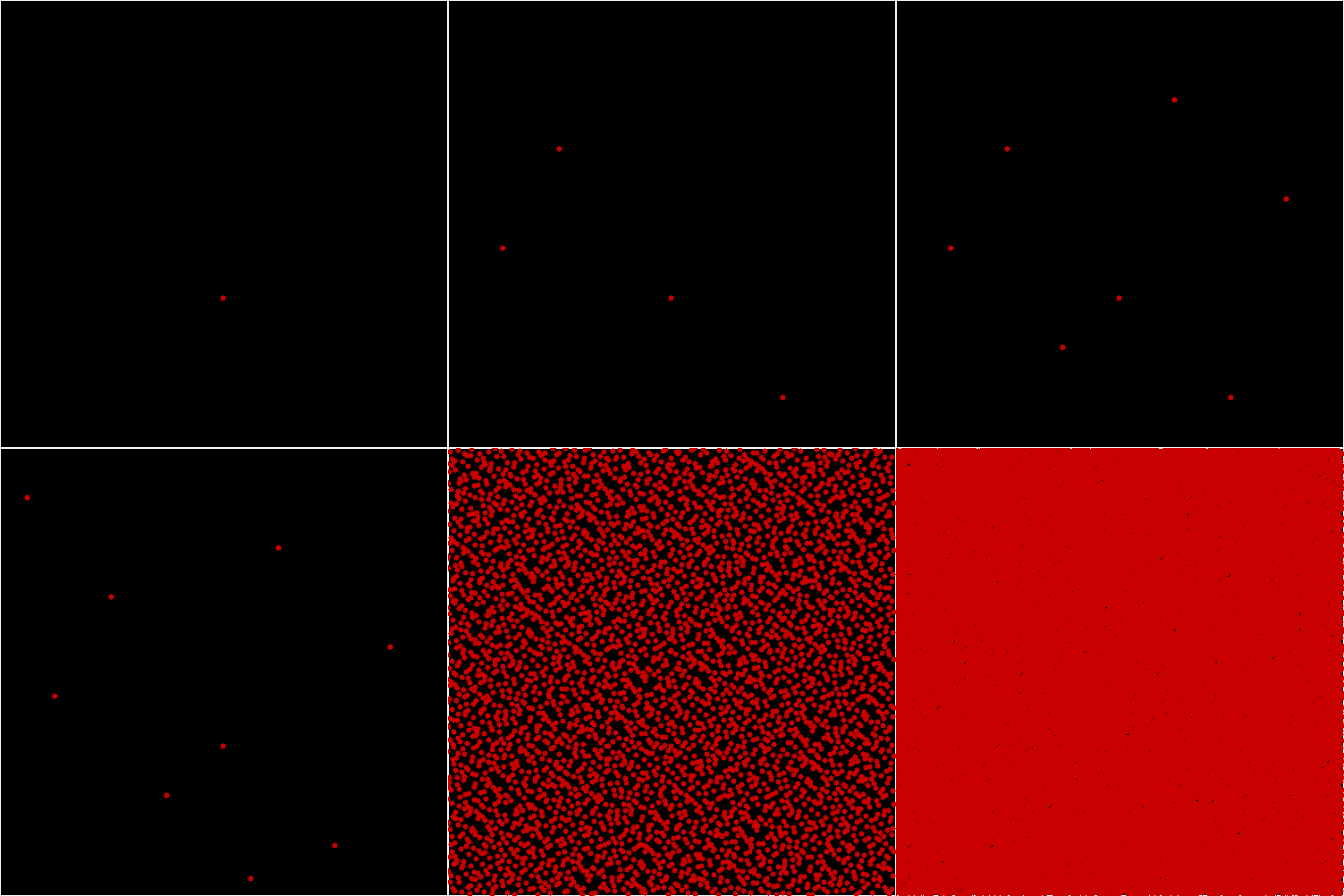
Halton points in base 3 also evenly fill the interval [0,1]. What happens if you apply the Halton sequence to a two-dimensional square rather a one-dimensional line? Suppose the bottom left-hand corner of the square has the co-ordinates (0,0) and the top right-hand corner has the co-ordinates (1,1). Find points (x,y) inside the square, with x supplied by the Halton sequence in base 2 and y supplied by the Halton sequence in base 3. The square will gradually fill like this:

square1

x = 1/2, y = 1/3


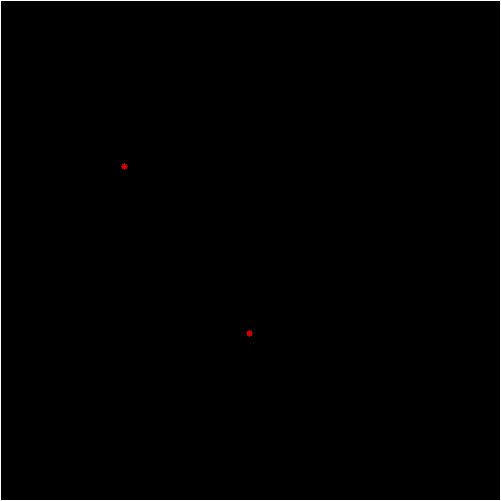
square2

x = 1/4, y = 2/3


square3

x = 3/4, y = 1/9


square4

x = 1/8, y = 4/9


square5

x = 5/8, y = 7/9


square6

x = 3/8, y = 2/9


square7

x = 7/8, y = 5/9


square8

x = 1/16, y = 8/9


square9

x = 9/16, y = 1/27…


square_anim

animated square


Read full page: For Revver and Fevver

Pigmental Paradox

From Raymond Smullyan’s Logical Labyrinths (2009):

We now visit another knight/knave island on which, like on the first one, all knights tell the truth and all knaves lie. But now there is another complication! For some reason, the natives refuse to speak to strangers, but they are willing to answer yes/no questions using a secret sign language that works like this:

Each native carries two cards on his person; one is red and the other is black. One of them means yes and the other means no, but you are not told which color means what. If you ask a yes/no question, the native will flash one of the two cards, but unfortunately, you will not know whether the card means yes or no!

Problem 3.1. Abercrombie, who knew the rules of this island, decided to pay it a visit. He met a native and asked him: “Does a red card signify yes?” The native then showed him a red card.

From this, is it possible to deduce what a red card signifies? Is it possible to deduce whether the native was a knight or a knave?

Problem 3.2. Suppose one wishes to find out whether it is a red card or a black card that signifies yes. What simple yes/no question should one ask?