Les Sez

In Terms of My Natural Life

(a pome crafted by Les Patterson)

I am an Australian in terms of Nation
And a Public Servant in terms of vocation,
But there’s one thing amazes my critics and that’s
How many I wear in terms of hats:
I chair the Cheese Board, I front the Yartz
You could term me a man of many parts.
I’m a Renaissance type, if you know the term
And I’ve held long office in terms of term,
Yes, I’ve long served Australia in terms of years
And in terms of refreshment I like a few beers.
My opponents are mongrels, scum and worms
Who I bucket in no uncertain terms
And my rich vocabulary always features
Large in terms of my public speeches.
My favourite terms in terms of debate
Are: “broadbased package” and “orchestrate”.
But one term I never employ is “failure” —
Especially when talking in terms of Australia!
For in terms of lifestyle we’ve got the germs of
A ripper concept to think in terms of.
Yes, in terms of charisma I’ve got the game mastered
In anyone’s terms I’m a well-liked bastard.

From the Back With A Vengeance Tour Brochure © 1989 Sir Les Patterson.


Elsewhere Other-Engageable:

Sir Les’s Website
Ex-Term-In-Ate!

Go Fig, Carr

“What they will find is a clear look into the molten core of a certain mind-set, a place where conspiracies are legion, victims are portrayed as perpetrators and so-called news is a fig leaf on a far darker art.” — “Sowing Mayhem, One Click at a Time”, David Carr, The New York Times, 15/xii/2014, viâ Steve Sailer.

Get Your Tox Off

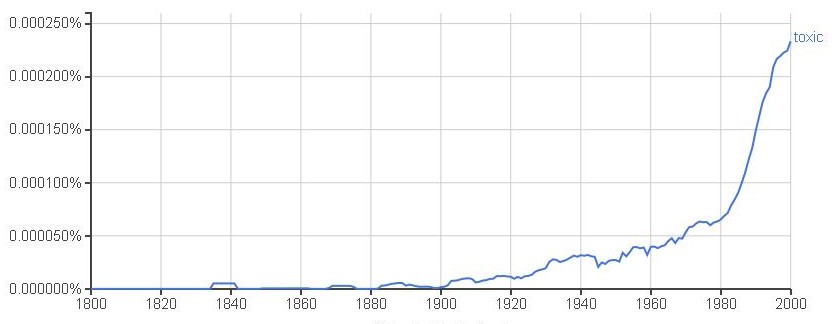
There’s only one word for it: toxic. The proliferation of this word is an incendiarily irritating abjectional aspect of contemporary culture. My visit to Google Ngram has confirmed my worst suspicions:

Toxic in English

Toxic in English

Toxic in English fiction

Toxic in English fiction

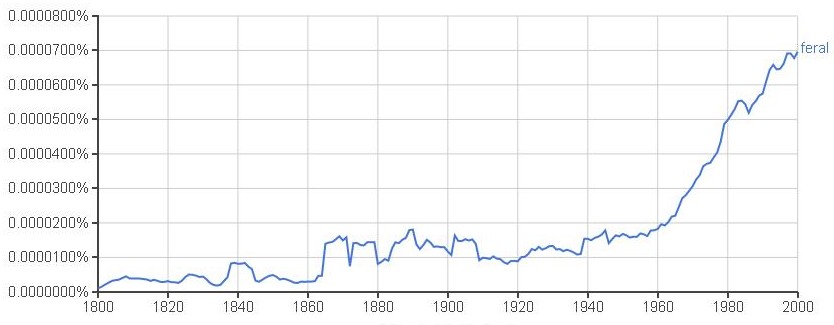
“Feral” isn’t irritating in quite the same way, but has similarly proliferated:

Feral in English

Feral in English

Feral in English fiction

Feral in English fiction

Noxious note: In terms of majorly maximal members of the Maverick Messiah community (such as myself), it goes without saying that when we deploy such items of Guardianese, we are being ironic dot dot dot


Previously pre-posted (please peruse):

Septics vs Dirties
Ex-term-in-ate!
Reds Under the Thread
Titus Graun

Vibe Alibe

“The recent election of Syriza in Greece offers a vibrant glimmer of hope for the future of social and economic democracy in Europe.” — from a letter to The Guardian by Judith Butler, Slavoj Žižek, Jacqueline Rose, et al.

Who Guards the Guardianistas?

“…We’re not so much a reaction against what’s going on – it’s more down to the music that we’re into – but in terms of guitar music there hasn’t been much in terms of louder groups.” – Bored of cookie-cutter conformity in music?, The Guardian, 6/iii/ 2014.


Elsewhere other-posted:

Ex-term-in-ate!

Bill Self

I would be disturbed and dismayed if Will Self ever wrote an essay on Evelyn Waugh or Clark Ashton Smith. In fact, I hope he has never even heard of CAS. But I’m happy to see Self writing in the Guardian on William Burroughs. It’s a perfect setting for a perfect pairing. And Self, like Christopher Hitchens, raises a very interesting question. What is his mother-tongue? Quechua? Tagalog? Sumerian? Whatever it is, it’s not even remotely related to English.


William Burroughs — the original Junkie — Will Self, The Guardian, 1/ii/2014.

Entitled Junkie: Confessions of an Unredeemed Drug Addict and authored pseudonymously by “William Lee” (Burroughs’ mother’s maiden name – he didn’t look too far for a nom de plume) …

[Self missed his chance there: nom de guerre would have been much better.]

The two-books-in-one format was not uncommon in 1950s America …

Despite its subhead, Wyn did think the book had a redemptive capability …

Both Junkie and Narcotic Agent have covers of beautiful garishness, featuring 1950s damsels in distress. On the cover of Junkie a craggy-browed man is grabbing a blond lovely from behind; one of his arms is around her neck, while the other grasps her hand, within which is a paper package. The table beside them has been knocked in the fray, propelling a spoon, a hypodermic, and even a gas ring, into inner space.

This cover illustration is, in fact, just that: an illustration of a scene described by Burroughs in the book. “When my wife saw I was getting the habit again, she did something she had never done before. I was cooking up a shot two days after I’d connected with Old Ike. My wife grabbed the spoon and threw the junk on the floor. I slapped her twice across the face and she threw herself on the bed, sobbing …” That this uncredited and now forgotten hack artist should have chosen one of the few episodes featuring the protagonist’s wife to use for the cover illustration represents one of those nastily serendipitous ironies that Burroughs himself almost always chose to view as evidence of the magical universe. …

… if you turn to his glossary of junk lingo and jive talk – you will see how many arcane drug terms have metastasised into the vigorous language. …

Burroughs viewed the postwar era as a Götterdämmerung and a convulsive re-evaluation of values. …

An open homosexual and a drug addict, his quintessentially Midwestern libertarianism led him to eschew any command economy of ethics …

For Burroughs, the re-evaluation was both discount and markup …

… and perhaps it was this that made him such a great avatar of the emergent counterculture. …

Janus-faced, and like some terminally cadaverous butler, Burroughs ushers in the new society of kicks for insight as well as kicks’ sake. …

Let’s return to that cover illustration with its portrayal of “William Lee” as Rock Hudson and his common-law wife, Joan Vollmer, as Kim Novak.

When I say Burroughs himself must have regarded the illustration – if he thought of it at all – as evidence of the magical universe he conceived of as underpinning and interpenetrating our own …

Much has been written and even more conjectured about the killing. Burroughs himself described it as “the accidental shooting death”; and although he jumped bail, he was only convicted – in absentia by the Mexican court – of homicide. …

When Burroughs was off heroin he was a bad, blackout drunk (for evidence you need look no further than his own confirmation in Junky). …

By the time Burroughs was living in Tangier in the late 1950s, his sense of being little more than a cipher, or a fictional construct, had become so plangent …

Burroughs was the perfect incarnation of late 20th-century western angst precisely because he was an addict. Self-deluding, vain, narcissistic, self-obsessed, and yet curiously perceptive about the sickness of the world if not his own malaise, Burroughs both offered up and was compelled to provide his psyche as a form of Petri dish, within which were cultured the obsessive and compulsive viruses of modernity. …

In a thin-as-a-rake’s progress …

… a deceptively thin, Pandora’s portfolio of an idea …

It is Burroughs’ own denial of the nature of his addiction that makes this book capable of being read as a fiendish parable of modern alienation. …

For, in describing addiction as “a way of life”, Burroughs makes of the hypodermic a microscope, through which he can examine the soul of man under late 20th-century capitalism.

William Burroughs – the original Junkie, The Guardian, 1/ii/2014.


The big disappointment is that he didn’t use in terms of.

Mix to the Marx

“And in the global climate of the early 90s, it’s perhaps not surprising that the ANC bent to the neoliberal flood tide, putting its Freedom Charter calls for public ownership and redistribution of land on the back burner.” — Mandela has been sanitised by hypocrites and apologists, Seamus Milne, The Guardian, 12/xii/2013.


Previously pre-posted (please peruse):

Reds under the Thread

Fifty Sense

I can recommend George Orwell’s essay “Politics and the English Language” (1946) to anyone who wants to write better English. Or better French, Georgian, Arabic, Mandarin or Tagalog, because some of Orwell’s advice is universal. But perhaps the essay is partly a joke: Orwell may deliberately have committed some of the literary sins he criticizes. Or not deliberately. Orwell wasn’t infallible, despite his modern cult. He wasn’t a perfect observer either, but I don’t think his failure to criticize “in terms of” in the essay is a bad oversight. The phrase wasn’t the blight in his day that it is today. All the same, you can see its spores beginning to drift through the flower-beds of English literature in the 1930s and ’40s. Orwell himself uses it nineteen times in the Fifty Orwell Essays available at the Australian Gutenberg site. But that’s roughly one I.T.O. for every 12,000 words or 2·63 essays, which I think is a healthy ratio. No I.T.O.’s at all would have been even healthier, though some are defensible and may be the best way of expressing Orwell’s thought. Others, however, seem to me to be tending towards Guardianese. I’ve collected them all here and suggested alternatives. Sometimes it might be better to re-write more fully, but only two alternatives are longer than the I.T.O. they replace (orthographically, at least).

From Charles Dickens:

More completely than most writers, perhaps, Dickens can be explained in terms of his social origin, though actually his family history was not quite what one would infer from his novels. → More completely than most writers, perhaps, Dickens can be explained by / through his social origin, though actually his family history was not quite what one would infer from his novels.

What now strikes us as remarkable about the new moneyed class of the nineteenth century is their complete irresponsibility; they see everything in terms of individual success, with hardly any consciousness that the community exists. → What now strikes us as remarkable about the new moneyed class of the nineteenth century is their complete irresponsibility; they see everything by / through individual success, with hardly any consciousness that the community exists.

When he speaks of human progress it is usually in terms of moral progress – men growing better; probably he would never admit that men are only as good as their technical development allows them to be. → When he speaks of human progress it is usually as moral progress – men growing better; probably he would never admit that men are only as good as their technical development allows them to be.

I have been discussing Dickens simply in terms of his “message”, and almost ignoring his literary qualities. → I have been discussing Dickens simply by / through his “message”, and almost ignoring his literary qualities.

The truth is that it is absurd to make such comparisons in terms of “better” and “worse”. → The truth is that it is absurd to make such comparisons with / by “better” and “worse”.

Charles Dickens (1940)


From Inside the Whale:

Alliances, changes of front etc., which only make sense as part of the game of power politics have to be explained and justified in terms of international socialism. → Alliances, changes of front etc., which only make sense as part of the game of power politics have to be explained and justified by / through international socialism.

Miller replied in terms of extreme pacifism, an individual refusal to fight, with no apparent wish to convert others to the same opinion – practically, in fact, a declaration of irresponsibility. → Miller replied as an extreme pacifist, as an individual refusing to fight, with no apparent wish to convert others to the same opinion – practically, in fact, a declaration of irresponsibility.

Inside the Whale (1940)


From The Lion and the Unicorn:

At the same time the Labour Party was a Socialist party, using Socialist phraseology, thinking in terms of an old-fashioned anti-imperialism and more or less pledged to make restitution to the coloured races. → At the same time the Labour Party was a Socialist party, using Socialist phraseology, thinking of / by an old-fashioned anti-imperialism and more or less pledged to make restitution to the coloured races.

Because the time has come when one can predict the future in terms of an “either–or”. → Because the time has come when one can predict the future with / by an “either–or”.

The Lion and the Unicorn: Socialism and the English Genius (1941)


From Looking Back on the Spanish War:

I saw, in fact, history being written not in terms of what happened but of what ought to have happened according to various “party lines”. → I saw, in fact, history being written not by what happened but by what ought to have happened according to various “party lines”.

Looking Back on the Spanish War (1942)


From Antisemitism in Britain:

There is more antisemitism in England than we care to admit, and the war has accentuated it, but it is not certain that it is on the increase if one thinks in terms of decades rather than years. → There is more antisemitism in England than we care to admit, and the war has accentuated it, but it is not certain that it is on the increase if one thinks in decades rather than years.

Antisemitism in Britain (1945)


From In Defence of P. G. Wodehouse:

He had missed the turning-point of the war, and in 1941 he was still reacting in terms of 1939. → He had missed the turning-point of the war, and in 1941 he was still reacting as though it were 1939.

In Defence of P. G. Wodehouse (1945)


From Notes on Nationalism:

A nationalist is one who thinks solely, or mainly, in terms of competitive prestige. → A nationalist is one who thinks solely, or mainly, of / by competitive prestige.

In practice, however, the necessary calculations cannot be made, because anyone likely to bother his head about such a question would inevitably see it in terms of competitive prestige. → In practice, however, the necessary calculations cannot be made, because anyone likely to bother his head about such a question would inevitably see it through / by competitive prestige.

But Chesterton was not content to think of this superiority as merely intellectual or spiritual: it had to be translated into terms of national prestige and military power, which entailed an ignorant idealisation of the Latin countries, especially France. → But Chesterton was not content to think of this superiority as merely intellectual or spiritual: it had to be translated into national prestige and military power, which entailed an ignorant idealisation of the Latin countries, especially France.

History is thought of largely in nationalist terms, and such things as the Inquisition, the tortures of the Star Chamber, the exploits of the English buccaneers (Sir Francis Drake, for instance, who was given to sinking Spanish prisoners alive), the Reign of Terror, the heroes of the Mutiny blowing hundreds of Indians from the guns, or Cromwell’s soldiers slashing Irishwomen’s faces with razors, become morally neutral or even meritorious when it is felt that they were done in the ‘right’ cause. → History is thought of largely through nationalism, and such things as the Inquisition, the tortures of the Star Chamber, the exploits of the English buccaneers (Sir Francis Drake, for instance, who was given to sinking Spanish prisoners alive), the Reign of Terror, the heroes of the Mutiny blowing hundreds of Indians from the guns, or Cromwell’s soldiers slashing Irishwomen’s faces with razors, become morally neutral or even meritorious when it is felt that they were done in the ‘right’ cause.

Notes on Nationalism (1945)


From The Sporting Spirit:

It is the most violently combative sports, football and boxing, that have spread the widest. There cannot be much doubt that the whole thing is bound up with the rise of nationalism – that is, with the lunatic modern habit of identifying oneself with large power units and seeing everything in terms of competitive prestige. → There cannot be much doubt that the whole thing is bound up with the rise of nationalism – that is, with the lunatic modern habit of identifying oneself with large power units and seeing everything by competitive prestige.

The Sporting Spirit (1945)


From Books vs. Cigarettes:

Exactly what reading costs, reckoned in terms of pence per hour, is difficult to estimate, but I have made a start by inventorying my own books and adding up their total price. → Exactly what reading costs, reckoned in pence per hour, is difficult to estimate, but I have made a start by inventorying my own books and adding up their total price.

There are books that one reads over and over again, books that become part of the furniture of one’s mind and alter one’s whole attitude to life, books that one dips into but never reads through, books that one reads at a single sitting and forgets a week later: and the cost, in terms of money, may be the same in each case. → There are books that one reads over and over again, books that become part of the furniture of one’s mind and alter one’s whole attitude to life, books that one dips into but never reads through, books that one reads at a single sitting and forgets a week later: and the cost, in money, may be the same in each case.

Books vs. Cigarettes (1946)


From Writers and Leviathan:

Quite largely, indeed, the workers were won over to Socialism by being told that they were exploited, whereas the brute truth was that, in world terms, they were exploiters. → Quite largely, indeed, the workers were won over to Socialism by being told that they were exploited, whereas the brute truth was that, viewed from overseas, they were exploiters.

Writers and Leviathan (1948)


From Reflections on Gandhi:

Even when he was fighting what was in effect a color war, he did not think of people in terms of race or status. → Even when he was fighting what was in effect a color war, he did not think of people by race or status.

At the same time there is reason to think that Gandhi, who after all was born in 1869, did not understand the nature of totalitarianism and saw everything in terms of his own struggle against the British government. → At the same time there is reason to think that Gandhi, who after all was born in 1869, did not understand the nature of totalitarianism and saw everything through his own struggle against the British government.

Reflections on Gandhi (1949)


Previously pre-posted (please peruse):

Ex-term-in-ate!

Titus Graun

Reds Under the Thread

Homotextuality

In terms of the highest levels of the United Kingdom’s counter-cultural community, it seems to be compulsory for non-conformists, mavericks, free-thinkers et al to be committed readers of The Guardian (which was nicknamed The Grauniad by Private Eye in honour of the misspellings once common there). Naturally enough, committed Guardian-readers use the special dialect of English known as Guardianese (which is also found in The Times Literary Supplement, The London Review of Books, etc). And there are a lot of such Guardianistas in the counter-cultural community, trust me. So the obvious question arises:

Myriads, myriads, off the wall,
Who is the Grauniest of them all?

Continue reading Homotextuality

Reds under the Thread

A clue, or clew, was originally a ball of thread, as unwound by the Greek hero Theseus en route to the centre of King Minos’ labyrinth on Crete. When he had found and slain the Minotaur, he used the thread to retrace his steps. So a clue is a guide: Theseus followed a thread to solve a puzzle. Nowadays, scientists are following much finer threads to solve much bigger puzzles: DNA is a microscopic thread of chemicals and the clue to all manner of puzzles. Perhaps the biggest and most important is the puzzle of language. How did it evolve? How is it encoded in our genes? How is it instantiated in the brain? Those are the big problems waiting to be slain at the centre of the labyrinth of human genetics. Without language, we wouldn’t be human and you wouldn’t be reading this essay.

But this essay is a thread too: like DNA, language consists of a string of symbols used to construct something bigger. DNA codes for brains and bodies; language codes for ideas and images. By looking at a sample of DNA, scientists can tell what kind of body it builds: its sex and race, for example. In future, we’ll be able to tell much more: DNA will offer clues to intelligence and personality. Samples of language offer similar clues: we can often deduce a lot about someone from his or her writing. There are already computer programs that claim to be able to identify the sex of a writer by the lexical and grammatical patterns in a text. But I wonder how much more computers will be able to deduce in future and what clues there already are in our language to our intellects and personalities. They might not be obvious ones. Perhaps it will be possible to deduce race or sexuality or political preferences from apparently trivial things. Perhaps libertarians or homosexuals or psychopaths use pronouns in a distinctive way or prefer certain kinds of consonants or vowels.

But those are differences between groups: regardless of politics or personality, it’s certain that every individual uses language in a unique way. In future, it will be possible to track people on the internet even when they’re writing anonymously or under false names. A bloodhound can track people after sniffing something known to belong to them. In future, bloodhound programs will track people after sniffing – statistically analyzing – texts known to have been written by them. It’s a worrying thought in our ever-more authoritarian times. Express anonymous thoughts on-line about a controversial topic and you may find a bloodhound-program sniffing you out and the thought-police knocking on your door. Science will hand totalitarian tools to tyrants and it may not be possible to escape even if you avoid controversial topics and write about innocuous things. If psychopaths use language in distinctive ways, as seems likely, perhaps other warped individuals will inadvertently betray themselves in their language. Going for a government job? Maybe you’ll have to write an essay about your last holiday or your first pet. And an apparently innocent metaphor will reveal that you’re racist or homophobic or sexist. So no job for you (and quite right, too).

I don’t know whether crime-think like that can be identified by linguistic patterns, but I do think that good-think can be. In terms of issues around progressive publications like The Guardian and London Review of Books, I’ve noticed again and again that members of the decent’n’compassionate community engage issues around imagery in a special way. In short, they like to mix their metaphors. The most recent example I’ve come across was in a review of a Derrida biography in The Guardian by the decent’n’compassionate Marxist Terry Eagleton:

Before long, the taciturn, socially gauche young man from the colonies was gracing the dinner tables of a galaxy of French luminaries: Jean Genet, Roland Barthes, Julia Kristeva, Maurice Blanchot and others.[1]

Reading that felt a little like stepping on a stair that wasn’t there: it was jarring to go from the image of “dinner tables” to the image of “a galaxy”, as though giant balls of flaming hydrogen could give dinner-parties. But that’s what a mixed metaphor does: it combines incongruent or incompatible images in a lingustically gauche way. George Orwell provided some good examples in his essay “Politics and the English Language” (1946):

By using stale metaphors, similes and idioms, you save much mental effort at the cost of leaving your meaning vague, not only for your reader but for yourself. This is the significance of mixed metaphors. The sole aim of a metaphor is to call up a visual image. When these images clash – as in the fascist octopus has sung its swan song, the jackboot is thrown into the melting pot – it can be taken as certain that the writer is not seeing a mental image of the objects he is naming; in other words he is not really thinking.[2]

The Eagleton example isn’t particularly egregious: Eagleton is mediocre even as a bad writer. He did a little badder six years ago in the same progressive forum:

This year’s calendar to celebrate Beckett’s 100th anniversary is crammed with literary events celebrating the life of the modern age’s most lovable pessimist, most of them, one imagines, awash with talk of the timeless human condition portrayed in his work… Yet there is also a distinctively Irish quality to Beckett’s deflation of the florid and high-flown, just as there is something recognisably Irish about those starved, stagnant landscapes where, like colonial victims, you do nothing but sit and wait for deliverance.[3]

“Talk” consists of vibrations in the air. Is “awash”, which refers to liquids around one’s feet, the right image for talk? And if the “calendar” is “crammed”, is “awash” not over-egging the pudding? Can landscapes be “stagnant”, like water or air? If they can, can they be “starved” at the same time? Or did Eagleton just want the alliteration and not give a toss about the meaning? I suspect it was the last: Eagleton seems to me a typical example of the progressive prosateur. He writes not to convey meaning or apply reason, but for a higher purpose: to demonstrate his own cleverness and assure other progressives of his goodthinkfulness. The Guardian and LRB are full of similar narcissists and Eagleton isn’t exceptional amongst them. So why did I choose his text to unlock the swamp of progressive windbaggery? Well, first because his review of the Derrida biography finally prompted me to write this essay, which I’ve been planning to write for a long time. And second because I didn’t want to give anyone whiplash. Reading Eagleton is a gentle introduction to the mixed metaphor, like driving slowly down a cobbled street in a car with good suspension. Reading another Guardian regular, on the other hand, is like driving fast through the aftermath of an earthquake in a tank with very bad suspension. But forewarned is forearmed. You’ve seen Eagleton and I doubt you’ve been very impressed. Okay, now marvel at the most magisterial mixed-metaphorizer I’ve ever come across:

But the kernel of a message black Britons had been trying to hammer home for decades suddenly took centre stage.[4]

Gary Younge, the Guardian’s resident race’n’racism-expert, is almost praeternatural in his command of the English language. He can cram more crap into less lexicality than anyone else I’ve ever seen. The mixed metaphor above, from 2005, is a triple-whammy: it manages to get three incongruent images into twenty words. If you think that’s easy, try it for yourself. Younge doesn’t have to try: as a progressive prosateur, he postures and preens without conscious effort. But his postural powers are far greater than those of Terry Eagleton. Beauty poured effortlessly from Mozart’s brain; bollocks pours effortlessly from Gary Younge’s. He rose to similar heights of mixed metaphory in 2012, when he interrogated issues around the shooting of a black teenager in Florida:

Outrage at the death of Trayvon Martin is finally lifting the lid on the US’s racist underbelly[5]

That, at least, was the sub-heading for his article: three incongruent images in seventeen words. If Younge himself wasn’t responsible for it, either he has a disciple almost as rhetorically gifted as he is or a sub-editor was taking the piss of his self-righteous posturing in terms of issues around race. I hope it’s the latter: someone really ought to take a mallet to the anti-racist windbags who litter the florid corridors of The Guardian’s stagnant columns. Not that anyone would dare do so openly. The windbags will be typing their socialist siren-songs for some time to come. Here is someone else who is Younge at heart:

Recognising the Conservatives’ persistent image as the “nasty party”, David Cameron saw her [Baroness Warsi’s] real value as someone who could prop up the image of a modern reformist party comfortable in its multi-cultural skin. The chimaera of an Asian woman influencing the levers of Tory power did prop up this illusion for most of the two-and-a-half years that Warsi was in the Cabinet.[6]

That was Ratna Lachman, the directrix of JUST West Yorkshire, “which promotes racial justice, civil liberties and human rights in the north of England”. Or says it does, at least. The language of Lachman suggests to me that she is not necessarily a trustworthy guide to reality or to its rectification. Like Younge and Eagleton, she habitually uses metaphors that don’t work: as Orwell put it in his essay, “the writer is not seeing a mental image of the objects he is naming; in other words he is not really thinking.” Or observing reality. And I can’t believe that this is irrelevant to the progressive politics persistently pursued and promoted by these posturing, preening paragons of pretension. If their relatively simple and easy-to-correct metaphors don’t work, what does that say about their vastly more ambitious and complicated plans for a fairer, juster, more equal society? I wouldn’t trust any of them to organize a party in a brewery or spot a three-foot needle in a two-foot haystack. Linguistics, as a science, insists on being descriptive rather than prescriptive: it describes what language-users do rather than prescribing what they ought to do.

I see the scientific point, but I don’t fully agree with it. Human beings are born to use language, but that doesn’t mean we always use it well. We are born to use bodies too, but that doesn’t mean we always use our bodies in healthy, sensible, and intelligent ways. Medicine describes bodies both in sickness and in health and linguistics should be more like medicine. Language, like DNA, can go wrong and the cancers created by faulty DNA have their linguistic equivalents in publications like The Guardian and London Review of Books. Eagleton, Younge, Lachman and countless other members of the progressive community produce pathological prose. I think they do so because of their politics. You don’t have to subject their writing to sophisticated statistical analysis to know this: the kernels have taken centre stage and the chimaeras are pulling levers in plain view. Lachman claims in one of her windy, wittering articles that “Tory DNA is in essence white, male, Anglo-Saxon and Protestant to its core”. It’s odd, then, that the first Jewish and first female Prime Ministers were Conservative rather than Labour. But I don’t support the Tories any more than I support Labour, in part because neither of them recognizes the importance of actual rather than metaphorical DNA. Our DNA makes us human, so DNA explains both language and politics, as gross aspects of human behaviour. But I think it also accounts for subtler variations in language and politics, from the Marxist windbaggery of Terry Eagleton to the High Tory clarity of Evelyn Waugh. Or the non-conformist clarity of George Orwell, who was diagnosing diseased English and inventing words to describe it in the middle of the last century:

Ultimately it was hoped to make articulate speech issue from the larynx without involving the higher brain centres at all. This aim was frankly admitted in the Newspeak word duckspeak, meaning “to quack like a duck”. Like various other words in the B vocabulary, duckspeak was ambivalent in meaning. Provided that the opinions which were quacked out were orthodox ones, it implied nothing but praise, and when The Times referred to one of the orators of the Party as a doubleplusgood duckspeaker it was paying a warm and valued compliment.[7]

Eagleton, Younge and Lachman are still quacking out orthodox opinions in The Guardian, but the climate is shifting and duckspeakers don’t have wings to fly away south.


[1] “Champion of ambiguity”: Derrida: A Biography, Benoît Peeters – Terry Eagleton enjoys a superb biography of an original thinker, The Guardian, Wednesday, 14th November, 2012.

[3] “Champion of ambiguity”, Terry Eagleton, The Guardian, Monday, 20th March 2006.

[4] “Riots are a class act — and often they’re the only alternative”, Gary Younge, The Guardian, Monday, 14th November 2005.

[5] “Trayvon Martin: a killing too far”, The Guardian, Wednesday, 21st March, 2012.

[7] Appendix to Orwell’s Nineteen Eighty-Four (1949).