
• Et harum scientiarum porta et clavis est Mathematica.
• And of these sciences the door and key is Mathematics. — Roger Bacon (c.1214-c. 1292)
Category Archives: Science
Performativizing Papyrocentricity #43
Papyrocentric Performativity Presents:
• Avens Above – Harrap’s Wild Flowers: A Guide to the Wild Flowers of Britain & Ireland, Simon Harrap (Bloomsbury 2013)
• Place of Glades – A Dictionary of British Place-Names, A.D. Mills (Oxford University Press 1991)
• De Minimis Curat Rex? – Infinitesimal: How a Dangerous Mathematical Theory Shaped the Modern World, Amir Alexander (Oneworld 2014)
• Seen and Not Heard – The Greatest Albums You’ll Never Hear, ed. Bruno MacDonald (Aurum Press 2014)
Or Read a Review at Random: RaRaR
Performativizing Papyrocentricity #42
Papyrocentric Performativity Presents:
• Feats for the Eyes – Drawn from Paradise: The discovery, art and natural history of the birds of paradise, David Attenborough and Errol Fuller (Collins 2012)
• Heart of the Mather – Chaotic Fishponds and Mirror Universes: the maths that governs our world, Richard Elwes (Quercus 2013)
• Bergblumen – Enchanting Alpine Flowers, Alfred Pohler, trans. Jacqueline Schweighofer
Or Read a Review at Random: RaRaR
He Say, He Sigh, He Sow #30
• Cognitio nostra est adeo debilis quod nullus philosophus potuit unquam perfecte investigare naturam unius muscae: unde legitur quod unus philosophus fuit triginta annis in solitudine, ut cognosceret naturam apis. — Sancti Thomae de Aquino Expositio in Symbolum Apostolorum (1273).
• Our knowledge is so weak that no philosopher has ever perfectly discovered the nature of a single fly, whence we read that one philosopher was thirty years in the wilderness that he might know the nature of a bee. — Thomas Aquinas, The Apostles’ Creed.
Performativizing Papyrocentricity #41
Papyrocentric Performativity Presents:
• Touring the Tower – Physics in Minutes: 200 key concepts explained in an instant, Giles Sparrow (Quercus 2014)
• Living with Rainbows – Miller’s Field Guide: Glass, Judith Miller (Octopus 2015)
• Men on the Margins – Edgelands: Journeys into England’s True Wilderness, Paul Farley and Michael Symmons Roberts (Chivers 2011)
• Sward and Sorcery – Watership Down, Richard Adams (1972) (posted @ Overlord of the Über-Feral)
• Obscene Screen – Necro-Sluts from Satan’s Anus: Fifty Filthy Fester-Films to F*** You Up, Freak You Out and Feralize Your Fetidest Fantasies, Dr Joan Jay Jefferson (TransToxic Texts* 2015)
Or Read a Review at Random: RaRaR
(*TransToxic Texts is an infra-imprint of TransVisceral Books.)
He Say, He Sigh, He Sow #29
“…on every page there are observations and facts that I no longer know, but know that I once knew.” — Brian Sewell, Outsider II: An Autobiography (2012), ch. 6, pg. 79
Sward and Sorcery
 Watership Down, Richard Adams (1972)
A book is a magical thing. Black marks on white paper create words; words conjure worlds. But the sorcery of Watership Down is remarkable even by literary standards. The world conjured here defies expectation and suspends disbelief. Richard Adams took a seemingly ludicrous subject – the adventures of a group of rabbits – and made it something that could grip the imagination and stir the emotions of readers at any age.
He did this by combining two distinct traditions of writing about animals: the realism of Jack London’s Call of the Wild (1903) and White Fang (1906) with the fantasy of Wind in the Willows (1908) and Beatrix Potter (1866-1943). Jack London’s animals are real and don’t speak, but Grahame and Potter turned animals into miniature humans, bringing them into our world, taming and civilizing them. Adams does the reverse: he takes us into the world of animals. He kept his rabbits wild and on all fours, sworn to the sward that they create with their teeth, but he used one piece of anthropomorphism. Hazel, Fiver, Bigwig and the other rabbits can all talk. They have a language, Lapine, and communicate with other animals using a “very simple, limited lingua franca of the hedgerow and woodland” (Part II, ch. 20).
How else could there be a proper story? But that one piece of anthropomorphism is actually an umbrella sheltering many other things: intelligence, memory, planning, persuasion, story-telling, the ability to lie, and so on. With language, the rabbits become like a tribe of primitive humans, pre-literate, almost innumerate:
Rabbits can count up to four. Any number above that is Hrair – ‘a lot’ or ‘a thousand’. Thus they say U Hrair – ‘The Thousand’ – to mean, collectively, all the enemies (or elil, as they call them) of rabbits – fox, stoat, weasel, cat, owl, man, etc. There were probably more than five rabbits in the litter where Fiver was born, but his name, Hrairoo, means ‘Little thousand’, i.e. the little one of a lot, or, as they say of pigs, ‘the runt’. (Part I, “The Journey”, ch. 1, “The Notice Board”)
At the beginning of the book, Fiver is the unacknowledged shaman of Sandleford Warren and foresees the doom that approaches it. Unfortunately, few rabbits believe him, which is why Adams heads the first chapter with a quote from Aeschylus, Cassandra’s warning that “The house reeks of death and dripping blood.” Every other chapter has its apposite quote, ancient or modern, poetry or prose, whimsical or serious: Aeschylus, Shakespeare, Tennyson, Napoleon, W.H. Auden, Dr Johnson, Clausewitz, Walter de la Mare and so on. The quotes stitch Watership Down deftly into the literary canon and into history, because the book is, in part, a celebration of story-telling and the possibilities of language.
That celebration is echoed inside the book, because the narrative is broken up by stories of El-ahrairah, the rabbits’ trickster-prince and protector. He’s like Odysseus and Watership Down is like the Odyssey. It’s a cycle of folk-tales in the making. Like Odysseus, the rabbits have to rely on their cunning and their speed, tricking monsters, not directly confronting them. Their own adventures will, in time, be attributed to El-ahrairah. Without writing, they have no history and sooner or later real events will melt into myth. But that’s the natural way: writing is a mysterious and evil thing to those rabbits who can intuit its purpose:
In the livid, foggy twilight, Fiver stared at the board. As he stared, the black sticks flickered on the white surface. They raised their sharp, wedge-shaped little heads and chattered together like a nestful of young weasels. The sound, mocking and cruel, came faintly to his ears, as though muffled by sand or sacking. ‘In memory of Hazel-rah! In memory of Hazel-rah! In memory of Hazel-rah! Ha ha ha ha ha ha!’ (Part II, ch. 26, “Fiver Beyond”)
Like Tolkien in The Hobbit (1937) and Lord of the Rings (1954-5), Adams is writing against the evils of technology and modernity; unlike Tolkien, he lists writing among those evils. A book that condemns writing is a paradox, but Adams is adopting a rabbit’s perspective. Tolkien’s books were, I’d suggest, a strong hidden influence on Watership Down. Rabbits are hole-dwellers like hobbits and the band of rabbits who set out from Sandleford Warren are rather like the Company of the Ring. Adams treats Lapine the way Tolkien treats his invented languages, using it to make us aware of the gulf across which the story comes to us:
With them was a third rabbit, Hlao – Pipkin – a friend of Fiver. (Hlao means any small concavity in the grass where moisture may collect, e.g. the dimple formed by a dandelion or thistle-cup.) (Part 1, ch. 4, “The Departure”)
Meriadoc was chosen to fit the fact that this character’s shortened name, Kali, meant in the Westron ‘jolly, gay’, though this was actually an abbreviation of the now unmeaning Buckland name Kalimac. (Lord of the Rings, Appendix F, “On Translation”)
But I think Adams is more linguistically creative and subtle than Tolkien, whose invented languages still seem like real ones: Welsh, Finnish, Old Norse and so on. Lapine isn’t reminiscent of anything familiar and some of its words – pfeffa, “cat”, and hrududu, “motor vehicle” – are cleverly simple, just the sort of onomatopoeias you can imagine a talking rabbit would use.

Cover of a recent edition of Watership Down
Lapine is also like Nadsat, the teen-speak invented by Anthony Burgess for A Clockwork Orange (1962). Adams leaves some words of Lapine untranslated at first, letting context give them meaning, sprinkling them through the text and allowing them to sink slowly into the reader’s mind. By the end of the book, you’ll find that you can understand basic Lapine: “Siflay hraka, u embleer rah,” says Bigwig to General Woundwort and the line doesn’t need translation.
General Woundwort is the Polyphemus or Sauron of Watership Down: a rabbit almost as big as a hare, the cunning and vicious megalomaniac who leads the slave-warren Efrafra. His wickedness is on a much smaller scale than Sauron’s, of course, but that makes it more credible and so more powerful. Lord of the Rings is more ambitious than The Hobbit, which is admirable, but also less successful, which was inevitable. Bilbo sets out to slay a dragon, not save the world. The rabbits in Watership Down are unwilling refugees who want to found a permanent warren of their own. It’s a small thing within the wider world, where humans rear giant metal pylons, span rivers with bridges, and speed to and fro in hrududim, but then human affairs are small within the wider universe.
It doesn’t matter: significance is not determined by size, purpose doesn’t have to be blunted by futility. The rabbits’ instincts drive them on and their ambitions are big enough for their abilities. They don’t need more. It’s General Woundwort’s desire to be great that prevents him from being so. He’s the most human of the rabbits and so the most evil: “All other elil do what they have to do and Frith moves them as he moves us. They live on the earth and they need food. Men will never rest till they’ve spoiled the earth and destroyed the animals.” (Part II, ch. 21, “For El-ahrairah to Cry”)
Man’s restlessness and meddling are a theme Adams took up again in The Plague Dogs (1977), a novel about two dogs that escape from a research laboratory in the Lake District. It’s a weak book set beside Watership Down, written more self-consciously and less coherently. Adams doesn’t stitch literary allusions into the story: he nails them in like corrugated iron. But his sympathy for animals is still there and so is his ability to describe the world through their sharper and subtler senses. The rabbits of Watership Down are like a primitive tribe of humans, but you never forget that they aren’t actually human:
A robin on a low branch twittered a phrase and listened for another that answered to him from beyond the farmhouse. A chaffinch gave its little falling song and farther off, high in an elm, a chiff-chaff began to call. Hazel stopped and then sat up, the better to scent the air. Powerful smells of straw and cow-dung mingled with those of elm-leaves, ashes and cattle-feed. Fainter traces came to his nose as the overtones of a bell sound in a trained ear. Tobacco, naturally: a good deal of cat and rather less dog and then, suddenly and beyond doubt, rabbit. He looked at Pipkin and saw that he too had caught it. (Part II, ch. 24, “Nuthanger Farm”)
That’s describing a raid on a farm that keeps pet rabbits. Hazel wants to find some does for the warren at Watership Down, where he and his fellow hlessil – “wanderers, scratchers, vagabonds” – seem to have finally found sanctuary. They’ve come a long way through strange country, but they’ll go further and see stranger before the end of the book. Watership Down is first and foremost an adventure story, but it’s also a celebration of the English countryside: its flowers, trees, birds, streams and rivers; its sounds, scents, shapes; its delights and dangers. The rabbits have their place there, naming themselves from nature, and unlike man, with his stinks and cacophonies, they don’t desire dominion over it.
The raucous gull Kehaar, their ally in their struggle with General Woundwort and Efrafra, brings word of far-off places and the mysterious sea, but their world is room enough. It fills their senses, challenges their cunning and ingenuity, sustains them, in the end will slay them. The countryside is the biggest character, as the title suggests, and rabbits were the best way to bring that character into a book. They’re social animals, mostly warren-dwelling, occasionally wandering, and if Adams could suspend disbelief and give them language, he could conjure a world of wonders through their eyes, ears, noses and mouths.
He could and did exactly that with the help of R.M. Lockley, who wrote The Private Life of the Rabbit, the “remarkable book” on which he drew for a “knowledge of rabbits and their ways” (“Acknowledgments”). Rabbits are in fact remarkable animals, but most people won’t realize that until they read the remarkable book called Watership Down. It’s a microcosm that mirrors the macrocosm, both reflecting man and reflecting on our ways. Rabbits “don’t name the stars”, Adams tells us, but in truth they don’t name anything, because Lapine doesn’t exist. It was his great achievement to make that impossibility plausible, turning sward-munchers into adventurers, mystics and dynasts with the sorcery of words:
A few minutes later there was not a rabbit to be seen on the down. The sun sank beneath Ladle Hill and the autumn stars began to shine in the darkening east – Perseus and the Pleiades, Cassiopeia, faint Pisces and the great square of Pegasus. The wind freshened, and soon myriads of dry beech leaves were filling the ditches and hollows and blowing in gusts across the dark miles of open grass. Underground, the story continued. (Part IV, ch. 50, “And Last”)
The Stages of Cin (#3)
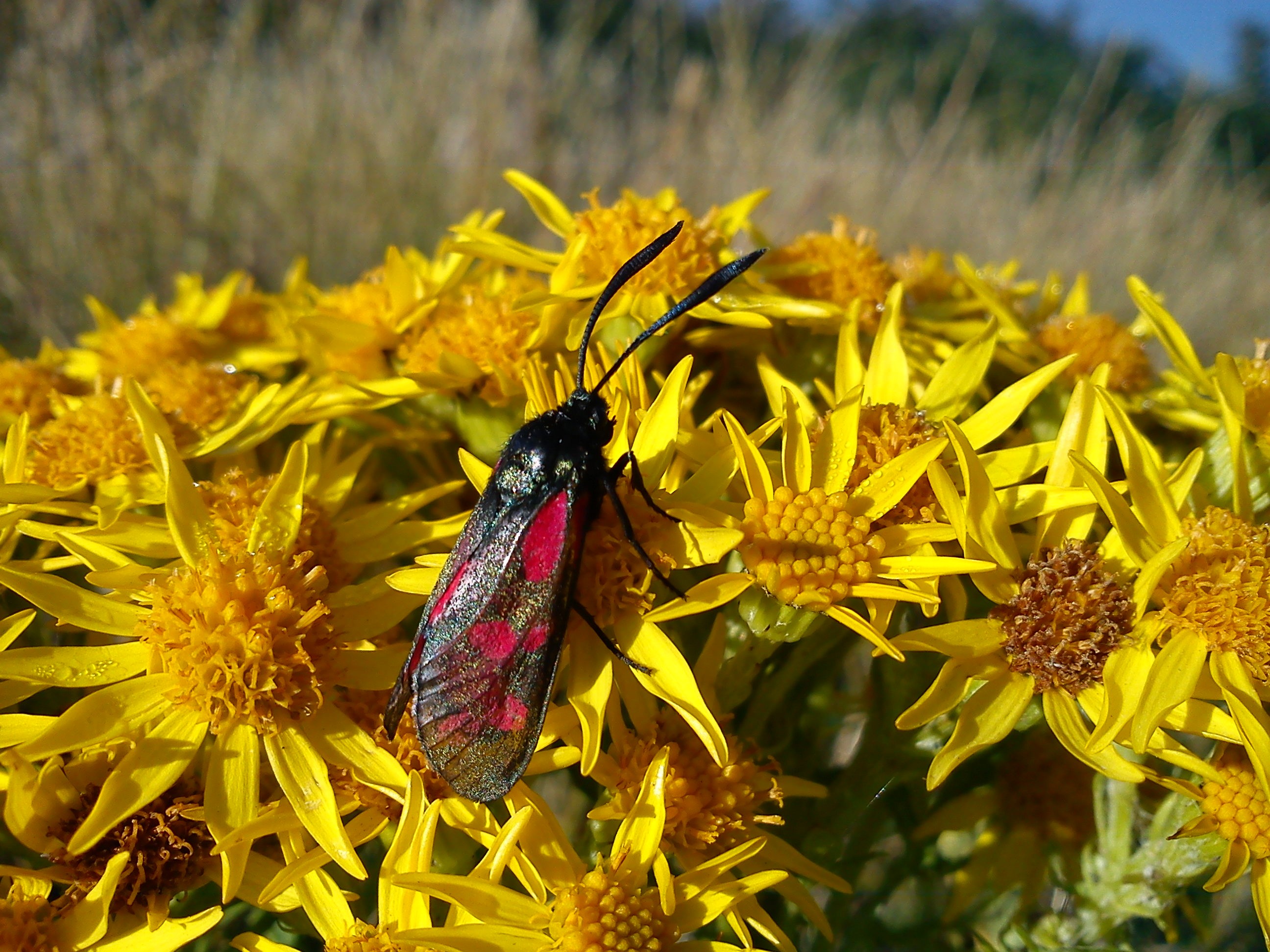
Cinnabar moth, Tyria jacobaeae, on ragwort, Jacobaea vulgaris
Update: In fact, it’s a Six-spot burnet, Zygaena filipendulae, on ragwort, Jacobaea vulgaris. Probably.
Hare Today
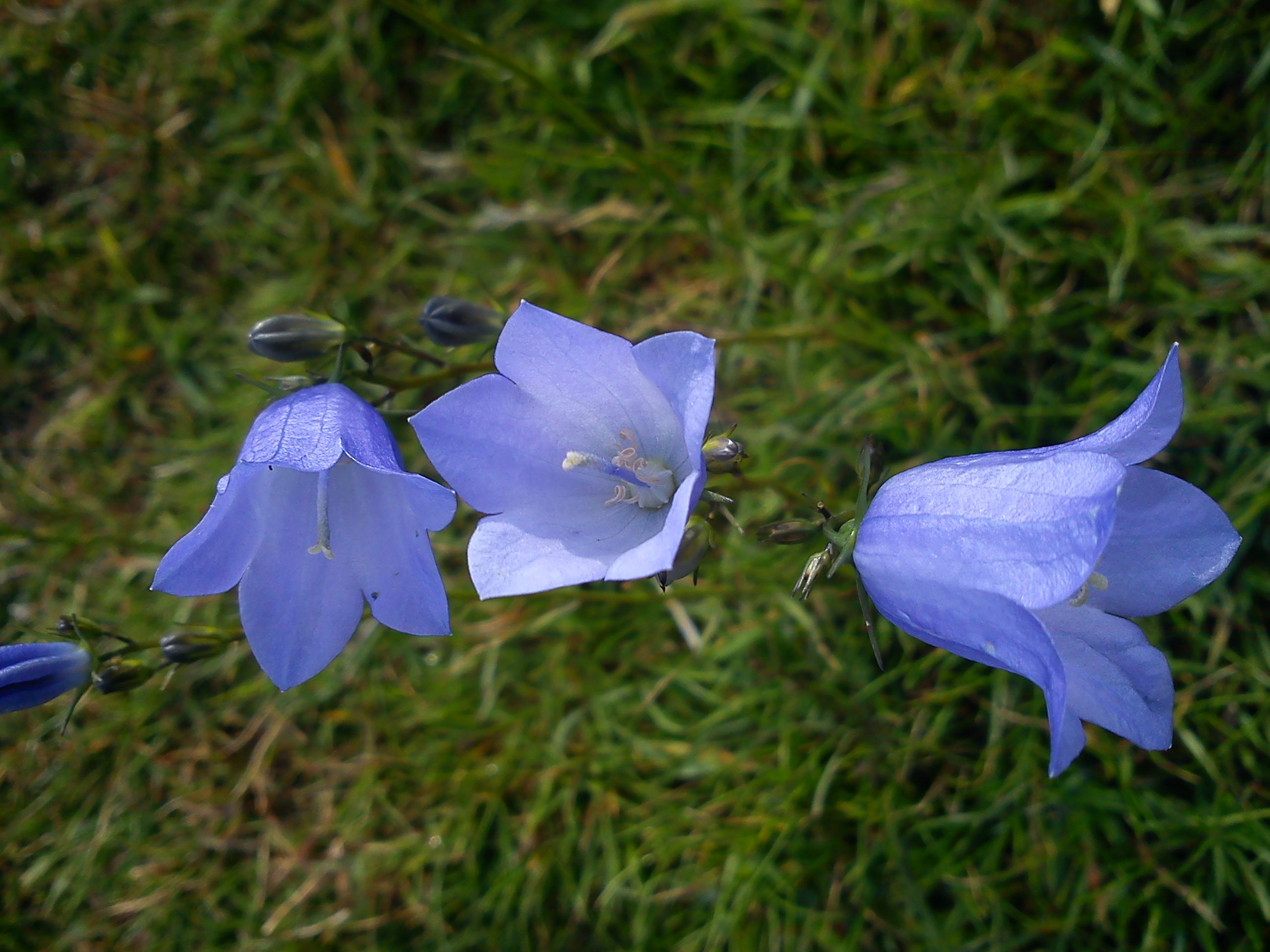
Harebells, Campanula rotundifolia.
Performativizing Papyrocentricity #39
Papyrocentric Performativity Presents:
• The Ogre by the Throat – Extreme Eiger: The Race to Climb the Direct Route up the North Face of the Eiger, Peter and Leni Gillman (Simon & Schuster 2015)
• Sing When You’re Winging – Butterflies and Moths in Britain and Europe, David Carter (Pan 1982)
• Soul Feud – The Soul of the Marionette: A Short Enquiry into Human Freedom, John Gray (Penguin 2015)
Or Read a Review at Random: RaRaR

