« La musique exprime ce qui ne peut être dit et sur quoi il est impossible de rester silencieux. » — Victor Hugo (1802-85)
• “Music expresses what cannot be said and on which it is impossible to remain silent.” — Victor Hugo

« La musique exprime ce qui ne peut être dit et sur quoi il est impossible de rester silencieux. » — Victor Hugo (1802-85)
• “Music expresses what cannot be said and on which it is impossible to remain silent.” — Victor Hugo

Post-Performative Post-Scriptum
“Jonglietzsche” is a portmanteau of German Jongleur / jonglieren, “juggler, juggling”, and the surname of core counter-cultural philosopher Friedrich Nietzsche (1844-1900). Jongleur is pronounced something like “zhawngloer”, as in French.
“Consciousness is a fascinating but elusive phenomenon; it is impossible to specify what it is, what it does, or why it evolved. Nothing worth reading has been written on it.” — Stuart Sutherland (1927-98), in The International Dictionary of Psychology (1995), entry on “Consciousness”
Suppose you allow a point to jump at random half-way towards one of the four vertices of a square. But not entirely at random — you ban the point from jumping towards the same vertex twice (or more) in a row. You get this pattern:
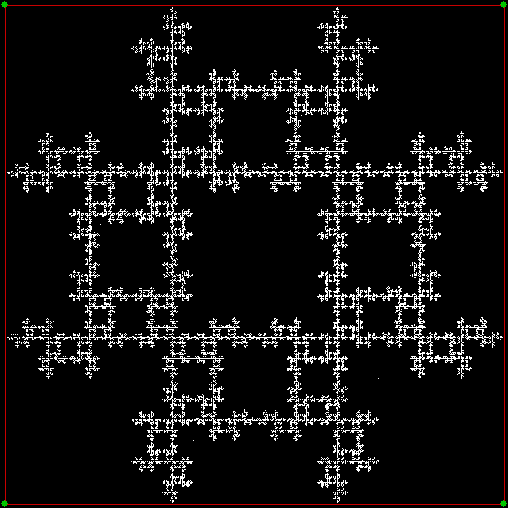
ban on v(i) + 0
It’s a fractal, that is, a shape that contains smaller and smaller copies of itself. Next you ban the point from jumping towards the vertex one place clockwise of the vertex it last jumped towards (i.e., it can jump towards, say, vertex 2 as many times as it likes, but it can’t jump towards vertex 2+1 = 3, and so on). You get this fractal:
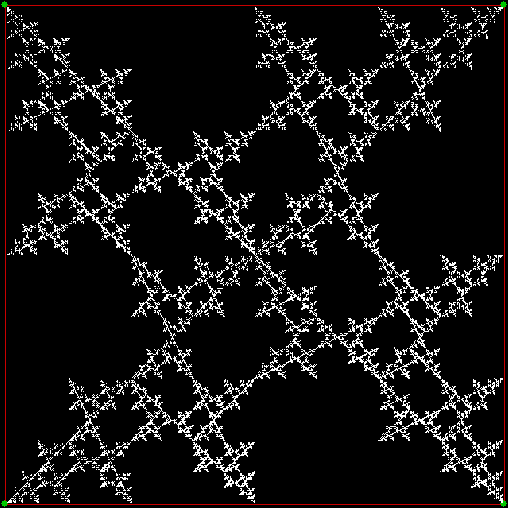
ban on v(i) + 1
Now ban it from jumping towards the vertex two places clockwise of the vertex it last jumped towards (i.e., it can’t jump towards the diagonally opposite vertex). You get this fractal:
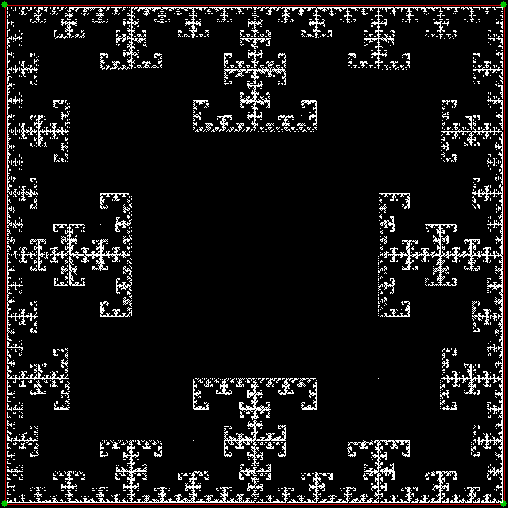
ban on v(i) + 2
And if you ban the point from jumping towards the vertex three places clockwise of the last vertex, you get a mirror-image of the v(i)+1 fractal (see above):

ban on v(i) + 3
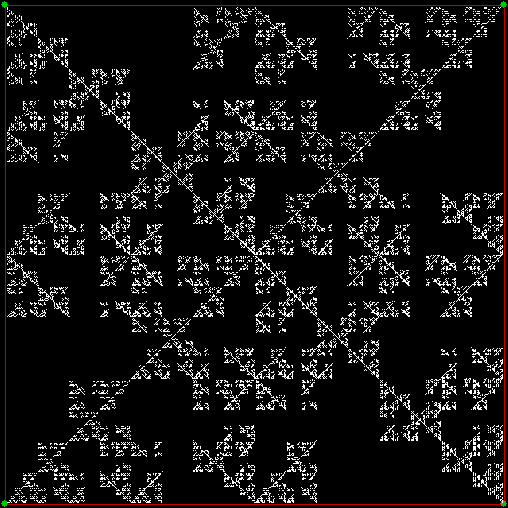
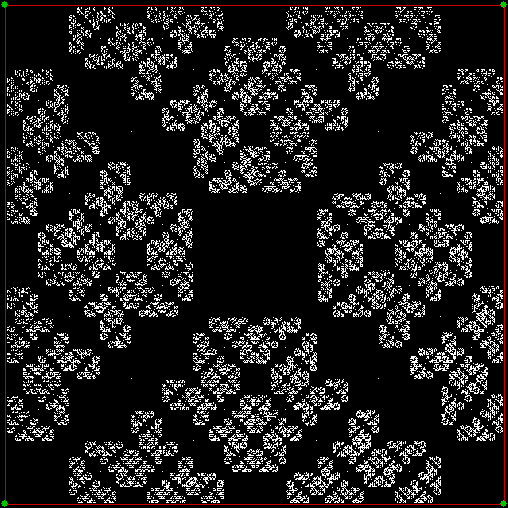
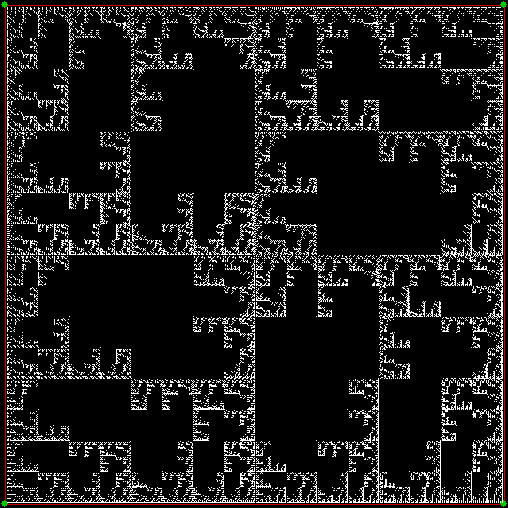
The fractals above have a memory one vertex into the past: the previous vertex. Let’s try some fractals with a memory two vertices into the past: the previous vertex and the pre-previous vertex (and even the pre-pre-previous vertex).
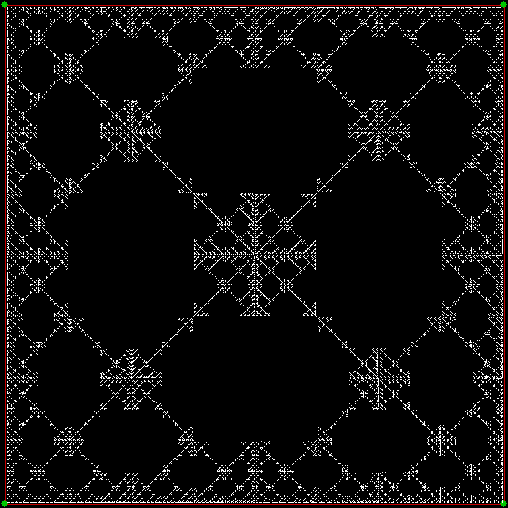
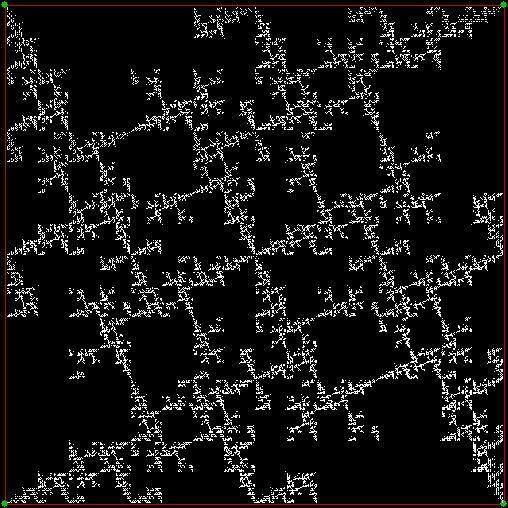
But this time, let’s suppose that sometimes the point can’t jump if the previous or pre-previous isn’t equal to v(i) + n. So sometimes the jump is banned when the test is true, sometimes when the test is false — you might call it a boolean ban or boole(b)an. Using boole(b)ans, you can get this set of fractals:

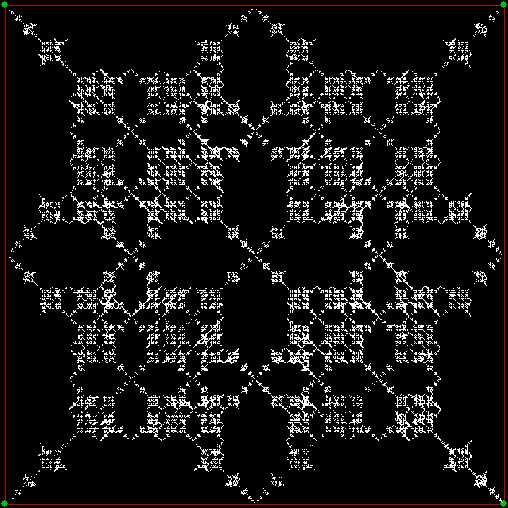


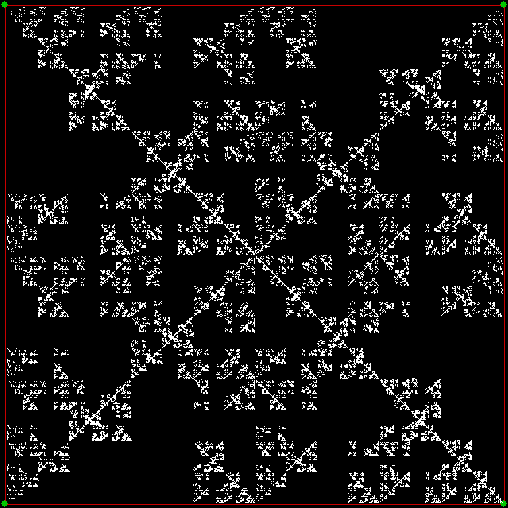
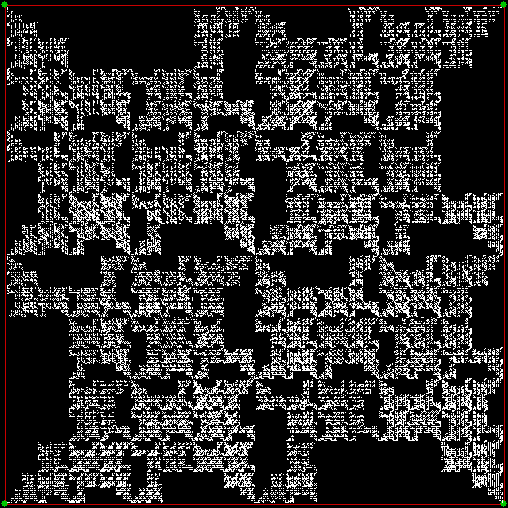
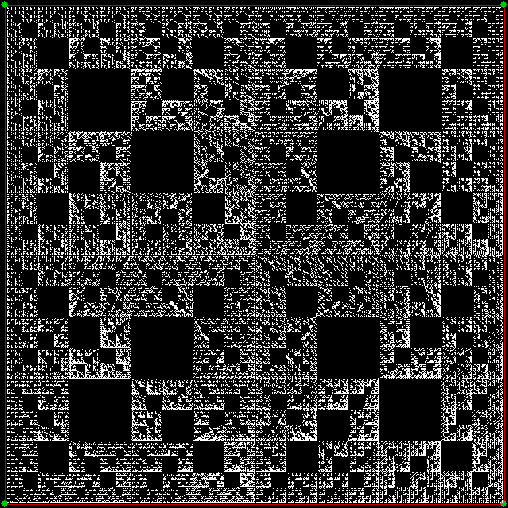

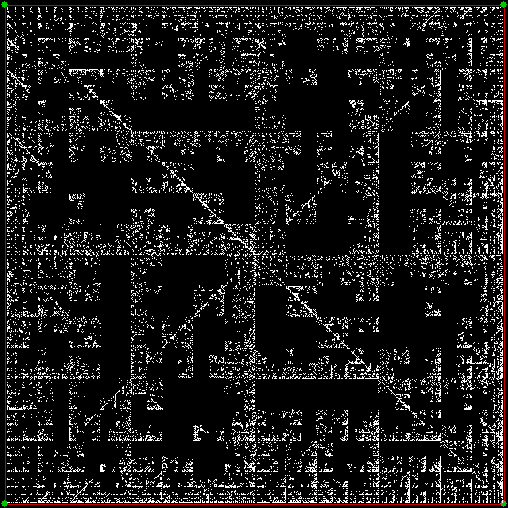

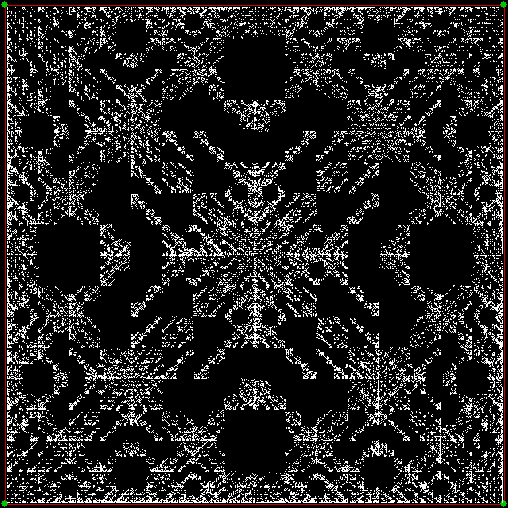
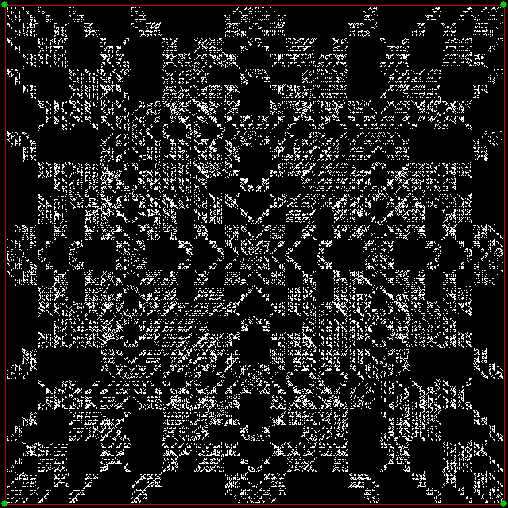

With these fractals, the boolean test sends the point back to the center of the square:




Posteriously post-posted
Boole(b)an #2 — a later look at ban-fractals
Вряд ли где можно было найти человека, который так жил бы в своей должности. Мало сказать: он служил ревностно, нет, он служил с любовью. Там, в этом переписываньи, ему виделся какой-то свой разнообразный и приятный мир. Наслаждение выражалось на лице его; некоторые буквы у него были фавориты, до которых если он добирался, то был сам не свой: и подсмеивался, и подмигивал, и помогал губами, так что в лице его, казалось, можно было прочесть всякую букву, которую выводило перо его. — Николай Гоголь, «Шинель» (1842)
It would be difficult to find another man who lived so entirely for his duties. It is not enough to say that Akakiy laboured with zeal: no, he laboured with love. In his copying, he found a varied and agreeable world. Enjoyment was written on his face: some letters were even favourites with him; and when he encountered these, he smiled, winked, and worked with his lips, till it seemed as though each letter might be read in his face, as his pen traced it. — Nikolai Gogol, “The Overcoat” (1842)
Post-Performative Post-Scriptum
Бу́ква, búkva, the Russian for “letter”, may be related to the German Buche, meaning “beech”, which in its turn may be related to the English word “book”. Why so? Because beech-bark was once used for writing.

Although this blog stands strongly and sternly against the use of any drugs weaker than water (which is all of ’em), some interesting art has been inspired by those weaker drugs. The front cover of Bongzilla’s Gateway (2002) by Malleus Rock Art Lab is a good and skilful example. Please be aware, however, that smoking grass is more likely to induce psychosis than turn you into a golden goat-god. Especially coz artificially strengthened varieties of grass are not what Gaia intended. (dot dot dot)
Post-Performative Post-Scriptum
Yes, the horns on the album-cover are those of a bovid, not a caprid, but I like to think of the image being that of a goat-god rather than a bull-god.
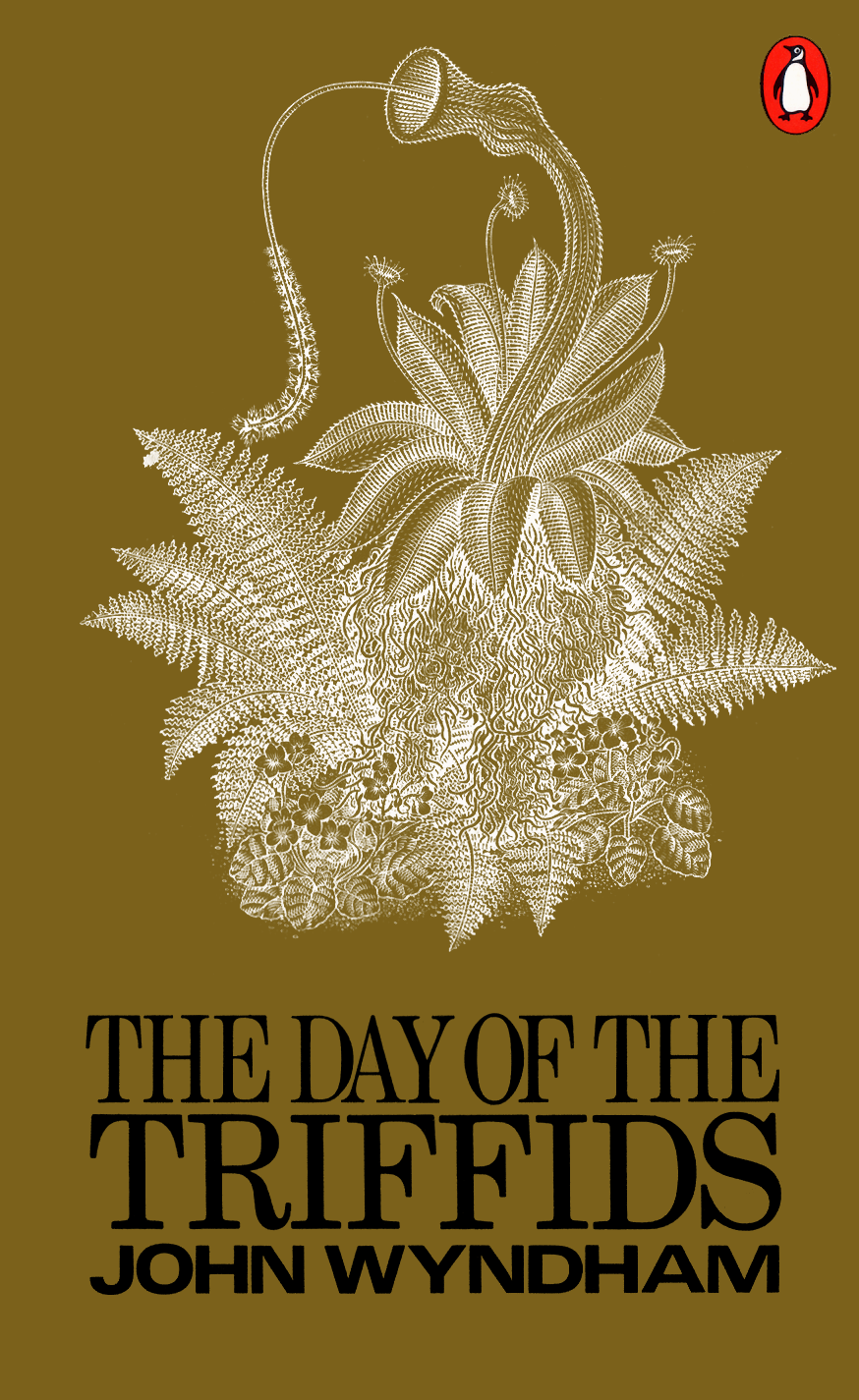
The Day of the Triffids, John Wyndham (1951)
If you want to know the difference between talent and genius, compare The Day of the Triffids (1951) with the book that obviously inspired it: The War of the Worlds (1897). John Wyndham (1903-69) had talent; H.G. Wells (1866-1946) had genius. But Wyndham had a lot of talent, all the same. And it’s powerfully displayed in The Day of the Triffids. However, although it’s his most famous book, it isn’t his best. I’m not sure what it is. Wyndham was an uneven writer, not very good at dialogue or characterization, and although he was born decades after Wells, in some ways his books have dated more.
And maybe he was better at short stories than novels. Either way, his big ideas were almost always good and so were the titles of his novels. There’s the humanity-hating submarine race in The Kraken Awakes (1953); the mysterious telepathic alien in Chocky (1968); the persecuted telepathic mutants in The Chrysalids (1955); and the world-threatening super-children in The Midwich Cuckoos (1955). In The Day of the Triffids there are really two big ideas: walking plants and worldwide blindness. In the chronology of the book, but not the narration, the walking plants come first: they’re the triffids, three-legged, seven-feet tall and equipped with a deadly whip-sting. Once you’ve mentally pictured them, the triffids will never leave your head. I think they’re a clever, chlorophyllic adaptation of the giant three-legged Martian war-machines in War of the Worlds.
But how can the triffids get loose and wreak havoc on the human race as the Martian war-machines did? Triffids are blind and sense rather than see their targets, so they are no match for sighted humans. Obviously, then, Wyndham had to take sight away from humans to get triffids and humans battling for possession of the earth. He did it in rather contrived but still memorable fashion, recorded like this by the first-person narrator as he lies in a hospital bed with bandaged eyes after a triffid attack:
“The sky’s simply full of shooting stars,” [a nurse] said. “All bright green. They make people’s faces look frightfully ghastly. Everybody’s out there watching them, and sometimes it’s almost as light as day – only all the wrong colour. Every now and then there’s a big one so bright that it hurts to look at it. It’s a marvellous sight. They say there’s never been anything like it before. It’s a pity you can’t see it, isn’t it? (ch. 1, “The End Begins”)
In fact, it isn’t a pity: it saves his life. It’s soon apparent that the green light from the “shooting stars” has destroyed the sight of everyone who watched them. The narrator describes how he takes the bandages off his eyes and discovers that he’s one of the very few sighted people left in a blinded world: London becomes “The Groping City”, as the title of chapter 3 puts it. The blindness would have been bad enough, but the triffids now begin breaking loose from the farms on which they’re being kept. The green light of the meteor-storm, probably an optical weapon accidentally released by a military satellite, has created a world where chlorophyll is king. Triffids don’t need sight to slash and slay, so blinded humans now have a simple choice: stay in hiding or try to find food and risk being stung to death by one of the triffids invading London in search of prey.
In the second chapter, the narrator looks back to describe the origin and spread of the triffids, and how he came to receive that a sight-preserving dose of triffid-poison in his eyes. Those opening few chapters have scenes and images that have always stayed with me since I first read the book as a kid. There’s the wonder and beauty of the meteor-storm; the horror of sudden, near-universal blindness and the first spate of suicides; the strangeness and deadliness of the triffids; and so on. Here’s one of the memorable images Wyndham conjures with words:
Perhaps Umberto’s plane exploded, perhaps it just fell to pieces. Whatever it was, I am sure that when the fragments began their long, long fall towards the sea they left behind them something which looked at first like a white vapour.
It was not vapour. It was a cloud of seeds, floating, so infinitely light they were, even in the rarefied air. Millions of gossamer-slung triffid seeds, free now to drift wherever the winds of the world should take them… (ch. 2, “The Coming of the Triffids”)
The triffids have been created artificially and mysteriously behind the Iron Curtain and yield a highly valuable vegetable oil. But that raises questions that aren’t answered. Why did they need to walk? Why are they equipped with long and deadly stings? Why are they uncannily intelligent? And how do they nourish themselves once they mature and begin walking? Their tripodic roots can’t dig very deep when they’re at rest and although Wyndham describes how they pull pieces of flesh off the decaying bodies of people they’ve killed, he doesn’t describe their digestive systems.
These unanswered questions mean that The Day of the Triffids is sometimes more like magic realism than hard science fiction. Particularly when the triffids show signs of intelligence, coordination and even cunning. But none of that is apparent when the triffids begin to sprout all over the world after the seeds in that “white vapour” reach the ground. The growing triffids attract curiosity but not wonder or fear. And even when they begin walking and stinging, they seem easy to manage. Thanks to that valuable vegetable oil, they’re soon being farmed in huge numbers. Their whip-stings are deadly, of course, and if the stings are docked, triffids yield less oil. But sighted humans can kept triffids under control easily enough, despite an occasional unlucky accident and the triffids’ unsettling ability to communicate between themselves. They have a kind of intelligence even though they don’t have brains. The narrator is a botanist conducting research on triffids and suffers one of the unlucky accidents, when a triffid lashes at the wire-mesh mask covering his face and a few drops from the poison-sacs reach his eyes.
So he’s in hospital when the meteor-storm lights up skies all around the world for a couple of days. He and a few other fortunates can’t watch the storm for one reason or another, so they keep their sight and have to fight the triffids to have a future. Wyndham describes how bands of survivors come together in various ways and decide on different ways of fighting the triffids. And that’s when the quality of the writing and the power of the imagery take a turn for the worse. The opening few chapters of The Day of the Triffids have always stayed with me since that first reading. I’ve re-read the book several times since then, but on this latest re-reading I found I’d almost completely forgotten what happened in the second half of the book.
But I can recommend it highly all the same. It might not be Wyndham’s best, but the triffids and their menacing ways will be with you for life once Wyndham’s words have become pictures in your head. And more than pictures:
The evening was peaceful, almost the only sounds that broke it were the occasional rattlings of the triffids’ little sticks against their stems. Walter [a triffid-researcher] regarded them with his head slightly on one side. He removed his pipe.
“They’re talkative tonight,” he said. (ch. 2)
Elsewhere other-accessible
• Reds in the Head — review of H.G. Wells’ The War of the Worlds (1897)
When the sands are all dry, he is gay as a lark,
And will talk in contemptuous tones of the Shark:
But, when the tide rises and Sharks are around,
His voice has a timid & tremulous sound. — Lewis Carroll, Alice in Wonderland (1865)
Here is a Clarificatory Conspectus for Core Comprehension of Key Counter-Culture:

(open in new window for larger version)
Please note the inclusion of James Joyce (1882-1941). You will see that he is at one remove from the Heart of Darkness represented by the despicable, deplorable and downright disgusting phrase “in terms of”. That is, I put Joyce in the clarificatory conspectus because he is popular among the abusers of “in terms of”, not because I think he would have abused “in terms of” himself. Although I can’t stand Joyce’s writing and think it has had a very bad influence on English literature, I also think he wrote too well and was too aesthetically and linguistically sensitive to use “in terms of” in the degraded fashion of his countless modern admirers and imitators.
Please note, however, that being at one or more removes from the Heart of Darkness is not exculpatory for any other inclusees in terms of the Clarificatory Conspectus (Marty Amis, Sal Rushdie, the LRB, etc).
Elsewhere other-accessible:
• Ex-term-in-ate! — core interrogation of why “in terms of” is so despicable, deplorable and downright disgusting…
• Titus Graun — core interrogation of key deployers of “in terms of”……
• Don’t Do Dot — core interrogation of why “…” is so despicable, deplorable and downright disgusting dot dot dot
Currently listening…
• Acid Rainbows, Hammer of Goth (1992)
• Greenlandic Three, Danish Daze (1992)
• LeuKoToMy, You’ve Gone Harpist (2020)
• Johan Zunder, Nine Pines (Remix) (2012)
• Decurrent-CDX, World Warp III (1988)
• Oswestry Quintet, Wrekin Heaves (2009)
• Yim Pamuvb, Iaqahhu (2008)
• Kinaesthetica, Plinnit (1988)
• Alchemia, Xenotrope / Quagmire (1994)
• Vanadium Sorceress, Vanadu (2001)
• Freaky Bulbs, Under the Serene (1995)
• Gaccub Liuoba, Pvjuyo s 1980 (1979)
• Twa Corbies, Bonnie Blue Een (1991)
• Tania By Torchlight, La Reine Vous Voit (1999)
• Knights of Viriconium, Naphtha Regimen (2007)
• Uzegor, Ec’ac Gqa Ihtku (2003)
• Gwen Lebrun, Whispersong (2000)
• Quentin’s Figs, Laddie Chutterly’s Liver (1997)
• Two Million Lightning-Bugs, Went Zooming (1985)
• Georg Friederich Händel, Organ Concerti (1993)
• Hank Yorpen, Ja! Licht und Nagel! (1998)
Previously pre-posted:
Toxic Turntable #1 • #2 • #3 • #4 • #5 • #6 • #7 • #8 • #9 • #10 • #11 • #12 • #13 • #14 • #15 • #16 • #17 • #18 • #19 • #20 •
 Overlord In Terms of Core Issues Around Maximal Engagement with Key Notions of the Über-Feral