
Outgoing Israeli foreign minister Avigdor Lieberman dismissed the report. “This report is not true. Obviously Israel has security interests to defend and we have our own intelligence. But we do not spy on the United States. There are enough participants in these negotiations, including Iranians,” he said in Israel. “We got our intelligence from other sources, not from the United States. The instruction has been clear for decades now: you don’t spy on the United States, directly or indirectly.” — Israel spied on US over Iran nuclear talks, The Guardian, 24/iii/2015.
Magistra Rules the Waves
One of my favourite integer sequences has the simple formula n(i) = n(i-1) + digitsum(n(i-1)). If it’s seeded with 1, its first few terms go like this:
n(1) = 1
n(2) = n(1) + digitsum(n(1)) = 1 + digitsum(1) = 2
n(3) = 2 + digitsum(2) = 4
n(4) = 4 + digitsum(4) = 8
n(5) = 8 + digitsum(8) = 16
n(6) = 16 + digitsum(16) = 16 + 1+6 = 16 + 7 = 23
n(7) = 23 + digitsum(23) = 23 + 2+3 = 23 + 5 = 28
n(8) = 28 + digitsum(28) = 28 + 2+8 = 28 + 10 = 38
As a sequence, it looks like this:
1, 2, 4, 8, 16, 23, 28, 38, 49, 62, 70, 77, 91, 101, 103, 107, 115, 122, 127, 137, 148, 161, 169, 185, 199, 218, 229, 242, 250, 257, 271, 281, 292, 305, 313, 320, 325, 335, 346, 359, 376, 392, 406, 416, 427, 440, 448, 464, 478, 497, 517, 530, 538, 554, 568, 587, 607, 620, 628, 644, 658, 677, 697, 719, 736, 752, 766, 785, 805, 818, 835, 851, 865, 884, 904, 917, 934, 950, 964, 983, 1003…
Given a number at random, is there a quick way to say whether it appears in the sequence seeded with 1? Not that I know, with one exception. If the number is divisible by 3, it doesn’t appear, at least in base 10. In base 2, that rule doesn’t apply:
n(1) = 1
n(2) = 1 + digitsum(1) = 10 = 1 + 1 = 2
n(3) = 10 + digitsum(10) = 10 + 1 = 11 = 2 + 1 = 3
n(4) = 11 + digitsum(11) = 11 + 1+1 = 101 = 3 + 2 = 5
n(5) = 101 + digitsum(101) = 101 + 1+0+1 = 111 = 5 + 2 = 7
n(6) = 111 + digitsum(111) = 111 + 11 = 1010 = 7 + 3 = 10
n(7) = 1010 + digitsum(1010) = 1010 + 10 = 1100 = 10 + 2 = 12
n(8) = 1100 + digitsum(1100) = 1100 + 10 = 1110 = 12 + 2 = 14
1, 2, 3, 5, 7, 10, 12, 14, 17, 19, 22, 25, 28, 31, 36, 38, 41, 44, 47, 52, 55, 60, 64, 65, 67, 70, 73, 76, 79, 84, 87, 92, 96, 98, 101, 105, 109, 114, 118, 123, 129, 131, 134, 137, 140, 143, 148, 151, 156, 160, 162, 165, 169, 173, 178, 182, 187, 193, 196, 199, 204, 208, 211, 216, 220, 225, 229, 234, 239, 246, 252, 258, 260, 262, 265, 268, 271, 276, 279, 284, 288, 290, 293, 297, 301, 306, 310, 315, 321, 324, 327, 332, 336, 339, 344, 348, 353, 357, 362, 367, 374…
What patterns are there in these sequences? It’s easier to check when they’re represented graphically, so I converted them into patterns à la the Ulam spiral, where n is represented as a dot on a spiral of integers. This is the spiral for base 10:
 Base 10
And these are the spirals for bases 2 and 3:

Base 2

Base 3
These sequences look fairly random to me: there are no obvious patterns in the jumps from n(i) to n(i+1), i.e. in the values for digitsum(n(i)). Now try the spirals for bases 9 and 33:
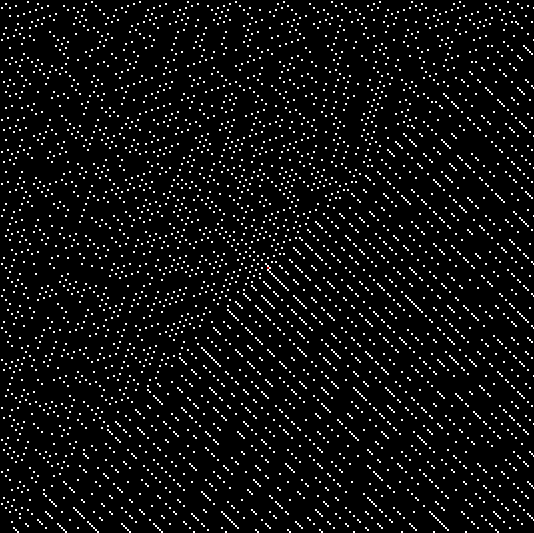
Base 9

Base 33
Patterns have appeared: there is some regularity in the jumps. You can see these regularities more clearly if you represent digitsum(n(i)) as a graph, with n(i) on the x axis and digitsum(n(i)) on the y axis. If the graph starts with n(i) = 1 on the lower left and proceeds left-right, left-right up the screen, it looks like this in base 10:
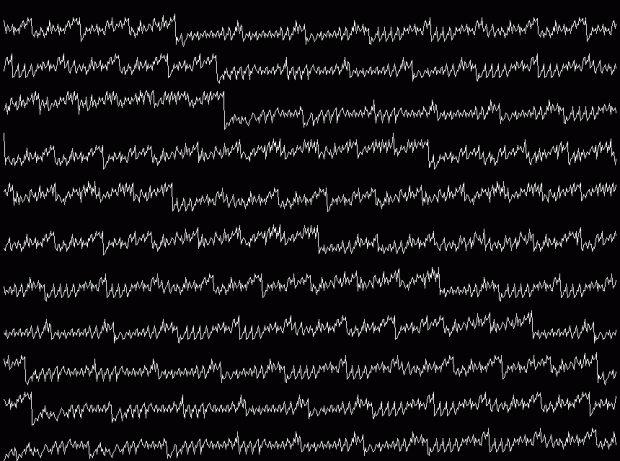
Base 10 (click to enlarge)
Here are bases 2 and 3:

Base 2
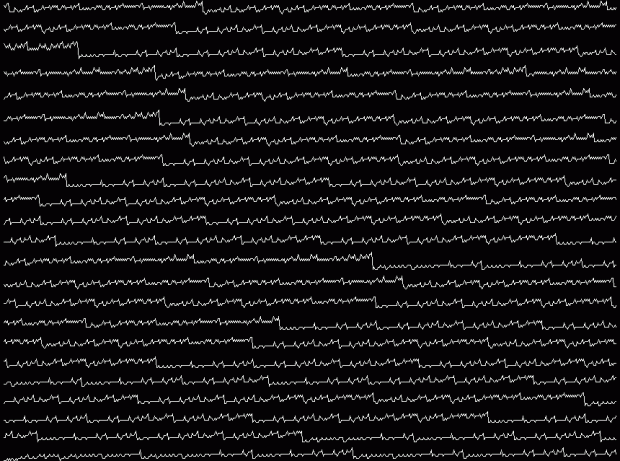
Base 3
The jumps seem fairly random. Now try bases 9, 13, 16, 17, 25, 33 and 49:

Base 9
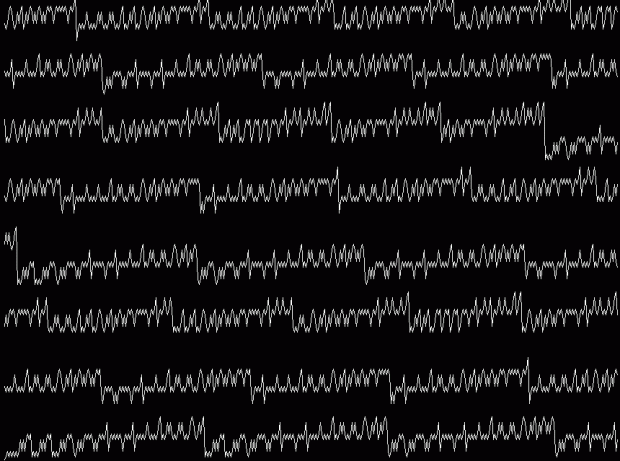
Base 13
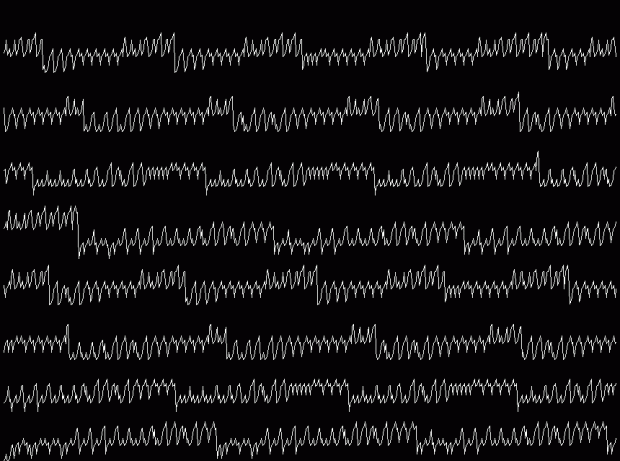
Base 16
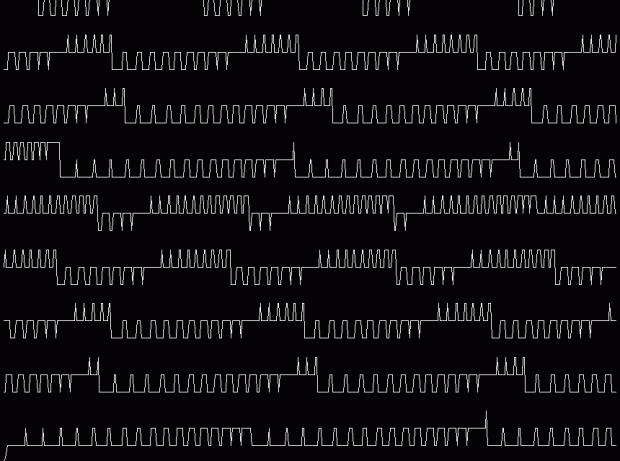
Base 17

Base 25
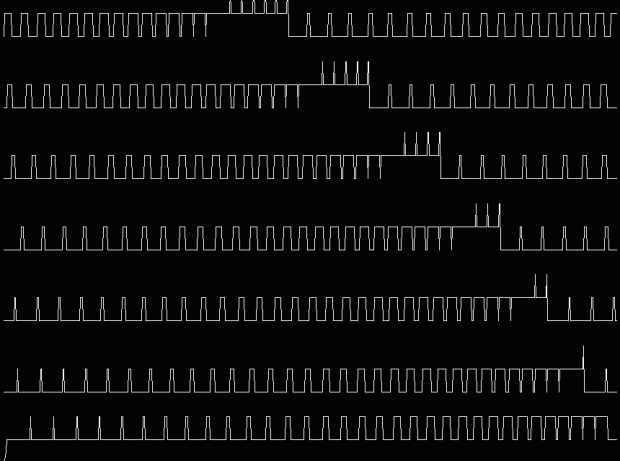
Base 33
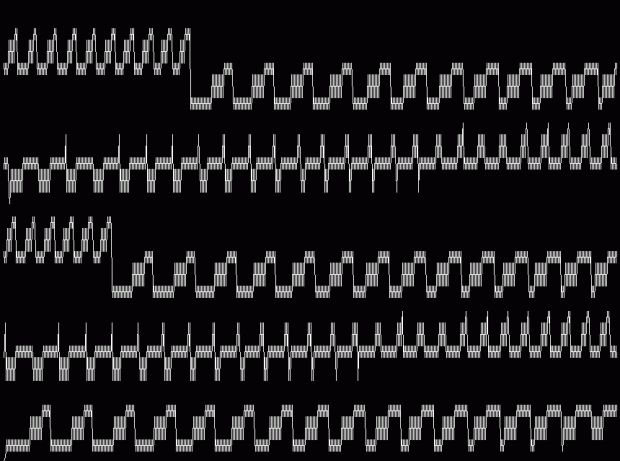
Base 49
In some bases, the formula n(i) = n(i-1) + digitsum(n(i-1)) generates mild randomness. In others, it generates strong regularity, like waves rolling ashore under a steady wind. I don’t understand why, but regularity seems to occur in bases that are one more than a power of 2 and also in some bases that are primes or squares.
Elsewhere other-posted:

Magistra Mysteriorum*

Rogier van der Weyden, Portrait of a Lady (1460)
*Mistress of Mysteries.
Performativizing Papyrocentricity #36
Papyrocentric Performativity Presents:
• Tormenting the Tongue – Georgian Dictionary and Phrasebook, Nicholas Awde and Thea Khitarishvili (Hippocrene Books 2011)
• Roc and Rawl – Rise of the Super Furry Animals, Ric Rawlins (The Friday Project 2015)
Or Read a Review at Random: RaRaR
Dig Sum Fib
The Fibonacci sequence is an infinitely rich sequence based on a very simple rule: add the previous two numbers. If the first two numbers are 1 and 1, the sequence begins like this:
1, 1, 2, 3, 5, 8, 13, 21, 34, 55, 89, 144, 233, 377, 610, 987, 1597, 2584, 4181, 6765, 10946, 17711, 28657, 46368, 75025…
Plainly, the numbers increase for ever. The hundredth Fibonacci number is 354,224,848,179,261,915,075, for example, and the two-hundredth is 280,571,172,992,510,140,037,611,932,413,038,677,189,525. But there are variants on the Fibonacci sequence that don’t increase for ever. The standard rule is n(i) = n(i-2) + n(i-1). What if the rule becomes n(i) = digitsum(n(i-2)) + digitsum(n(i-1))? Now the sequence falls into a loop, like this:
1, 1, 2, 3, 5, 8, 13, 12, 7, 10, 8, 9, 17, 17, 16, 15, 13, 10, 5, 6, 11, 8, 10, 9, 10, 10, 2, 3… (length=28)
But that’s in base 10. Here are the previous bases:
1, 1, 2, 2, 2… (base=2) (length=5)
1, 1, 2, 3, 3, 2, 3… (b=3) (l=7)
1, 1, 2, 3, 5, 5, 4, 3, 4, 4, 2, 3… (b=4) (l=12)
1, 1, 2, 3, 5, 4, 5, 5, 2, 3… (b=5) (l=10)
1, 1, 2, 3, 5, 8, 8, 6, 4, 5, 9, 9, 8, 7, 5, 7, 7, 4, 6, 5, 6, 6, 2, 3… (b=6) (l=24)
1, 1, 2, 3, 5, 8, 7, 3, 4, 7, 5, 6, 11, 11, 10, 9, 7, 4, 5, 9, 8, 5, 7, 6, 7, 7, 2, 3… (b=7) (l=28)
1, 1, 2, 3, 5, 8, 6, 7, 13, 13, 12, 11, 9, 6, 8, 7, 8, 8, 2, 3… (b=8) (l=20)
1, 1, 2, 3, 5, 8, 13, 13, 10, 7, 9, 8, 9, 9, 2, 3… (b=9) (l=16)
Apart from base 2, all the bases repeat with (2, 3), which is set up in each case by (base, base) = (10, 10) in that base, equivalent to (1, 1). All bases > 2 appear to repeat with (2, 3), but I don’t understand why. The length of the sequence varies widely. Here it is in bases 29, 30 and 31:
1, 1, 2, 3, 5, 8, 13, 21, 34, 27, 33, 32, 9, 13, 22, 35, 29, 8, 9, 17, 26, 43, 41, 28, 41, 41, 26, 39, 37, 20, 29, 21, 22, 43, 37, 24, 33, 29, 6, 7, 13, 20, 33, 25, 30, 27, 29, 28, 29, 29, 2, 3… (b=29) (l=52)
1, 1, 2, 3, 5, 8, 13, 21, 34, 26, 31, 28, 30, 29, 30, 30, 2, 3 (b=30) (l=18)
1, 1, 2, 3, 5, 8, 13, 21, 34, 25, 29, 54, 53, 47, 40, 27, 37, 34, 11, 15, 26, 41, 37, 18, 25, 43, 38, 21, 29, 50, 49, 39, 28, 37, 35, 12, 17, 29, 46, 45, 31, 16, 17, 33, 20, 23, 43, 36, 19, 25, 44, 39, 23, 32, 25, 27, 52, 49, 41, 30, 41, 41, 22, 33, 25, 28, 53, 51, 44, 35, 19, 24, 43, 37, 20, 27, 47, 44, 31, 15, 16, 31, 17, 18, 35, 23, 28, 51, 49, 40, 29, 39, 38, 17, 25, 42, 37, 19, 26, 45, 41, 26, 37, 33, 10, 13, 23, 36, 29, 35, 34, 9, 13, 22, 35, 27, 32, 29, 31, 30, 31, 31, 2, 3 (b=31) (l=124)
The sequence for base 77 is short like that for base 30:
1, 1, 2, 3, 5, 8, 13, 21, 34, 55, 89, 68, 81, 73, 78, 75, 77, 76, 77, 77, 2, 3 (b=77) (l=22)
But the sequence for base 51 is this:
1, 1, 2, 3, 5, 8, 13, 21, 34, 55, 39, 44, 83, 77, 60, 37, 47, 84, 81, 65, 46, 61, 57, 18, 25, 43, 68, 61, 29, 40, 69, 59, 28, 37, 65, 52, 17, 19, 36, 55, 41, 46, 87, 83, 70, 53, 23, 26, 49, 75, 74, 49, 73, 72, 45, 67, 62, 29, 41, 70, 61, 31, 42, 73, 65, 38, 53, 41, 44, 85, 79, 64, 43, 57, 50, 57, 57, 14, 21, 35, 56, 41, 47, 88, 85, 73, 58, 31, 39, 70, 59, 29, 38, 67, 55, 22, 27, 49, 76, 75, 51, 26, 27, 53, 30, 33, 63, 46, 59, 55, 14, 19, 33, 52, 35, 37, 72, 59, 31, 40, 71, 61, 32, 43, 75, 68, 43, 61, 54, 15, 19, 34, 53, 37, 40, 77, 67, 44, 61, 55, 16, 21, 37, 58, 45, 53, 48, 51, 49, 50, 99, 99, 98, 97, 95, 92, 87, 79, 66, 45, 61, 56, 17, 23, 40, 63, 53, 16, 19, 35, 54, 39, 43, 82, 75, 57, 32, 39, 71, 60, 31, 41, 72, 63, 35, 48, 83, 81, 64, 45, 59, 54, 13, 17, 30, 47, 77, 74, 51, 25, 26, 51, 27, 28, 55, 33, 38, 71, 59, 30, 39, 69, 58, 27, 35, 62, 47, 59, 56, 15, 21, 36, 57, 43, 50, 93, 93, 86, 79, 65, 44, 59, 53, 12, 15, 27, 42, 69, 61, 30, 41, 71, 62, 33, 45, 78, 73, 51, 24, 25, 49, 74, 73, 47, 70, 67, 37, 54, 41, 45, 86, 81, 67, 48, 65, 63, 28, 41, 69, 60, 29, 39, 68, 57, 25, 32, 57, 39, 46, 85, 81, 66, 47, 63, 60, 23, 33, 56, 39, 45, 84, 79, 63, 42, 55, 47, 52, 49, 51, 50, 51, 51, 2, 3… (b=51) (l=304)
Performativizing Papyrocentricity #35
Papyrocentric Performativity Presents:
• Volc-Lore – Volcanoes: A Beginner’s Guide, Rosaly Lopes (Oneworld 2010)
• Stokes’ Strokes – Philosophy: 100 Essential Thinkers: The Ideas That Have Shaped Our World, Philip Stokes (Arcturus Publishing 2012)
• Art of Darkness – Doubled Slaughter: Barbarism, Brutalism and Bestial Bloodlust in the Music of Simon and Garfunkel, Dr Miriam B. Stimbers (Serpent’s Tail 2007)
Or Read a Review at Random: RaRaR
I Say, I Sigh, I Sow #12
The quickest way to improve your life is to stop watching TV.
• White Dot — the International Campaign against Television
Summer Set Sequence
I wondered what would happen if you added to a set of numbers, (a, b, c), the first number that wasn’t equal to the sum of any subset of the numbers: a + b, a + c, c + b, a + b + c. If the set begins with 1, the first number not equal to any subset of (1) is 2. So the set becomes (1, 2). 3 = 1 + 2, so 3 is not added. But 4 is added, making the set (1, 2, 4). The sequence of additions goes like this:
1, 2, 4, 8, 16, 32, 64, 128, 256, 512, 1024, 2048, 4096, 8192, 16384, 32768, 65536…
It’s the powers of 2, because some subset of the powers of 2 < 2^p will equal any number from 1 to (2^p)-1, therefore the first addition will be 2^p = the cumulative sum + 1:
1 (cumulative sum=1), 2 (cs=3), 4 (cs=7), 8 (cs=15), 16 (cs=31), 32 (cs=63), 64 (cs=127), 128 (cs=255), 256 (cs=511), 512 (cs=1023), 1024 (cs=2047), 2048 (cs=4095), 4096 (cs=8191), 8192 (cs=16383), 16384 (cs=32767), 32768 (cs=65535)…
If you seed the sequence with the set (2), the first addition is 3, but after that the powers of 2 re-appear:
2, 3, 4, 8, 16, 32, 64, 128, 256, 512, 1024, 2048, 4096, 8192, 16384, 32768, 65536…
It becomes more complicated if the sequence is seeded with the set (3):
3, 4, 5, 6, 16, 17, 49, 50, 148, 149, 445, 446, 1336, 1337, 4009, 4010, 12028, 12029, 36085, 36086…
You can predict the pattern by looking at the cumulative sums again:
3, 4, 5, 6 (cumulative sum=18), 16, 17 (cs=51), 49, 50 (cs=150), 148, 149 (cs=447), 445, 446 (cs=1338), 1336, 1337 (cs=4011), 4009, 4010 (cs=12030), 12028, 12029 (cs=36087), 36085, 36086 (cs=108258)…
The sequence begins with a block of four consecutive numbers, followed by separate blocks of two consecutive numbers. The first number in each 2-block is predicted by the cumulative sum of the last number in the previous block, according to the formula n = cumulative sum – seed + 1. When the seed is 3, n = cs-3+1.
If the seed is 4, the sequences goes like this:
4, 5, 6, 7, 8, 27, 28, 29, 111, 112, 113, 447, 448, 449, 1791, 1792, 1793, 7167, 7168, 7169…
Now the sequence begins with a block of five consecutive numbers, followed by separate blocks of three consecutive numbers. The formula is n = cs-4+1:
4, 5, 6, 7, 8 (cumulative sum=30), 27, 28, 29 (cs=114), 111, 112, 113 (cs=450), 447, 448, 449 (cs=1794), 1791, 1792, 1793 (cs=7170), 7167, 7168, 7169 (cs=28674)…
And here’s the sequence seeded with (5):
5, 6, 7, 8, 9, 10, 41, 42, 43, 44, 211, 212, 213, 214, 1061, 1062, 1063, 1064, 5311, 5312, 5313, 5314…
5, 6, 7, 8, 9, 10 (cs=45), 41, 42, 43, 44 (cs=215), 211, 212, 213, 214 (cs=1065), 1061, 1062, 1063, 1064 (cs=5315), 5311, 5312, 5313, 5314 (cs=26565)…
Life in Vein
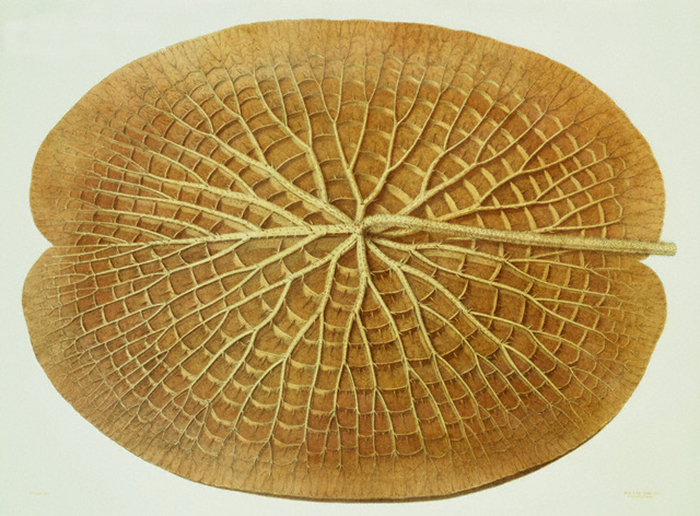
William Sharp, “Victoria Regia or the Great Water Lily of America (Underside of a Leaf)” (1854), viâ Jeff Thompson
Les Sez
In Terms of My Natural Life
(a pome crafted by Les Patterson)
I am an Australian in terms of Nation
And a Public Servant in terms of vocation,
But there’s one thing amazes my critics and that’s
How many I wear in terms of hats:
I chair the Cheese Board, I front the Yartz
You could term me a man of many parts.
I’m a Renaissance type, if you know the term
And I’ve held long office in terms of term,
Yes, I’ve long served Australia in terms of years
And in terms of refreshment I like a few beers.
My opponents are mongrels, scum and worms
Who I bucket in no uncertain terms
And my rich vocabulary always features
Large in terms of my public speeches.
My favourite terms in terms of debate
Are: “broadbased package” and “orchestrate”.
But one term I never employ is “failure” —
Especially when talking in terms of Australia!
For in terms of lifestyle we’ve got the germs of
A ripper concept to think in terms of.
Yes, in terms of charisma I’ve got the game mastered
In anyone’s terms I’m a well-liked bastard.
From the Back With A Vengeance Tour Brochure © 1989 Sir Les Patterson.
Elsewhere Other-Engageable:
 Overlord In Terms of Core Issues Around Maximal Engagement with Key Notions of the Über-Feral